Carefully timing my visit to miss the weekend crowds, I spent the better part of the last week of July (2011) in the Yosemite National Park high country along and around Tioga Pass Road. I posted the first photograph from this visit earlier today, and more will appear here soon. But while the visit is still fresh in my mind, I thought I’d share a few observations and comments that might be useful to others heading there or to other parts of the high Sierra soon.
In a typical late July, all of the snow is melted out at “campground elevations” (generally 8000′ – 9000′ or so – Tuolumne Meadows is at 8600′), essentially all of the usual high country areas are accessible by trail or cross-country travel, wildflowers are at or near their peak, mosquito populations have reached their peak, and visitors are starting to arrive en masse for day use, camping, and backpacking. With the exception of the influx of visitors, this is not quite a typical season, however.
Snow – As I drove up Tioga Pass Road on July 26, the first surprise was finding that there were still large snow patches in some forested areas as low as 8000′ or so. I don’t recall seeing this much snow so low so late in the season in the past. (My memory may not include the lower elevations at this time of year in 1996, the last year with such impressive snow fall.) I stayed at the Porcupine Flat campground, and at least one site there still had enough snow as to make it pretty unusable. Continue reading Yosemite High Country – A Brief Late July Report→
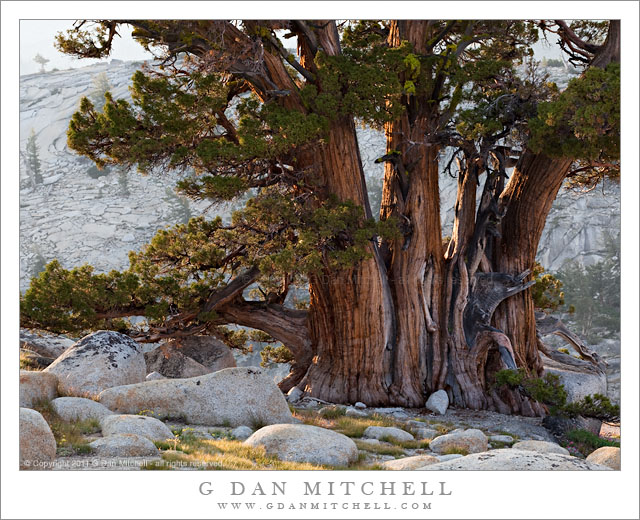
Morning light falls on rugged Juniper trees growing in glaciated terrain near Yosemite’s Olmsted Point.
The Yosemite high country along (and beyond) Tioga Pass Road, which crossed the Sierra through the national park, is a land shaped by glaciers. The night before I had decided that the morning photography subjects would be in an area of granite domes, glacial erratics, small ponds, and rugged granite-bound trees in an area generally centered around the iconic Olmsted Point viewpoint.
My first subject, generally defined, was going to be an area of large granite slabs on a ridge that I knew would be hit by the early morning sun shortly after sunrise. I arrived in the general area after dawn but before the direct light arrived here, and I headed up the slabs to scope out possible subjects. The atmosphere was quite hazy, which can be a mixed blessing for photography. On one hand, distant subjects are muted an indistinct. On the other, the light on closer subjects can be diffused and soft, and this helps fill in shaded areas. It also means that more distant background elements can be muted both in contrast and color saturation. When I found this rugged cluster of old juniper trees, I looked for a composition that would catch the first light striking them from behind and also include a bit of the more distant exfoliated dome as background.
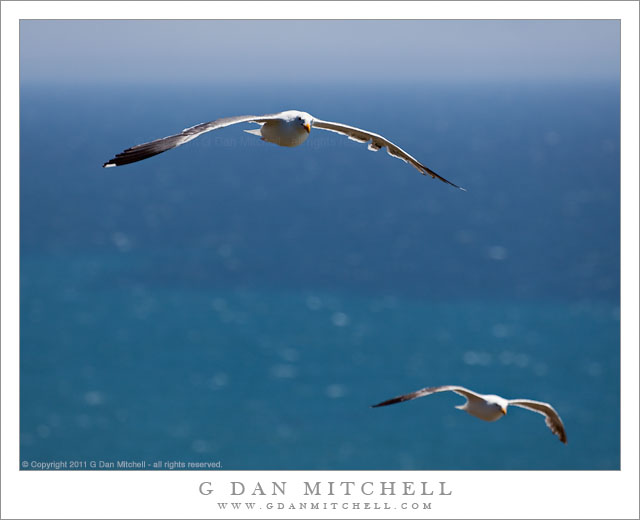
Two sea gulls glide along the top of coastal bluffs above the Pacific Ocean north of Santa Cruz, California.
Since I’ve related the basic story previously – more than once – I’ll keep it short this time. Since I live within an hour or less of the California coast, I head over that way frequently to photograph. Among my favorite subjects are the pelicans that travel up and down (but mostly, for some inexplicable reason up) the coast, riding the updrafts along the tops of coastal bluffs. I had some free time on this day, so I headed over with photographing the birds as one of my possible goals.
When I got to this familiar spot, there were no pelicans. (Eventually a few did fly past, but this was not a good day for pelicans.) Before moving on to other subjects I thought I’d at least stay here a while and practice the skills involved in photographing these birds in flight since even though there were no pelicans, there were plenty of other obliging birds. Most of the time it is difficult to get two gulls in the frame once they get close and start to fly past, but these two hung close enough together to be in the same frame, and their low trajectory placed them right in front of the deep blue water, with the fog-softened horizon near the top of the frame.
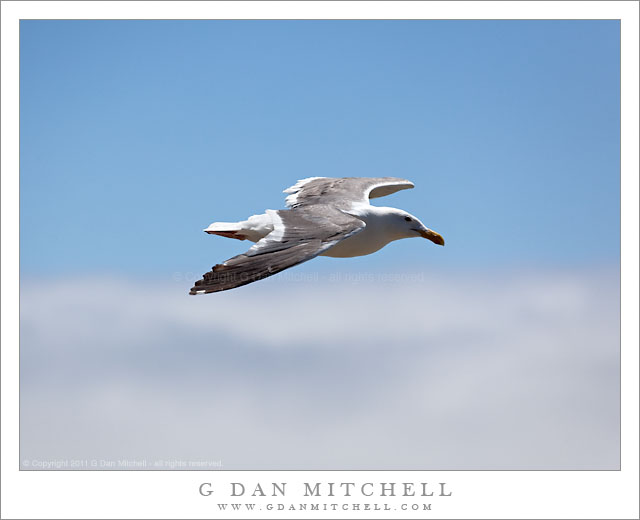
A solitary gull flies above California’s Pacific Ocean coastline with a fog bank and blue sky beyond.
With some free time earlier this week, and the excuse of driving my son to a summer-session class at UC-Santa Cruz, I headed north from Santa Cruz looking for things to photograph. Because there was a lot of fog, even in the middle of the day, fog was one of my general subject ideas. And I almost always make at least a quick stop at a couple of bluff-top locations that I know of where shore birds often glide by very close as they ride the updrafts from the ocean winds. It turned out that my first stop was precisely one of these locations. With nothing else specific in mind at this midday hour, I figured I would at least spend a bit of time honing my skills and tracking and photographing birds in flight.
Although sea gulls are not necessarily my favorite subjects, there sure were plenty of them to practice on! At the spot I picked, they first become visible perhaps 10-15 seconds away as they come around the edge of a bluff to the south. As they approach they tend to vary their altitudes, with some dropping low enough that they disappear behind the cliff and others going so high that only their shaded undersides are visible. But a few come very close at almost eye level.
I almost always learn something new when I photograph birds in flight and this session was no exception. While in retrospect it seems like one of those “Well, duh!” realizations, I figured out that really strong winds tend to upset the birds ability to remain level, and for this reason they are constantly adjusting to remain level. From moment to moment the wings move into interesting positions or they find themselves tilting wildly to get back on course. This is much more interesting than what they do in benign conditions, where they often seem to just… coast.
So, add one more thing to watch for as they fly past. This isn’t an easy thing, and I have the greatest admiration for those who are really great at photographing birds in flight – or “BIF,” as some call them. The first challenge is simply to keep the moving birds in the viewfinder when using a long focal length lens. (I advise practicing the process of simply following the birds without even firing the shutter at first.) But that’s not enough. You must also attempt to keep the bird(s) in a position within the frame that is aesthetically interesting and which will position the target under the active AF points on the camera. Easier said than done! Then there is the matter of trying also be aware of what the bird is doing – watching wing and head position and so forth. On top of that, you ideally also want to be aware of the what else is in the frame – sky, clouds, water, other birds – and factor that into the decision about when to press the shutter. There are exposure challenges, too, especially with birds like this gull that have white on their backs… and this portion of the bird is in direct sun.
Let’s just say that – for me at least – it takes a lot of exposures to get a few shots that I like.
(Basic EXIF data may be available by “mousing over” large images in posts. Leave a comment if you want to know more.)
Photographer and visual opportunist. Daily photos since 2005, plus articles, reviews, news, and ideas.
Manage Consent
To provide the best experiences, we use technologies like cookies to store and/or access device information. Consenting to these technologies will allow us to process data such as browsing behavior or unique IDs on this site. Not consenting or withdrawing consent, may adversely affect certain features and functions.
Functional
Always active
The technical storage or access is strictly necessary for the legitimate purpose of enabling the use of a specific service explicitly requested by the subscriber or user, or for the sole purpose of carrying out the transmission of a communication over an electronic communications network.
Preferences
The technical storage or access is necessary for the legitimate purpose of storing preferences that are not requested by the subscriber or user.
Statistics
The technical storage or access that is used exclusively for statistical purposes.The technical storage or access that is used exclusively for anonymous statistical purposes. Without a subpoena, voluntary compliance on the part of your Internet Service Provider, or additional records from a third party, information stored or retrieved for this purpose alone cannot usually be used to identify you.
Marketing
The technical storage or access is required to create user profiles to send advertising, or to track the user on a website or across several websites for similar marketing purposes.