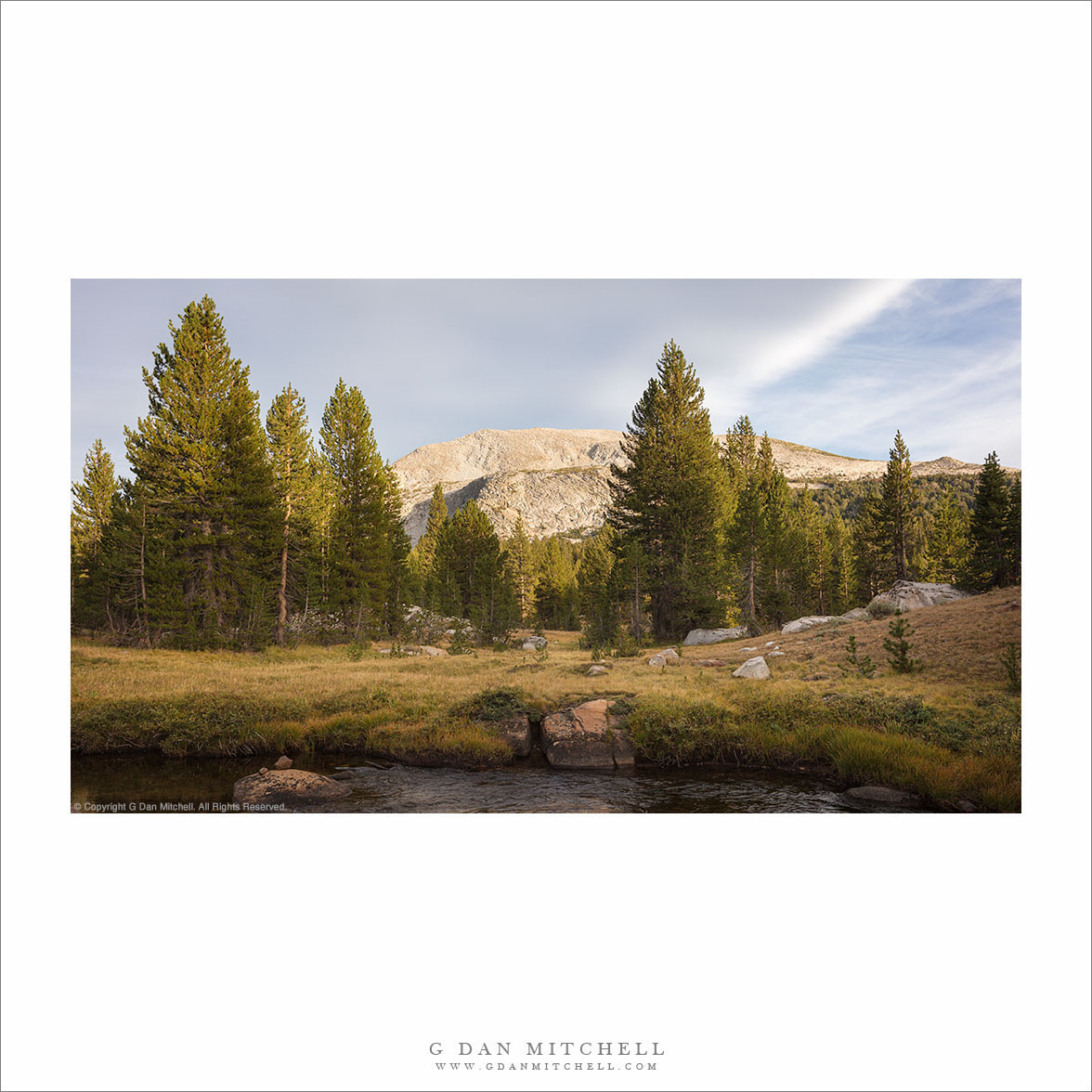
“Subalpine Meadow, Evening Light” — A ridge rises above a subalpine meadow and forest, Yosemite.
This is another “quiet” photograph — no brilliant colors, not really an iconic location. It simply captures, I hope, something of the feeling of being in the High Sierra as the day winds down, the light warms as sunset approaches, and begin to stretch across the landscape. It is a beautiful time of day — everything slows down, it gets quieter as people go to camp for dinner.
“Green Chain” — A chain casts a shadow on a corrugated metal wall.
I have admitted to a fascination with graphical elements — shapes, textures, colors, curves, and more. Finding them in the urban or natural landscape can make fairly mundane subjects interesting, at least to me. Here we see a small section of the corrugated metal wall of a very green industrial building. A couple of loops of chain hang from a gap between panels, for reasons that seem inscrutable.
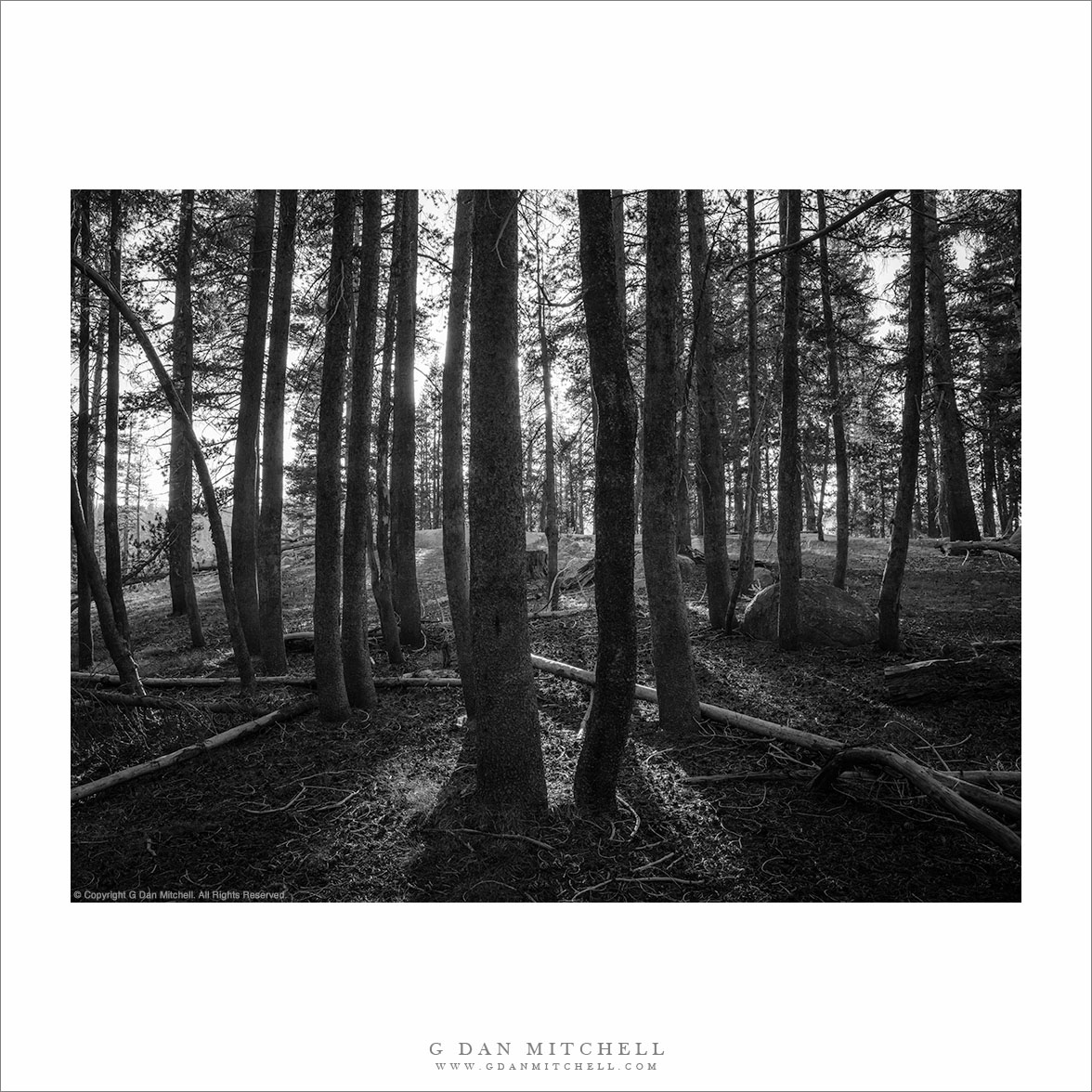
“Evening Forest and Hill” — Early evening light streams between forest trees on a Sierra Nevada hill.
I have long been a sucker for backlight. I’m attracted to the glow of light coming straight at me, and I’m intrigued by the dark shadowed sides of objects and by the beams of light that lead toward the camera. Put a forest full of trees in front of me in that light and I cannot resist.
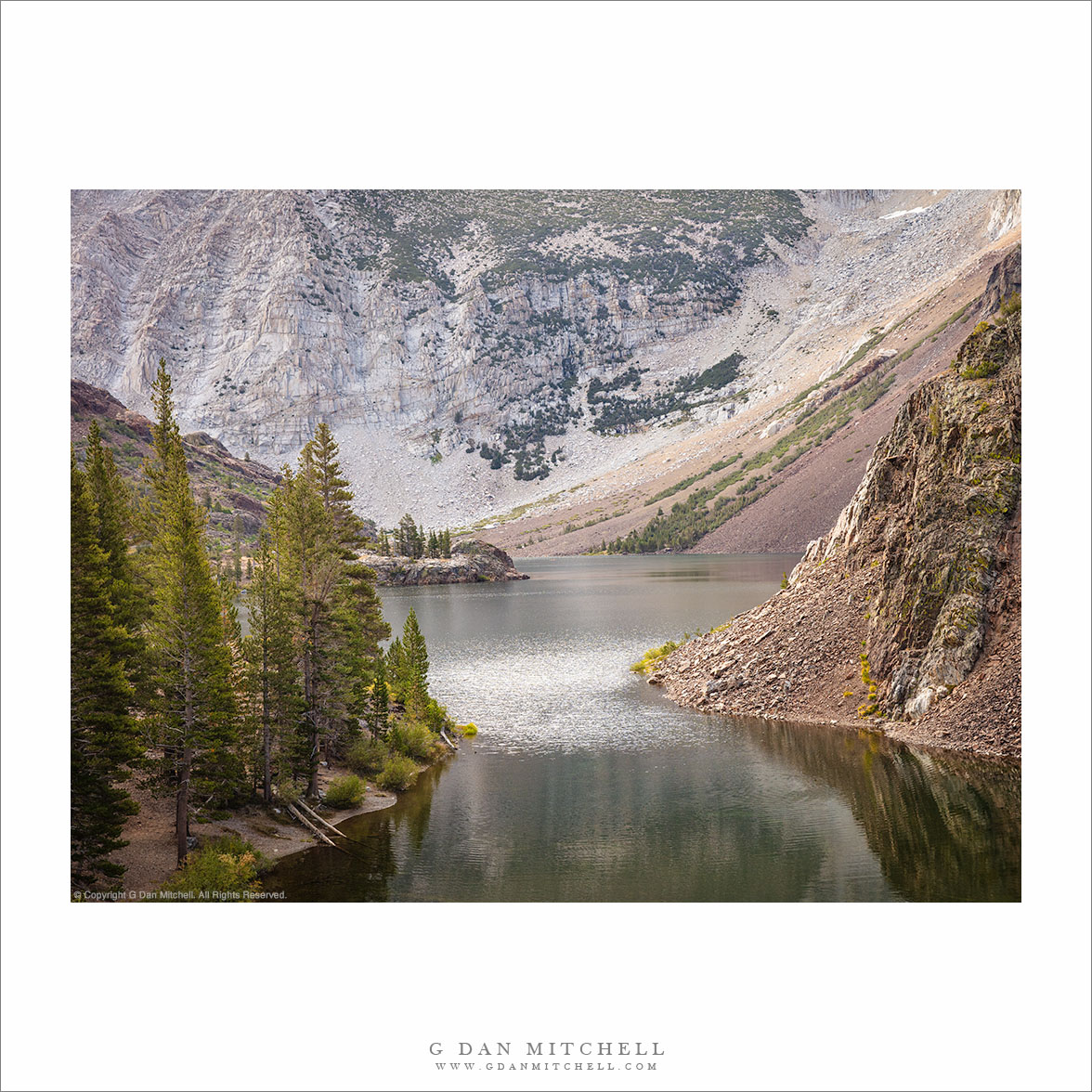
“Soft Light, Ellery Lake” — Ellery Lake in early morning soft light.
This spot and this view have long intrigued me. The lines and curves lead from the shoreline forest at left, past that talus-covered slope on the right, across the water to another peninsula, and finally to the massive face rising beyond. The personality of this view can change remarkably — I’ve photographed during storms, under the full moon, in direct sunlight.
Photographer and visual opportunist. Daily photos since 2005, plus articles, reviews, news, and ideas.
Manage Consent
To provide the best experiences, we use technologies like cookies to store and/or access device information. Consenting to these technologies will allow us to process data such as browsing behavior or unique IDs on this site. Not consenting or withdrawing consent, may adversely affect certain features and functions.
Functional
Always active
The technical storage or access is strictly necessary for the legitimate purpose of enabling the use of a specific service explicitly requested by the subscriber or user, or for the sole purpose of carrying out the transmission of a communication over an electronic communications network.
Preferences
The technical storage or access is necessary for the legitimate purpose of storing preferences that are not requested by the subscriber or user.
Statistics
The technical storage or access that is used exclusively for statistical purposes.The technical storage or access that is used exclusively for anonymous statistical purposes. Without a subpoena, voluntary compliance on the part of your Internet Service Provider, or additional records from a third party, information stored or retrieved for this purpose alone cannot usually be used to identify you.
Marketing
The technical storage or access is required to create user profiles to send advertising, or to track the user on a website or across several websites for similar marketing purposes.