
Tag Archives: old

Golden Eagle Hotel

Golden Eagle Hotel
Golden Eagle Hotel

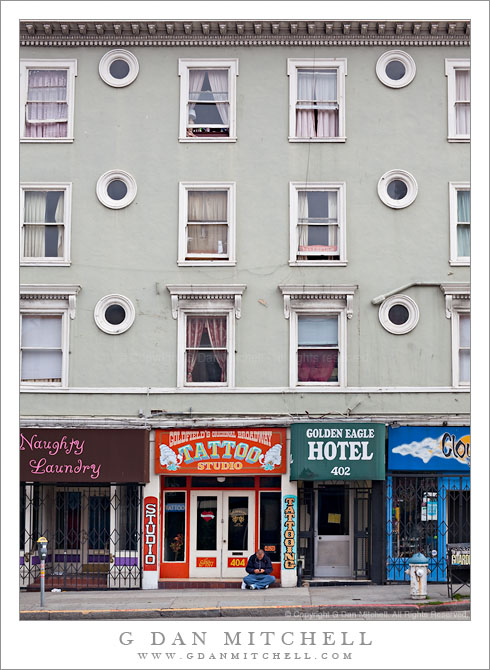
Golden Eagle Hotel. San Francisco, California. July 12, 2010. © Copyright G Dan Mitchell – all rights reserved.

Man sitting on steps in front of tattoo parlor below the Golden Eagle Hotel, San Francisco.

Last summer, on one of my “walking shoots” in San Francisco, I wandered into a less-than-lovely area of The City – though it has its points of visual interest, for sure. I named this photograph after the Golden Eagle Hotel at least partly because I assume that the dilapidated green apartment building above the colorful (in many senses) shops at street level comprise the “hotel.” Another reason is that I wasn’t sure I wanted to title a photograph “Tattoo” or “Naughty Laundry!” (I don’t know what the “Naughty Laundry” place is, and I probably am better of keeping it that way! :-)

In a sense, every photograph I make is “about” something, though often they are simply about the qualities of the subject or subjects themselves. You could certainly look at this image that way. I was certainly intrigued by the juxtaposition of the very colorful and closely packed shops and the very drab apartments above. The building itself, which may have seen better days, is interesting to me architecturally. What is with the little round windows, with their thick frames, between the conventional rectangular windows? And despite having some interesting San Francisco qualities, the building is terribly run down. A close look reveals peeling paint, wires running here and there, painted over spots of what might have been graffiti, and so forth.

Then there is that guy sitting on the step of “Goldfield’s Original Broadway Tattoo Studio.” There are no other people in the scene, and my recollection is that there really weren’t many people around. He sits, face downward and headphones on, apparently completely engrossed in whatever technology he holds in his hand, and apparently also completely disassociated from his environment. You can find a lot of people like this today.

G Dan Mitchell Photography | Flickr | Twitter (follow me) | Facebook (“Like” my page) | LinkedIn | Email
Text, photographs, and other media are © Copyright G Dan Mitchell (or others when indicated) and are not in the public domain and may not be used on websites, blogs, or in other media without advance permission from G Dan Mitchell.
Abandoned Mining Cabin Ruins, Panamint Range

Abandoned Mining Cabin Ruins, Panamint Range

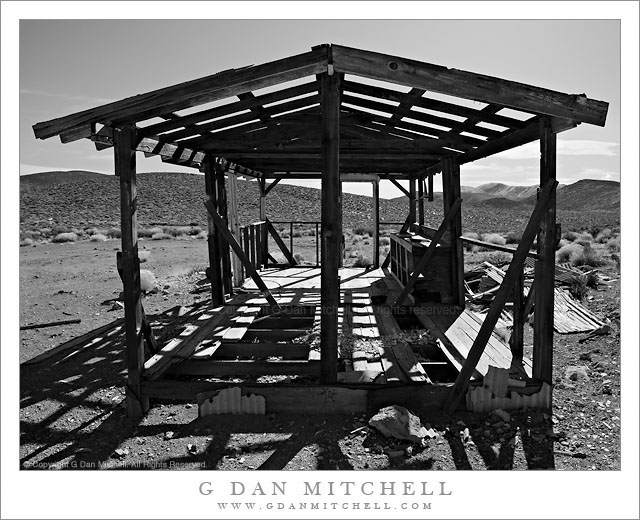
Abandoned Mining Cabin Ruins, Panamint Range. Death Valley National Park, California. March 29, 2011. © Copyright G Dan Mitchell – all rights reserved.

Black and white photograph of the ruins of an abandoned mining cabin high in the Panamint Mountain Range of Death Valley National Park.

There are a number of things that make Death Valley National Park, to the best of my knowledge, rather unique. One is the extensive history of human habitation inside the park boundaries, quite a bit of which is visible –  though some takes a bit more effort and attention to spot. The history of mining in the park is well-known, and many of the icons of the park have connections to this history. If you visit Furnace Creek, for example, you cannot miss the displays of old wagons and so forth used to move ore out of the Valley. It doesn’t take a lot of careful study to figure out that many park roads originated in an era of prospecting and mining. There are several well-known examples of structures left over from that era in and around the park, too.

It is largely because of this history that many areas of this national park are (or have been – some are now reverting to wilderness status) accessible by gravel road or four-wheel-drive routes. I would argue that you can’t really get to know this park if you just stick to the paved roads and the points of interest that they access. If you drive any of these other routes and keep your eyes open you will often be surprised by the left overs from relatively recent mining and prospecting, much of which isn’t really written about or described in the usual guides to the park. (And I’m not going to offer specific details about where to find such places here, since I don’t want to be even a little bit responsible for damage to them. If you do visit, treat them with care and respect.)

As I drove along a gravel road in one of the many mountain ranges of the park, returning from a site that is somewhat well-known, I began to notice evidence of fairly recent mining and prospecting. Faint tracks depart from the main “road” and cross valleys and hills, here and there tailing piles and mine entrances are visible, and sometimes you come across old structures such as cabins, storage bunkers, or wooden towers above mine entrances. I spotted the ruins of this old cabin above the road at one point and decided to walk up and investigate.

I’m almost always surprised at how “modern” many of the traces found at these places seem to be. I guess I am expecting something from the 1800s, but quite a few of these places look like they were build and occupied much later than that. I find modern things like linoleum flooring or modern-looking nails or electrical wire in many of them. There obviously isn’t much left of this cabin now, but from the detritus lying around near it and the form and materials found here, it must have been a reasonably comfortable place to live. As I walk around such places I often try to imagine what it must have been like to wake up every morning in this silent desert and head out for another day of physical labor.

G Dan Mitchell Photography | Flickr | Twitter (follow me) | Facebook (“Like” my page) | LinkedIn | Email
Text, photographs, and other media are © Copyright G Dan Mitchell (or others when indicated) and are not in the public domain and may not be used on websites, blogs, or in other media without advance permission from G Dan Mitchell.
Yellow Building With Dark Windows, Star Trails

Yellow Building With Dark Windows, Star Trails
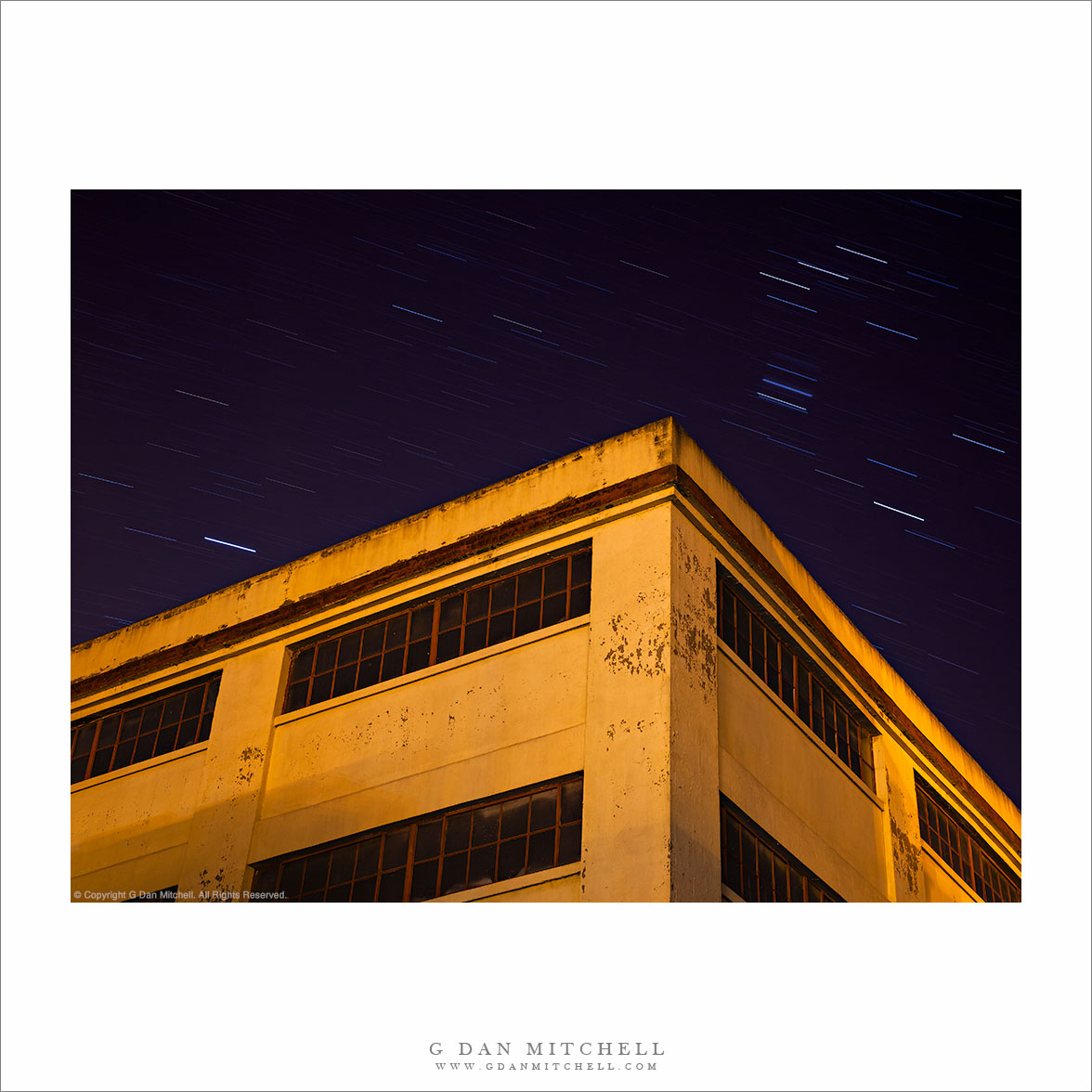
“Yellow Building With Dark Windows, Star Trails” — Industrial building and star trails, Mare Island.

This is probably a fairly conventional image of Mare Island buildings in some ways, and it includes the ever popular star trails! One aspect of doing night photography – especially when exposures are measured in minutes rather than seconds or fractions of seconds, and double-especially when you must wait for a second dark-frame exposure to complete – is that you have a lot of time to stand around and observe and think about what you see. A whole lot of time. Before I made this photograph, I had made one of a nearby wall with some interesting windows and a door and illuminated by some light that passed through some intervening stuff, producing interesting shadows. The alley where I was shooting was quite dark, necessitating fairly long exposures, so as I made that previous photograph I had perhaps 10-15 minutes of “standing around time,” during which I was able to closely observe my surroundings.

Lately one subject that I’ve been experimenting with is the upper stories of buildings, shot from below and with sky beyond. Near where I was shooting and next to a nearby alley was this large concrete building with dark windows, with its pointed prow against a backdrop of relatively dark sky. I noticed that this section of sky held more bright stars that some other areas and that if I lined things up just right I could position some to either side of the point at the corner of the building.


COMMENT OR QUESTION? Scroll down to the comment form.

Prints are available. Read about licensing and print sales.

G Dan Mitchell is a California photographer and visual opportunist. His book, “California’s Fall Color: A Photographer’s Guide to Autumn in the Sierra” (Heyday Books) is available directly from him.
Blog | Bluesky | Mastodon | Substack Notes | Flickr | Email

Shacks and Ship Yard Structures

Shacks and Ship Yard Structures

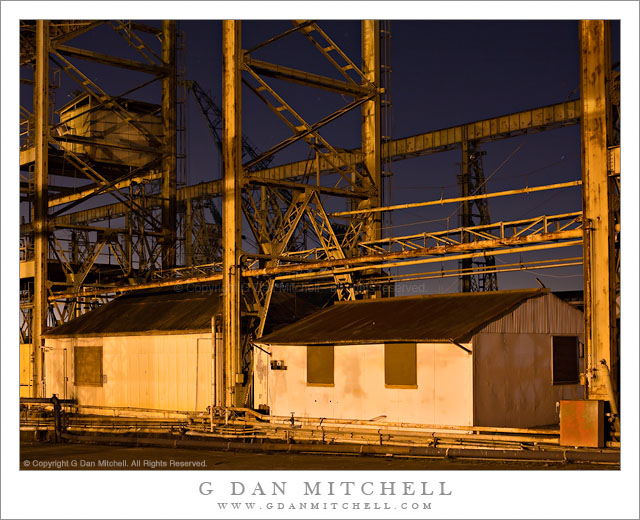
Shacks and Ship Yard Structures. Mare Island Naval Ship Yard, California. February 12, 2011. © Copyright G Dan Mitchell – all rights reserved.

Shacks, trestles, pipes and other shipyard structures against a night sky – Mare Island Naval Ship Yard.

Several years ago I shot more or less this scene and created a black and white photograph from it, and since then I’ve been thinking of trying to work with the scene again. I’ve been back, but ended up not shooting it for a variety of reasons, including a tall fence that now blocks the view a bit. On another occasion I decided not to shoot it since there was no moon… and the original photograph was done in full moon light. (“It wouldn’t look like my other photograph.” What a silly reason to not shoot it!)

This time I wandered over to this area to shoot a different subject, the companion structure that sits just north of this one. (Both support large overhead “tracks” along which some sort of machinery was able to lift and move large things like ship engines from the shop to the waterfront.) With my tripod cranked up to a foot or so above my head, the camera could “see” over the fence, so I decided to go ahead and shoot this subject again.

Technically, there are a few challenges in the shot. The bright light is very close to the first building and it ends up being very bright and the light is a very saturated yellow color – so that limits the maximum exposure. At the same time, there are some deeply shadowed areas in the structure that you can probably spot – come of the areas under parts of the tower for example. In addition, the city of Vallejo lies beyond this facility – you can see a bit of the glow from its lights in the distance – and some of the city lights would be directly visible if I wasn’t careful with camera placement.

I’m intrigued by several things about this subject. As a decommissioned ship yard, it is interesting to think about what it must have been like here in the past when all of this was in use. (Mare Island’s history goes well back into the 1800’s when it was the first west coast naval ship yard.) I also marvel at the “stuff” that I see that I can’t understand at all. I have no idea what many of those pipes were for or even what must have gone on in these little buildings. And the weathered, rusted, decaying character of the structure itself is interesting to me.

G Dan Mitchell Photography | Flickr | Twitter | Facebook | Email
Text, photographs, and other media are © Copyright G Dan Mitchell (or others when indicated) and are not in the public domain and may not be used on websites, blogs, or in other media without advance permission from G Dan Mitchell.