
Tag Archives: patterns

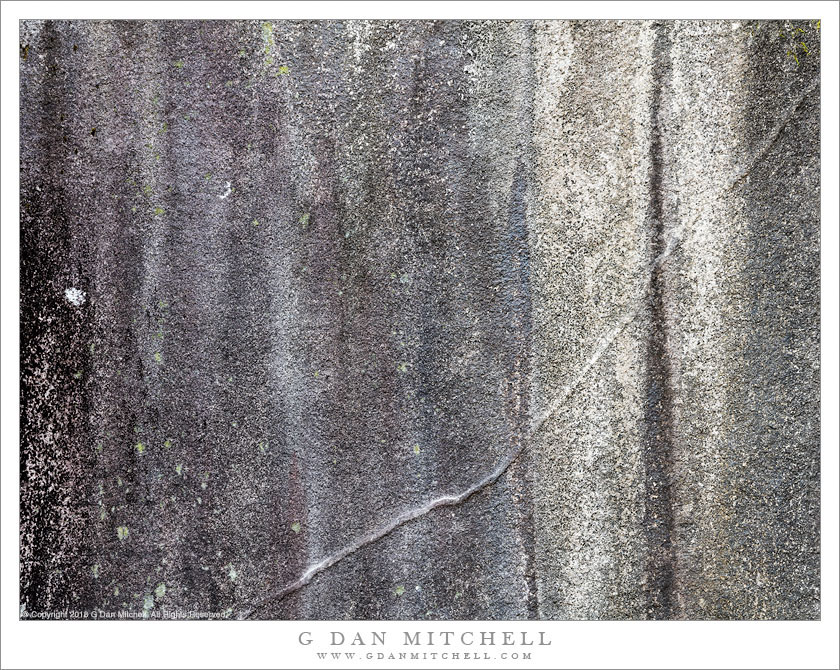
Patterns In Granite

Patterns In Granite
Patterns in a section of Yosemite Valley granite

Patterns In Granite. © Copyright 2018 G Dan Mitchell – all rights reserved.

Patterns in a section of Yosemite Valley granite

Of all the things that characterize and define Yosemite, rock may be the most important. The Valley itself is lined with huge granite* forms in the shapes of domes and cliffs and more, carved by water, glaciers, and slow erosion. Wandering about the Valley one eventually becomes aware that the granite “moves,” and that giant chunks have fallen from the surrounding heights and sometimes managed to travel a good distance into the valley — a sobering thought. This rock continues into the high country, where some of the same features are found, along with others — the glacial “erratics” left behind as ice retreated, places were rivers flow across smooth rock, meadows dotted with boulders.

The character of granite on the large scale is hard to miss, but its character close up is also fascinating. Many years ago, for a few years, I was a bit of a rock climber. As a climber one gets “up close and intimate” with rock, learning (and remembering the tactile qualities) of the rock — smooth, straight cracks, rough, covered by lichen, disintegrating, marked by water, and more. That may explain why this little spot caught my attention. Quite a few stories are in this rock. It lies at the base of some very large cliffs, suggesting its source. It is covered by lichen, part of the reason for the color variations. Stained streaks produce vertical lines, and one odd section, which must be harder than the rest, angles up from left to right.

  • A geologist friend has pointed out to me in the past that “granite” is not a technically correct blanket description for the rock of Yosemite. I’m using the term in the casual and familiar sense. And for those who get this far, did you notice a compositional link to the recent redwing blackbird photograph? :-)

G Dan Mitchell is a California photographer and visual opportunist. His book, “California’s Fall Color: A Photographer’s Guide to Autumn in the Sierra” is available from Heyday Books and Amazon.
Blog | About | Flickr | Twitter | FacebookGoogle+ | LinkedIn | Email


All media © Copyright G Dan Mitchell and others as indicated. Any use requires advance permission from G Dan Mitchell.
Dormant and Alive

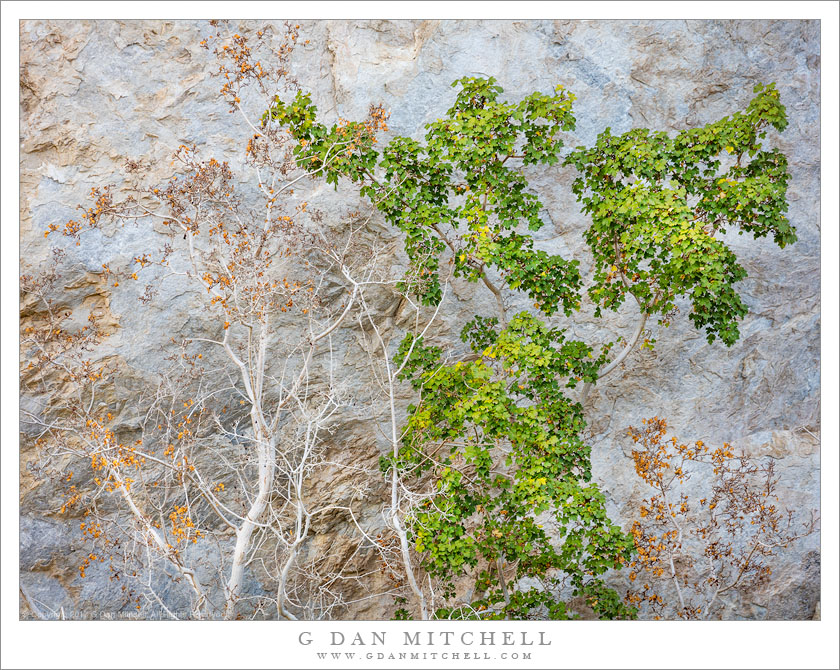
Dormant and Alive
dormant and live trees form patterns against a cliff face, Great Basin National Park

Dormant and Alive. Great Basin National Park, Nevada. September 26, 2017. © Copyright 2017 G Dan Mitchell – all rights reserved.

Dormant and live trees form patterns against a cliff face, Great Basin National Park

On my first visit to Nevada’s Great Basin National Park near the end of September, my initial impression was that the “big features” of the park that probably draw the most visitors are two: The Lehman Caves near the entrance and visitor center and the high, alpine area close to Wheeler Peak, the highest point in the park and the second tallest in the state of Nevada. I did not visit the caves, but I did spend a fair amount of time high up near the peaks, photographing and hiking to the alpine lakes and the bristlecone pine groves. (My one regret is that I started out a bit too late on the bristlecone pine visit, and I didn’t have enough time to cover the additional two miles up to and back from the Wheeler Glacier.)

Eventually, as typically happens, I had made my acquaintance with the iconic subjects in the park, and I started to feel the familiar impulse to look around a bit for things that might not be so obvious or immediately impressive. The first foray was up a gravel road past some less developed campgrounds, where I came across at section of low cliff running alongside a gravel road and stream bed. The autumn colors were just beginning to arrive here, so I got out and wandered a bit, looking for juxtapositions of rock and tree. This little vignette attracted my attention, and I was fascinated by the pairing of a living tree full of leaves (albeit just about to turn colors and drop) and the nearby bare, white branches holding only dead leaves, with both set off from the rock behind them.


G Dan Mitchell is a California photographer and visual opportunist. His book, “California’s Fall Color: A Photographer’s Guide to Autumn in the Sierra” is available from Heyday Books and Amazon.
Blog | About | Flickr | Twitter | FacebookGoogle+ | LinkedIn | Email


All media © Copyright G Dan Mitchell and others as indicated. Any use requires advance permission from G Dan Mitchell.
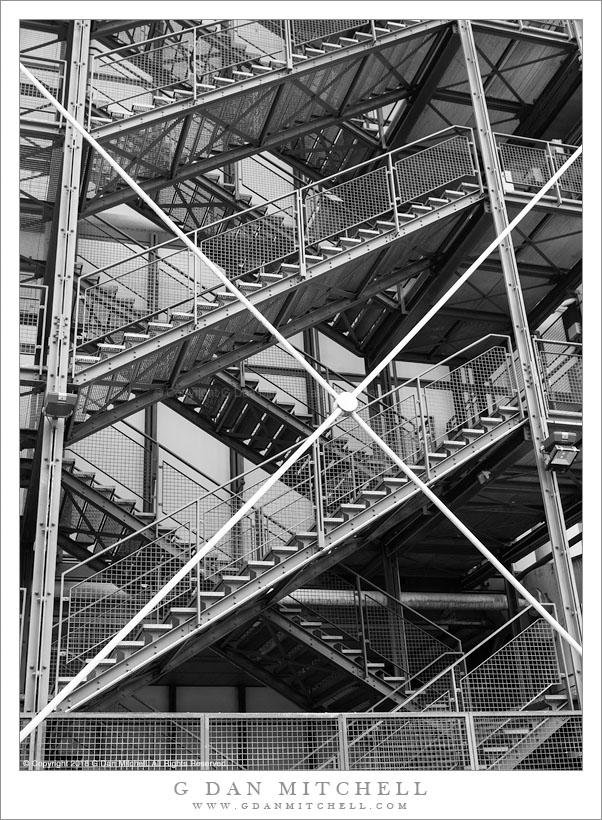
Shadow and Line Study

Shadow and Line Study
Patterns of lines, curves, concrete and shadows

Shadow and Line Study. San Francisco, California. May 20, 2016. © Copyright 2016 G Dan Mitchell – all rights reserved.

Patterns of lines, curves, concrete and shadows

I have always been intrigued by and occasionally obsessed with patterns and juxtapositions and form. When I go back and look at my earliest photography from when I was in middle school or high school I can now see that even then I wasn’t just looking at things for what they “are,” but for the other things that they might also be — the aspects of them that are not immediately visible. This is simple (or so it seems) study of some lines and curves and perspective lines, made quickly while walking along the Embarcadero on San Francisco’s waterfront one morning.

Recently the discussion about realism and honesty and manipulation in photographs has crescendoed a bit, as it does from time to time. On one side are those who think that anything goes — not exactly my point of view, though I might be more “permissive” that you would expect. On the other side are members the “no manipulation” faction, who want to apply the supposed standards of photojournalism to all photographs — their job is to show truth and be completely objective and no “manipulation” is permitted. The problem with the extremes of the first position are obvious. The problems with the extremes of the second deserve a lot more thoughtful scrutiny then they have generally been receiving. All photographs lie, even those that tell truths. Some might imagine that a photograph like this one represents an objective truth, a straightforward (and straight photography) look at the true nature of a thing. But if you saw this subject, you would not likely see anything like this, and my choices (to make it black and white, to use a particular lens, to render the image in black and white, to look at this particular subset of the whole, and much more) are entirely subjective. In the end, this is still truth — but it is my very subjective truth about this subject and it most certainly is not an objective “record” of a thing.


G Dan Mitchell is a California photographer and visual opportunist. His book, “California’s Fall Color: A Photographer’s Guide to Autumn in the Sierra” is available from Heyday Books and Amazon.
Blog | About | Flickr | Twitter | FacebookGoogle+ | LinkedIn | Email


All media © Copyright G Dan Mitchell and others as indicated. Any use requires advance permission from G Dan Mitchell.
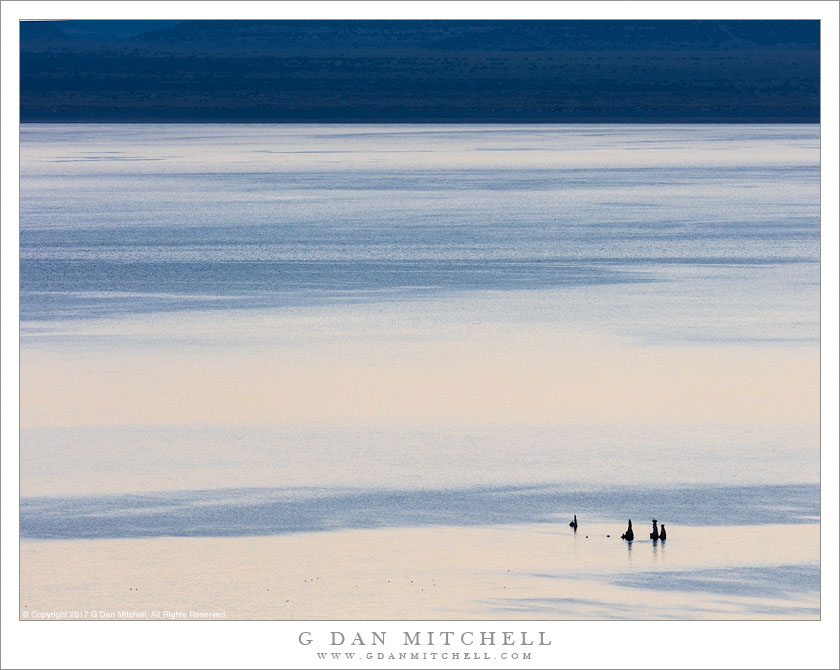
Sea of Sand

Sea of Sand
Overlapping sand dune patterns, morning

Sea of Sand. Death Valley National Park, California. March 31, 2016. © Copyright 2016 G Dan Mitchell – all rights reserved.

Overlapping sand dune patterns, morning

On the last day in Death Valley this spring we were planning to head off to the Los Angeles area in the morning, but I decided I wanted to photograph one more time before departing. Although I really wanted to sleep in, after many days of rising very early, I decided to get up early one more time and head back to the dunes alone for one final bit of photography. I headed out before dawn and arrived at a location I had been to before, parked the car, hoisted a backpack and tripod, and headed out across the playa toward a section of dunes where I was reasonably certain I would be able to photograph alone. The distances are always deceiving, and the playa walk took much more than the ten minutes one might guess that it would take if unfamiliar with these places. Eventually I came to the low dunes that I had been aiming for, and I began to look for places where I could make sand fill the frame.

The dunes are deceiving on other ways, too. You might imagine that they are on the march, being pushed along by winds. The wind does move sand — and it was blowing around my feet on this morning — but overall the dune forms are actually quite stable. Sometimes these active looking yet stable features make me think of a sort of stop motion ocean, with waves and crests and valley mostly frozen — a stopped landscape mirroring the active surface of water. The patterns here range from small (the little ripples in the foreground) to quite large (the overlapping crests marching into the distance.) I worked this scene and others like it for an hour, and then it was time to leave — a walk back across the playa back to my vehicle, and then the long drive out of the desert.


G Dan Mitchell is a California photographer and visual opportunist. His book, “California’s Fall Color: A Photographer’s Guide to Autumn in the Sierra” is available from Heyday Books and Amazon.
Blog | About | Flickr | Twitter | FacebookGoogle+ | 500px.com | LinkedIn | Email


All media © Copyright G Dan Mitchell and others as indicated. Any use requires advance permission from G Dan Mitchell.