
Tag Archives: peak

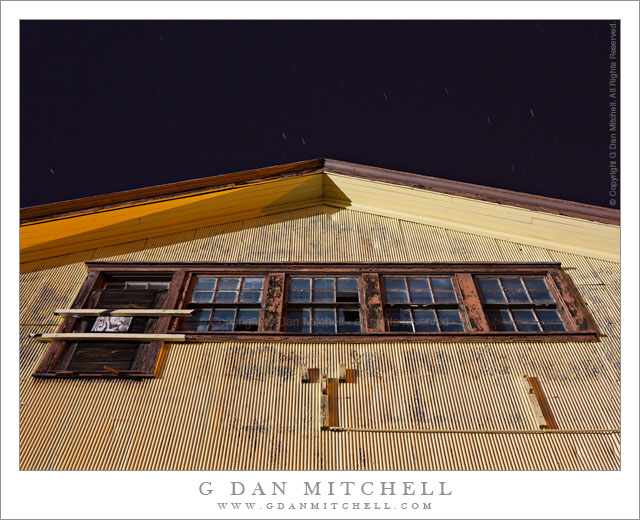
Yellow Building with Weathered Windows, Night Sky

Yellow Building with Weathered Windows, Night Sky

Yellow Building with Weathered Windows, Night Sky. Mare Island Naval Ship Yard, California. February 12, 2011. © Copyright G Dan Mitchell – all rights reserved.

Weathered windows below the eaves of a dilapidated yellow building at Mare Island Naval Ship Yard with star trails in the night sky.

This is another building that I have photographed a number of times when I’ve visited the Mare Island Naval Ship Yard to do night photography. Typically I have focused on the lower walls of the building, which are interesting due to the presence of garish yellow sodium vapor lighting, the interesting texture of corrugated metal walls with peeling paint, dilapidated and broken doors and windows, and the odd presence of a UFO-shaped shadow from a lamp hanging on the exterior. (A recent photo I posted featured that oddity.)

Here I wanted to shoot something a bit less complex and graphically simple – so I aimed the camera almost straight up from a position right in front of the building. Though they are difficult to see in this small jpg, the sky is filled with faint star trails from the two-minute exposure, and I like the way its inky blue-black color contrasts with the very warm colors of the yellow walls that are lit by sodium vapor light coming from multiple directions. The terribly weathered window frame, the bit of conduit attached to the wall, and the broken window panes break up the wall.

G Dan Mitchell Photography | Flickr | Twitter | Facebook | Email
Text, photographs, and other media are © Copyright G Dan Mitchell (or others when indicated) and are not in the public domain and may not be used on websites, blogs, or in other media without advance permission from G Dan Mitchell.
Two Hikers at the Summit of Death Valley Dunes

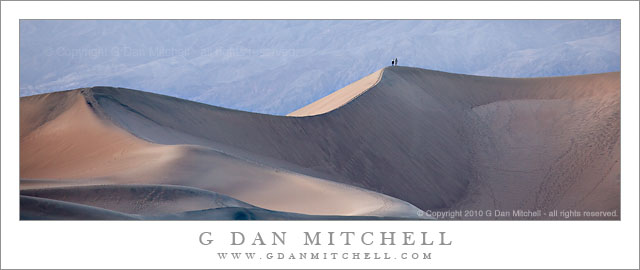
Two Hikers at the Summit of Death Valley Dunes

Two Hikers at the Summit of Death Valley Dunes. Death Valley National Park, California. © Copyright G Dan Mitchell – all rights reserved.

Two hikers take in the evening landscape of Death Valley National Park from the Summit of the dunes.

Many times I might have been disappointed to have two hikers enter “my” scene in such beautiful dusk light, but here I feel like they crystalize the scene. In a larger version of the photograph the two of them seem to stand silently facing the rugged vastness of Death Valley – and I think their presence invites us to think of ourselves in the scene and to imagine our own reaction to it.

My favorite time to photograph these iconic dunes near Stovepipe Wells is in the evening during a brief interval right around sunset and lasting a while after the sun drops behind the peaks to the west. The light softens, especially if there is a bit of haze in the sky, and the dunes that are so bright and harsh at other times of day take on a smoother and softer quality and their subtle colors become visible.

This photograph is not in the public domain and may not be used on websites, blogs, or in other media without advance permission from G Dan Mitchell.
G Dan Mitchell Photography
Flickr | Twitter | Facebook Fan Page | Facebook | Friendfeed | Email

McGee Canyon and Mount Morgan

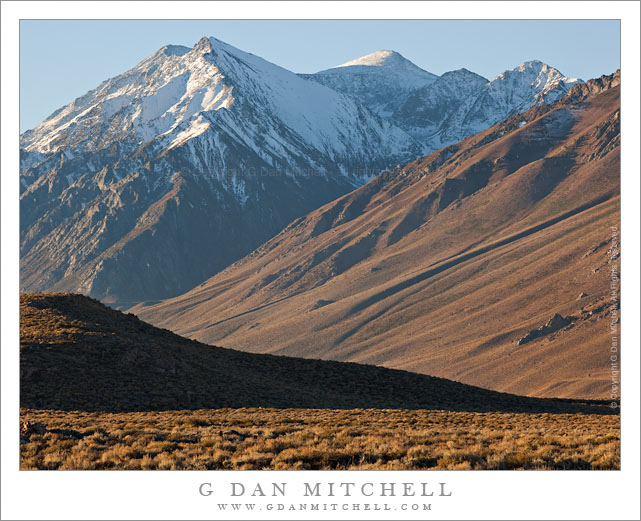
McGee Canyon and Mount Morgan

McGee Canyon and Mount Morgan. Owens Valley, California. October 10, 2010. © Copyright G Dan Mitchell – all rights reserved.

Snow crested Mount Morgan rises above McGee Canyon and the sagebrush-covered hills of Owens Valley in the eastern Sierra Nevada.

I’ve been traveling to the Sierra for many years. My first recollection of the range is a faint mental image of a shoreline park at Lake Tahoe when my family moved to California – I was four years old. My next memory is of staying at a small motel in El Portal next to the high water of the Merced River back in the days before the current mega-hotels were erected. One thing that all of my early Sierra experiences had in common is that I always approached the range from the west since I lived (and still live) in the San Francisco Bay Area. For the person whose orientation to the range is from the west, the Sierras are a range that begins almost imperceptibly in the Central Valley. Although you can see distant peaks from the Valley on clear days, it is hard to say where the range begins. As you head east you encounter some very small and rounded hills which gradually get larger. Eventually you are going up more than up and down as you  travel through oak and grass lands. At some point the road rises into forest, but the mountain tops are mostly rounded and forest covered. Keep going and a few rocky prominences begin to appear along the ridges and some distant granite peaks become visible. Only after a lot of driving do you find yourself in the higher reaches of the range, and this only in the few areas where roads cross from west to east. In most places you cannot even see the summit of the range close up from the west without walking a long ways.

It was only many years later that I first went over the summit of the range and saw it from the east side. The Sierra is (are?) completely different when approached this way. Instead of a long, gradual, and relatively gentle rise to high valleys and forests and meadows, the eastern escarpment of the Sierra rises abruptly – one might say violently – and directly, in most places, from the high desert sagebrush country of Owens Valley and similar places. This wall of peaks seems almost inaccessible, and I imagine that many people who only drive past on highway 395 must regard it that way.

This photograph was made from a spot just a mile or two east of highway 395, out an a gravel road that I know. I have photographed this shadowed foreground ridge and the peaks beyond in the past, so I had a fairly good idea of what I would find at this location before I made the photograph on an early October morning when fall storms had dusted the highest peaks with snow. I used a somewhat long lens and tight framing to emphasize the rise from the foreground desert to the very high peaks beyond.

This photograph is not in the public domain and may not be used on websites, blogs, or in other media without advance permission from G Dan Mitchell.

G Dan Mitchell Photography
Flickr | Twitter | Facebook Fan Page | Facebook | Friendfeed | Email

Mount Morrison and Desert Hills, Morning

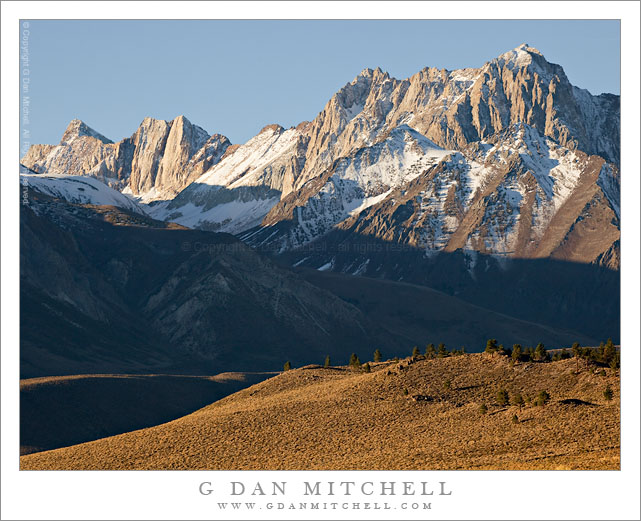
Mount Morrison and Desert Hills, Morning

Mount Morrison and Desert Hills, Morning. Owens Valley, California. October 10, 2010. © Copyright G Dan Mitchell – all rights reserved.

Early morning light on sagebrush covered Owens Valley hills and the Sierra crest near Mount Morrison.

I was out in this section of Owens Valley early on this October morning, initially to photograph at a small lake further out in the valley. However, knowing parts of this area pretty well from past visits, I wanted to try a photograph that included the foreground tree-covered ridge in morning light with the Sierra peaks in the background – so I headed back on a gravel road that travels a bit north of the paved road I had taken earlier in the morning. I found this scene with the early light illuminating the crest of the Sierra and the sagebrush-covered foreground hills, but with morning shadows still lying across the lower eastern face of the Sierra just south of Convict Lake.

The dusting of early season snow was left over from a week of early autumn storms. Mt. Morrison is the huge and impressive summit at the right end of the ridge. Mt. Baldwin is the small but very high summit near the left end. In between is a vertical rock face that appears to be split by a crack – I think it is called “the Great White Fang.”

This photograph is not in the public domain and may not be used on websites, blogs, or in other media without advance permission from G Dan Mitchell.

G Dan Mitchell Photography
Flickr | Twitter | Facebook Fan Page | Facebook | Friendfeed | Email