
Tag Archives: ridge

Trail Canyon

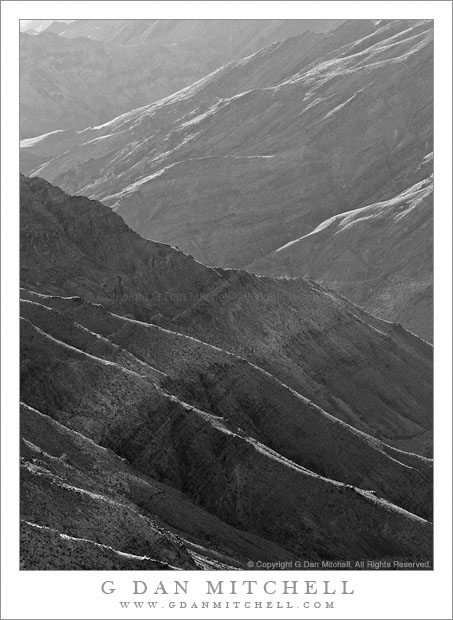
Trail Canyon - Morning light angles across eroded ridges and gullies on lower slopes of the Panamint Range above Trail Canyon, Death Valley National Park.
Morning light angles across eroded ridges and gullies on lower slopes of the Panamint Range above Trail Canyon, Death Valley National Park.

Trail Canyon. Death Valley National Park. January 5, 2012. © Copyright 2012 G Dan Mitchell – all rights reserved.

Morning light angles across eroded ridges and gullies on lower slopes of the Panamint Range above Trail Canyon, Death Valley National Park.

This is another photograph that I’ve been thinking about for a while, and one that I was virtually certain would be in black and white when I shot it. I’ve looked down into Trail Canyon quite a few times and tried to “see” a photograph that would somehow consist entirely of the overlapping ridges and layers of stratified rock, tilted at crazy and seemingly opposing angles. My previous photographs of this location had been made late in the day – when the light is beautiful in many directions from this overlook, but when the canyon itself is often shrouded in early shade.

I made this photograph in the morning. It was my first time at this location high in the Panamints at dawn instead of at sunset. I arrived on a cold winter morning before dawn to find no other people there and no wind. (The latter is a bit unusual here, but was certainly welcome, seeing that I would be shooting with long focal length lenses.) The first subject to shoot was the pre-dawn light on clouds high above the landscape. Then my attention moved to the first light striking various higher points within my range of view, and then followed the light as it worked its way down to lower elevations. After that I turned my attention more to guts of this canyon, but was not getting quite what I wanted at first – until the sun rose high enough to peak over ridges and begin to highlight the inner folds of the canyon as seen in this photograph. I made several different compositions, but in the end decided on this one that eliminates any extraneous elements outside of the canyon itself.

G Dan Mitchell is a California photographer whose subjects include the Pacific coast, redwood forests, central California oak/grasslands, the Sierra Nevada, California deserts, urban landscapes, night photography, and more.
Blog | About | Flickr | Twitter | FacebookGoogle+ | 500px.com | LinkedIn | Email

Text, photographs, and other media are © Copyright G Dan Mitchell (or others when indicated) and are not in the public domain and may not be used on websites, blogs, or in other media without advance permission from G Dan Mitchell.
Eureka Valley Dunes, Dusk

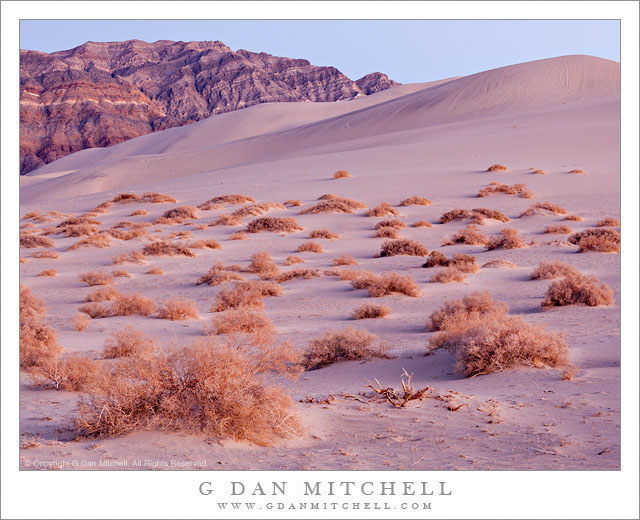
Eureka Valley Dunes, Dusk - Pink dusk light on the Eureka Valley Sand Dunes, Death Valley National Park.
Pink dusk light on the Eureka Valley Sand Dunes, Death Valley National Park.

Eureka Valley Dunes, Dusk. Death Valley National Park, California. January 5, 2012. © Copyright 2012 G Dan Mitchell – all rights reserved.

Pink dusk light on the Eureka Valley Sand Dunes, Death Valley National Park.

On the second-to-last day of my January visit to Death Valley, I decided that it would make sense to exit the park to the north by way of miles of gravel roads heading into the northern portion of the park then out via more gravel and then some paved roads to Big Pine the next day, setting me up to return home over snow-free (in January!) Tioga Pass. After shooting early in the morning I headed back to my camp – at Stovepipe Wells at that time – had some breakfast, took down my camp, and packed. By the time I fueled up my car and headed north, I was a bit behind my planned schedule, but I figured that I might still make it to Eureka Valley in time to shoot in some late afternoon light.

A few hours later, after a drive including over 40 miles of gravel, I finally arrived at the site of these monumental dunes. At nearly 700 feet tall, they are supposedly the tallest dunes in the United States – or is it in North America? Eureka Vally is a lonely place, being a long drive on rough roads from any direction and almost completely without the civilized services found in some other areas of the park. When I got there, a family that had visited was just leaving, and there was one other photographer shooting high up on the dunes. I knew that I didn’t have enough time to try that, so I grabbed my gear and hiked over to one side of the dunes where their lower slopes begin to merge with the flat surface of the valley and where the last sun would hit the dunes. I shot there for a while and after the sun dropped below the ridges to the west I went looking for subjects that might benefit from the post-sunset soft and pink light. Very close to my “campsite” (which was in the back of my vehicle that night!) I saw these plants leading up toward the summit of the dunes and the higher stratified peaks beyond, and I made a few photographs in the rose-colored late light.

G Dan Mitchell is a California photographer whose subjects include the Pacific coast, redwood forests, central California oak/grasslands, the Sierra Nevada, California deserts, urban landscapes, night photography, and more.
Blog | About | Flickr | Twitter | FacebookGoogle+ | 500px.com | LinkedIn | Email

Text, photographs, and other media are © Copyright G Dan Mitchell (or others when indicated) and are not in the public domain and may not be used on websites, blogs, or in other media without advance permission from G Dan Mitchell.
Cook Bank Ruins, Rhyolite

Cook Bank Ruins, Rhyolite - The ruins of the Cook Bank in the ghost town of Rhyolite, Nevada, with barren desert hills under a pre-sunrise sky.
The ruins of the Cook Bank in the ghost town of Rhyolite, Nevada, with barren desert hills under a pre-sunrise sky.

Cook Bank Ruins, Rhyolite. Rhyolite, Nevada. January 3, 2012. © Copyright 2012 G Dan Mitchell – all rights reserved.

The ruins of the Cook Bank in the ghost town of Rhyolite, Nevada, with barren desert hills under a pre-sunrise sky.

This was the closest to the winter solstice that I’ve visited Rhyolite, so I shouldn’t have been surprised by several things. First, the sun came up not only later, but also a bit further south along the horizon – and the light that would usually strike these ruins at sunrise was blocked for a while by a large hill that sits next to the town. Second, it was cold! Third, no one else was there at sunrise! This is a bit unusual since in the Death Valley high season (which arrives a bit later in the year), Rhyolite can be a pretty popular place… for a ghost town… in the middle of the desert… in Nevada. :-)

Because I have photographed here several times before and for the reasons mentioned above, I took a bit of a different approach to photographing the place this time. The winter light, some high clouds, and the different point along the horizon of the sun rise meant that the light was quite different from what I’ve occasionally had to work with in the past. At first I was a bit disappointed to realize that the direct dawn light was not going to strike the old Cook Bank and other nearby buildings. But when some clouds to the east obscured the direct light and high, thin overhead clouds begin to pick up color and fill in the shadows, I saw that other interesting lighting was going to make up for it. At the moment that I made this photograph, those clouds to the east (right) of my position beautifully softened what might otherwise have been some stark and harsh light on the pinnacles beyond the town. They also created an unusual and beautiful quality of light for a few moments – a reddish-pink quality from the light reflected from the clouds but with a few soft quality.

I decided to shoot from a distance with a long lens so as to control the position of the ruins against the background hills, and the longer focal length makes these hills more prominent than they would be if I shot the building with a shorter focal length from a closer position. This also allowed me to more carefully eliminate some distracting elements that invariably appear at old sites like this. (The first times I visited, access to most of the ruins was quite unimpeded. Now fences have been erected around some of them. Part of me regrets the loss of access, but the greater part of me understands that this will allow these buildings to be around longer so that more people will get to see them. I stayed behind the fences.) If you look around on the web a bit, you can find some wonderful old photographs of this town when it was a bustling place with thousands of residents, and when the Cook Bank was a very impressive and modern-for-the-time building.

G Dan Mitchell is a California photographer whose subjects include the Pacific coast, redwood forests, central California oak/grasslands, the Sierra Nevada, California deserts, urban landscapes, night photography, and more.
Blog | About | Flickr | Twitter | FacebookGoogle+ | 500px.com | LinkedIn | Email

Text, photographs, and other media are © Copyright G Dan Mitchell (or others when indicated) and are not in the public domain and may not be used on websites, blogs, or in other media without advance permission from G Dan Mitchell.

Kit Fox Hills and Death Valley Buttes, Dusk

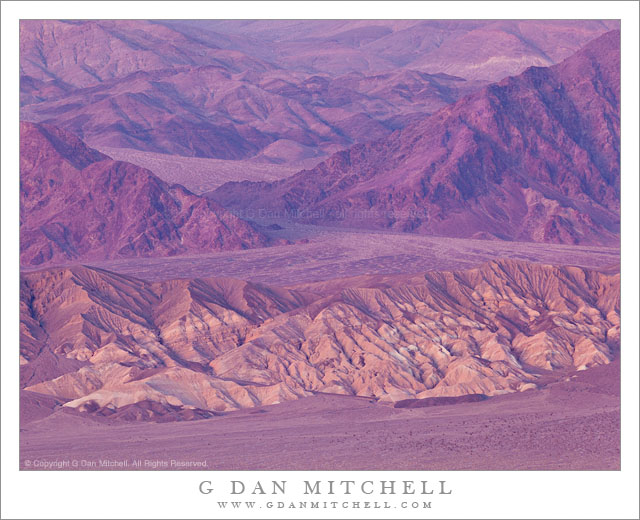
Kit Fox Hills and Death Valley Buttes, Dusk - Post-sunset light on the Kit Fox Hills, Death Valley Buttes, and the slopes of the Grapevine Mountains, Death Valley National Park
Post-sunset light on the Kit Fox Hills, Death Valley Buttes, and the slopes of the Grapevine Mountains, Death Valley National Park

Kit Fox Hills and Death Valley Buttes, Dusk. Death Valley National Park, California. January 3, 2012. © Copyright 2012 G Dan Mitchell – all rights reserved.

Post-sunset light on the Kit Fox Hills, Death Valley Buttes, and the slopes of the Grapevine Mountains, Death Valley National Park.

The view of the eroded Kit Fox Hills and the larger masses of Death Valley Buttes beyond with ascending ridges and valleys of the Amargosa Range beyond is one that I’ve been working on for a few years now. During the day these formations are interesting, but in many ways not much more so than any of scores of other hills, washes, rocky ridges and so forth throughout the park and other desert areas. But sometimes the light does absolutely incredible things to these hills along the east side of the Valley.

I first saw this happen during a previous visit when evening clouds lit up in astonishing and almost surreal ways after the sun had set. As the sky to the west of Death Valley began to glow in the post-sunset light a wash of amazing and intense color began to fill the scene. I’m not even sure how to describe the color. Rose? Purple? Pink? Some combination of the three and more? At that time I was shooting from a small hill in a less visited portion of the Valley, and I I photographed a large “fan” along the base of huge mountains not far from Stovepipe Wells. While the colors in that photograph are, indeed, real, I have a heck of a time convincing people that this is the case. I end up doing so much explaining that I don’t show the photograph all that often!

This light is similar, though a bit less intense. The light was fading quickly at this point, and I only had a few moments of this particularly beautiful light, which might have been hard to see in person since it was getting late. I photographed this from yet another spot that it just a bit off the beaten track, though not far at all from some very popular areas. In fact, as I worked alone as the evening came on, I could swing my camera around and use my longest focal length to see hordes of people visiting and photographing another nearby feature, oblivious to the light in this spot far to their east.

G Dan Mitchell is a California photographer whose subjects include the Pacific coast, redwood forests, central California oak/grasslands, the Sierra Nevada, California deserts, urban landscapes, night photography, and more.
Blog | About | Flickr | Twitter | FacebookGoogle+ | 500px.com | LinkedIn | Email

Text, photographs, and other media are © Copyright G Dan Mitchell (or others when indicated) and are not in the public domain and may not be used on websites, blogs, or in other media without advance permission from G Dan Mitchell.