
Tag Archives: usa

Shack with Red and Green Interior Lights

Shack with Red and Green Interior Lights

Shack with Red and Green Interior Lights. Mare Island Naval Ship Yard, California. February 26, 2011. © Copyright G Dan Mitchell – all rights reserved.

A small shack with interior lit by red and green lights at the Mare Island Naval Ship Yard, California.

At last weekend’s night photography shoot with The Nocturnes at Mare Island Naval Ship Yard I wandered a bit further afield than I have on some previous visits, eventually ending up in an area where I have only photographed once before when I unsuccessfully shot a couple of large barn-like buildings. (I think I have a shot of these buildings from this trip that I like, and I’ll post it later on.)

While spending nearly a half hour photographing a light post against the backdrop of a very dark brick building (which amounted to two photographs, given the long exposure times and the follow-up “dark frame exposures) I kept thinking I saw a faint red glow inside a small nearby building. At first I thought that one of my fellow night photographers might be doing some light painting, but the light seemed awfully dim. Eventually I noticed that it was also quite constant – and light painting virtually always involves moving the hand held light source around in order to get a smooth lighting effect. Once I finished shooting the light pole (unsuccessfully, it turns out) I decided I would go over and see what was creating this light.

The buildings appears to be a small “guard shack” or similar, a very old and very dilapidated one room structure. Inside, as best as I could tell, there is a small table, a few chairs, a digital clock of some sort with green letters, and some kind of very dim red light. Intrigued, I decided to see if I could photograph it. One technical problem was going to be the very large difference in lighting between the bright light on the clock and the extremely dim exterior, made worse by the dark color of the building. I figured that I could probably put enough extra light onto the building’s exterior using a very small key chain LED light than I happened to have with me, and that is the major source of light on the front of the building and on the yellow foreground curve – I simply walked around on both sides of the building and moved the small light over its surface.

In the end, I think this is another example of night photography as a source of a certain kind of “fantastic” lighting. The actual scene was very, very dim, and the the intensity of the colors here is almost entirely the result of the very long exposure and a bit of improvised lighting on the yellow curb behind the fence – a photograph of something that cannot be seen with our own eyes.

More Night Photography

G Dan Mitchell Photography | Flickr | Twitter | Facebook | Email
Text, photographs, and other media are © Copyright G Dan Mitchell (or others when indicated) and are not in the public domain and may not be used on websites, blogs, or in other media without advance permission from G Dan Mitchell.
Brick Wall with Windows and Doors, Artificial Light

Brick Wall with Windows and Doors, Artificial Light

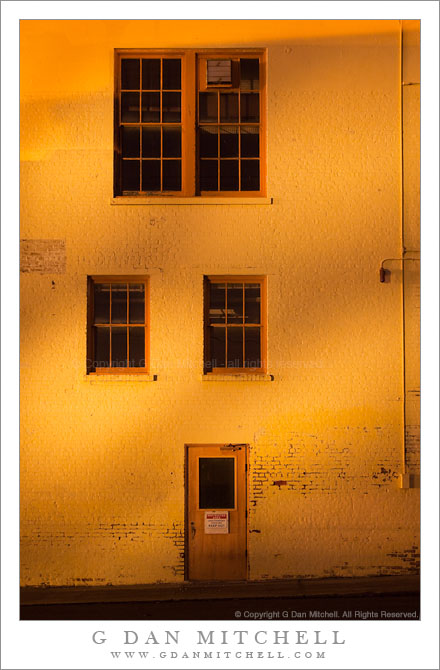
Brick Wall with Windows and Doors, Artificial Light. Mare Island Naval Ship Yard, California. February 26, 2011. © Copyright G Dan Mitchell – all rights reserved.

A brick wall with windows and a door is illuminated by garish yellow artificial lighting at Mare Island Naval Ship Yard.

During the final weekend of February I was able to join my friends from The Nocturnes for an “alumni” shoot at the historic Mare Island Naval Ship Yard at Vallejo, California. I photograph at this location a few times every year – most often with The Nocturnes – and each time I go I find something new or else find a new way to photograph something familiar.

This wall is in a little side alley off or one of the main roads through the facility. Although it certainly doesn’t look like it in this photograph, this is a fairly dark area of the island where rows of large factory buildings (mostly abandoned) are lit, for the most part, by a few security lights. Standing there next to me as I made the photograph, this is not what you would have seen. At best, I could make out the shapes and arrangement of the windows and door, recognize that the wall was constructed of bricks, and notice that the light from nearby yellowish artificial lights was diffused and broken up by shining through intervening fences and other stuff.

But, for me at least, one of the goals of night photography is to see what cannot be seen with our own eyes. The whole idea of a “realism” in night photography seems almost crazy to me, at least when shooting such dark subjects as this one. “Reality” is an incredibly dark and dim and barely visible wall. What is more interesting to me is what the camera can see in the near dark. Here it reveals the intense yellow/orange color of the artificial lighting and the uneven patterns of light and shadow.

(It also occurred to me as I worked on this photograph that while I generally am somewhat conservative with color and saturation and all the rest in my photography of natural landscapes… the wild, garish, and intense color and light of this night photography may represent an opposite pole for me.)

More Night Photography

G Dan Mitchell Photography | Flickr | Twitter | Facebook | Email
Text, photographs, and other media are © Copyright G Dan Mitchell (or others when indicated) and are not in the public domain and may not be used on websites, blogs, or in other media without advance permission from G Dan Mitchell.
Branch, Water on Salt Flats

Branch, Water on Salt Flats

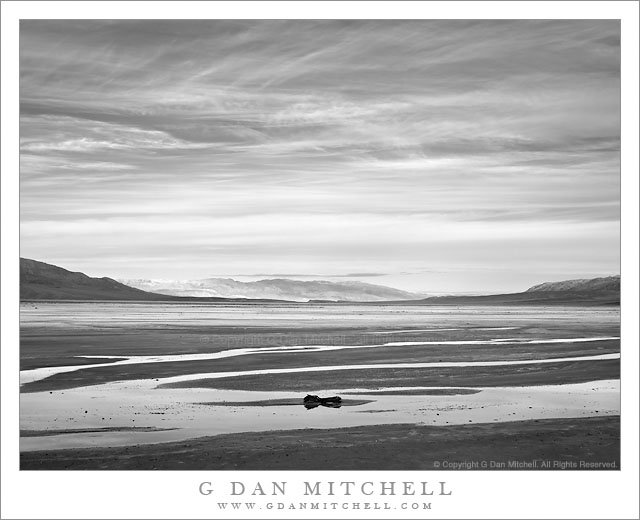
Branch, Water on Salt Flats. Death Valley National Park, California. February 21, 2011. © Copyright G Dan Mitchell – all rights reserved.

A forelorn branch sits near pools of reflecting water on salt flats of Death Valley National Park.

After the brief dawn light on the Panamints ended (see the photograph I posted yesterday) and the world went gray over in that direction, I noticed this odd log or branch sitting out on the mud in the salt flats between some of the ponds that streak this section of the flats. While the two minutes of beautiful color on the Panamints had ended, the increasing light was transforming what had been a fairly solid covering of gray into a transparency that revealed interesting layers and patterns of clouds in the morning sky.

I moved a bit closer and made one final sequence of Death Valley photographs before heading back to Stovepipe Wells to take down my camp and start the long drive home. I tried a couple different compositions, including some in which I was closer to the log, but in the end I prefer this one that put some distance between it and me and, I think, suggests the huge spaces that are among of the most compelling characteristics of this landscape.

G Dan Mitchell Photography | Flickr | Twitter | Facebook | Email
Text, photographs, and other media are © Copyright G Dan Mitchell (or others when indicated) and are not in the public domain and may not be used on websites, blogs, or in other media without advance permission from G Dan Mitchell.

Dawn Light, Panamint Range and Salt Flats

Dawn Light, Panamint Range and Salt Flats

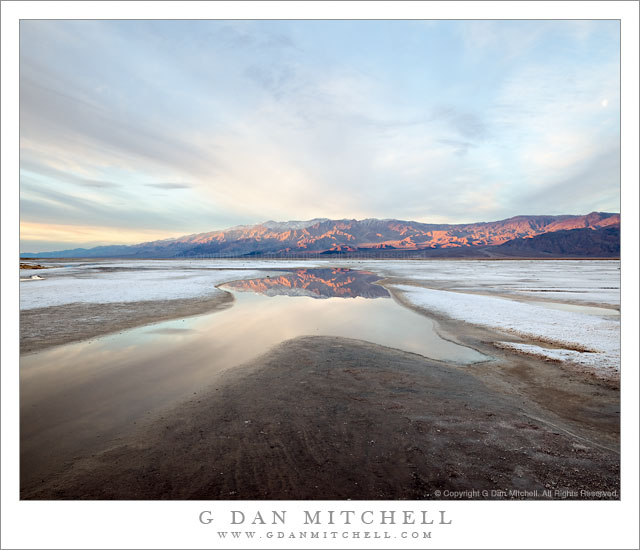
Dawn Light, Panamint Range and Salt Flats. Death Valley National Park, California. February 21, 2011. © Copyright G Dan Mitchell – all rights reserved.

The first dawn light on the snow-dusted Panamint Range is reflected in shallow winter pools on the salt flats of Death Valley National Park.

This is yet another story of serendipity, I think, though it also does involve some advance work – which should please those who become uncomfortable with the idea that not every landscape photograph results from a slow and deliberate and well-planned process! ;-)

The general location of this scene is along a section of salt flat just below the Salt Creek turnoff from the main highway – it is the first area of obvious salt flats that you come to as you head south towards the Furnace Creek area. One one of my first photographic visits to Death Valley I recall stopping near this location along the road and trying to make a photograph pointing down the length of the Valley. It was not successful, but I’ve always been a bit intrigued by this location where the road has to curve around to the east to avoid this salt flat. A day or two earlier on this trip I had stopped along the road at almost this exact location during the “boring light” part of the day after shooting somewhere else. I had wandered – without any camera gear – down across the wash to a patch of brown salt grass and beyond to the edge of the salt flat. I had noticed a lot of things: the very alien nature of this landscape consisting of mud and caked salt and not much else, the surprising presence of some worms and larvae in this tremendously salty water, the fact that the water seemed to seep from beneath the wash, and the interesting shapes that the water created as it slowly spread along the edge of the salt flat.

Move ahead to this morning, the final one of this trip to Death Valley, and I was up well before first light. I had several ideas about what I might photograph, but had not made a firm decision yet since the weather was something of an unknown. I had a vague idea about heading north up the valley and photographing the first light on the hills along its western edge. I was keeping open the possibility that spectacular light might make it worth while to photograph Zabriskie. But I really didn’t know.

I drove to the Furnace Creek/Scotty’s Castle junction and pulled over to watch the light begin to grow. There were lots of clouds! It looked like a lighter area might evolve straight to my east, but I couldn’t quite see photographic potential in it. To the north things looked pretty bleak. There was some possibility that light could happen way to the south, but I wasn’t convinced. I decided to drive a bit south and see what might happen, and very soon I came back to this place where I had stopped earlier. The light wasn’t very promising – clouds to the east seemed likely to block the sunrise light even though there were some interesting cloud patterns overhead that were starting to become more transparent as the sky began to lighten.

Then I caught just a bit of light on some of the higher clouds above the middle level clouds and I started to wonder if the light just might make it through. I went to the back of the car and grabbed my camera with one lens already attached and mounted it on the tripod. I wasn’t sure if I’d want wide or tele for some of the possible subjects, so I grabbed two additional lenses and stuck them in a shoulder bag and headed down the wash, not really looking up too much, just heading straight towards these little areas of water that I remembered from earlier. As I got close to the edge of the flats I saw that, indeed, a band of sunrise light was coming in below the cloud deck to the east (something I have learned to watch for) and starting to light up the highest peaks of the Panamints. I knew that if this light survived long enough to make it down across the range that it was going to happen fast, so I quickly headed out onto the edge of the flats, more or less ignoring the larger scene and simply looking for an interesting reflecting pool. As I set up – working very quickly now – the first sun lit up the face of the panamints and revealed radiating cloud shapes above. I had perhaps two minutes of this light… and then the small gap along the eastern horizon must have closed up as the light disappeared and went back to gray.

G Dan Mitchell Photography | Flickr | Twitter | Facebook | Email
Text, photographs, and other media are © Copyright G Dan Mitchell (or others when indicated) and are not in the public domain and may not be used on websites, blogs, or in other media without advance permission from G Dan Mitchell.