Tag Archives: water

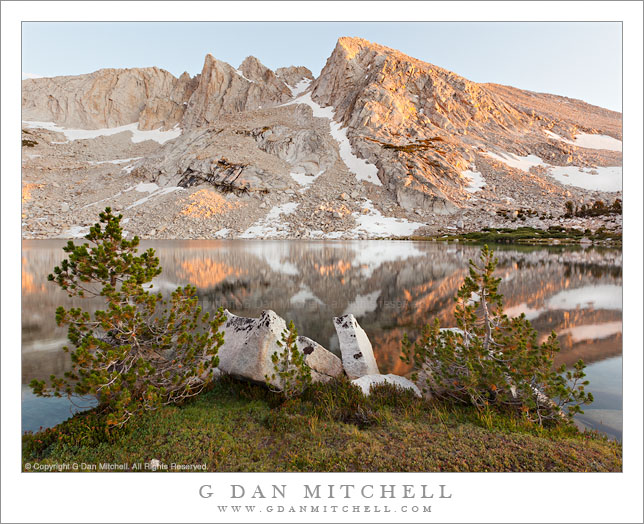
Flooded Meadow Near Greenstone Lake

Flooded Meadow Near Greenstone Lake

Flooded Meadow Near Greenstone Lake. Sierra Nevada, California. August 11, 2011. © Copyright 2011 G Dan Mitchell – all rights reserved.

Late-season snow fields are reflected in the pond of a flooded alpine meadow near Greenstone Lake, Sierra Nevada.

During this year of heavy and late winter snowfall, there is still a surprising amount of snow in the Sierra Nevada high country. In the upper portion of this image you can see large snow fields (with much larger ones higher on the slope and out of the frame) at that base of this talus slope at around 10,000+ feet of elevation. During a more typical year, there would still be a few scattered snow fields, but nothing like we see this year. And because there is still so much snow, the plants that would normally be well-developed by now are still just emerging, and the creeks and ponds are overflowing, the meadows are flooded… and the mosquitos are having a field day!

This little pond among the boulder-filled meadows near Greenstone Lake at the far end of Saddlebag Lake was still overflowing with snowmelt water that reflected the extensive snow fields still on the talus field beyond. To get to this spot – in mid-August! – I had to cross a number of still frozen snow fields, follow trails that were flooded in places, and pick my way carefully across waterlogged meadows. It is going to be a short summer season in the high Sierra, but as a compensatory bonus we may still see wildflowers all the way into September.

G Dan Mitchell Photography
About | Flickr | Twitter | FacebookGoogle+ | 500px.com | LinkedIn | Email

Text, photographs, and other media are © Copyright G Dan Mitchell (or others when indicated) and are not in the public domain and may not be used on websites, blogs, or in other media without advance permission from G Dan Mitchell.

(Basic EXIF data may be available by “mousing over” large images in posts. Leave a comment if you want to know more.)

Sunset and Moonrise, Kuna Crest

Sunset and Moonrise, Kuna Crest

Sunset and Moonrise, Kuna Crest. Yosemite National Park, California. August 10, 2010. © Copyright 2011 G Dan Mitchell – all rights reserved.

The nearly- full moon rises above the sunset light on Kuna Crest, Yosemite National Park.

Kuna Crest runs up Lyell Canyon between the Lyell and Dana forks of the Tuolumne River with the Sierra crest at one end and Mammoth Peak at the other. (Mammoth Peak is the large peak straight in front of you as you top Tioga Pass entering Yosemite National Park.) This ridge can catch great sunset light during the summer, and as I came down from the pass, heading back toward my camp at Porcupine Flat, and saw the almost full moon appearing over the shoulder of the ridge I decided to quickly stop and make a few exposures as the last light was about to leave the forest and soon after the peaks.

If you have tried photographing a scene that includes the moon in the early evening you know that the exposure is a tricky thing. The moon is lit by daylight, so it isn’t too surprising that the “correct” exposure for the moon is close to a normal daytime exposure. But that is not the right exposure for the rest of the scene, which turns out to be quite a bit darker than daylight at this time of day. In this scene things were even more complicates as the very saturated red colors on the ridge were quite “hot,” while the foreground meadow and forest was in shade and both darker and cooler in color. Basically, the dynamic range between the moon and the foreground was too large for a single exposure… so I made several.

At the time of exposure I thought that I might need as many as three component images in the final photograph – they would be one exposed for the bright ridge and sky, one exposed for the rather dark and shadowed foreground, and possibly a third that correctly exposed the moon. To be on the safe side I bracketed four exposures. When I began to work on the image I figured out that in this case I could construct a final “believable” image from two exposures if I was careful and could make some additional adjustments during post.

This is an example of a shot in which the use of a graduated neutral density filter could have been problematic, but where exposure blending could work very well. (“Exposure blending” is one term for the process of manually combining two component exposures using masked layers in Photoshop. No, it is not the same thing as HDR photography.) One of the things that would have been quite tricking using graduated neutral density filters is that the division between the brighter upper half and the darker lower half is not linear. Instead, the roughly follows the curved boundary between the lower meadow and dark trees and the still sunlit trees and the peak and sky.

G Dan Mitchell Photography
About | Flickr | Twitter | FacebookGoogle+ | 500px.com | LinkedIn | Email

Text, photographs, and other media are © Copyright G Dan Mitchell (or others when indicated) and are not in the public domain and may not be used on websites, blogs, or in other media without advance permission from G Dan Mitchell.

(Basic EXIF data may be available by “mousing over” large images in posts. Leave a comment if you want to know more.)
Yosemite High Country – A Brief Late July Report

Carefully timing my visit to miss the weekend crowds, I spent the better part of the last week of July (2011) in the Yosemite National Park high country along and around Tioga Pass Road. I posted the first photograph from this visit earlier today, and more will appear here soon. But while the visit is still fresh in my mind, I thought I’d share a few observations and comments that might be useful to others heading there or to other parts of the high Sierra soon.

In a typical late July, all of the snow is melted out at “campground elevations” (generally 8000′ – 9000′ or so – Tuolumne Meadows is at 8600′), essentially all of the usual high country areas are accessible by trail or cross-country travel, wildflowers are at or near their peak, mosquito populations have reached their peak, and visitors are starting to arrive en masse for day use, camping, and backpacking. With the exception of the influx of visitors, this is not quite a typical season, however.

Snow – As I drove up Tioga Pass Road on July 26, the first surprise was finding that there were still large snow patches in some forested areas as low as 8000′ or so. I don’t recall seeing this much snow so low so late in the season in the past. (My memory may not include the lower elevations at this time of year in 1996, the last year with such impressive snow fall.) I stayed at the Porcupine Flat campground, and at least one site there still had enough snow as to make it pretty unusable. Continue reading Yosemite High Country – A Brief Late July Report

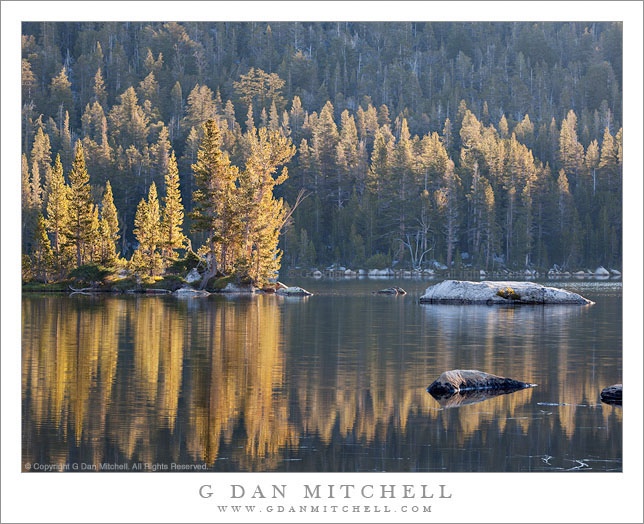
Alpenglow, Trees, and Granite

Alpenglow, Trees, and Granite
“Alpenglow, Trees, and Granite” — Alpenglow light on trees among granite boulders below glacially-carved Yosemite cliffs..

This is one of my favorite locations in the Yosemite back-country and, in fact, in the entire Sierra Nevada range. This beautiful sub-alpine basis contains three lovely lakes and is surrounded by varied terrain that includes distant views, peaks and ridges towering above, lodgepole pine forests, meadows small and large, and an open view to the west that often provides stunning light late in the day.

As is usually the case, I was camped at the of the three lakes – this time for several days of photography – and I had headed to the upper lake late in the day to do some evening photography. I have photographed there quite a few times, but I still haven’t come close to exhausting the photographic potential of the place. On this evening I knew that I wanted to be ready to photograph the golden hour light, but I was also interested in the smaller groups of trees that grow among the granite boulders and I wanted to see what might develop as alpenglow struck the glacial slopes above the lake.

There is a small, fun twist to the story of this visit. I took a semi-cross-country route to the upper lake from my camp at the lower lake, and because I knew that I’d be returning alone in deep twilight or after dark, on the hike up I was concentrating intensely on fixing a series of landmarks in my mind for the return hike. I was so single-minded about this that I made it all the way to the lake and my first intended subject (a small shoreline tree) without looking around much. It was only a moment after arriving that I got out of focus-on-the-route mode and looked around. I had walked right past the campsite of a couple of photographers without even seeing them, much less saying “hi.” Turns out that the photographers were John Sexton and Anne Larsen. After exchanging greetings and conversation, I went about my business of shooting along the edge of the lake. (If I recall correctly, John was shooting nearby as I made this exposure.)


COMMENT OR QUESTION? Scroll down to the comment form.

G Dan Mitchell is a California photographer and visual opportunist. His book, “California’s Fall Color: A Photographer’s Guide to Autumn in the Sierra” (Heyday Books) is available directly from him. Blog | Bluesky | Mastodon | Substack Notes | Flickr | Email

All media © Copyright G Dan Mitchell and others.