I will have more to say about this video and its context in a later post (though see below for a bit more information), but I wanted to share this Scot Miller video about the band of photographers known informally as “The First Light Group” and my role in the group.
There’s a lot more to say about the First Light project, but for now here is a little background. In the early 2000s the group assembled, with support from the Yosemite Conservancy, and headed into the Sierra Nevada backcountry with a special mission: to place landscape photographers in the wilderness for extended periods of time to create photographs that embody the character of these remote places. Over a period of nearly two decades we photographed all over the range.
You can subscribe to Scot Miller’s YouTube channel, where you’ll find more First Light videos and plenty of other material from him.
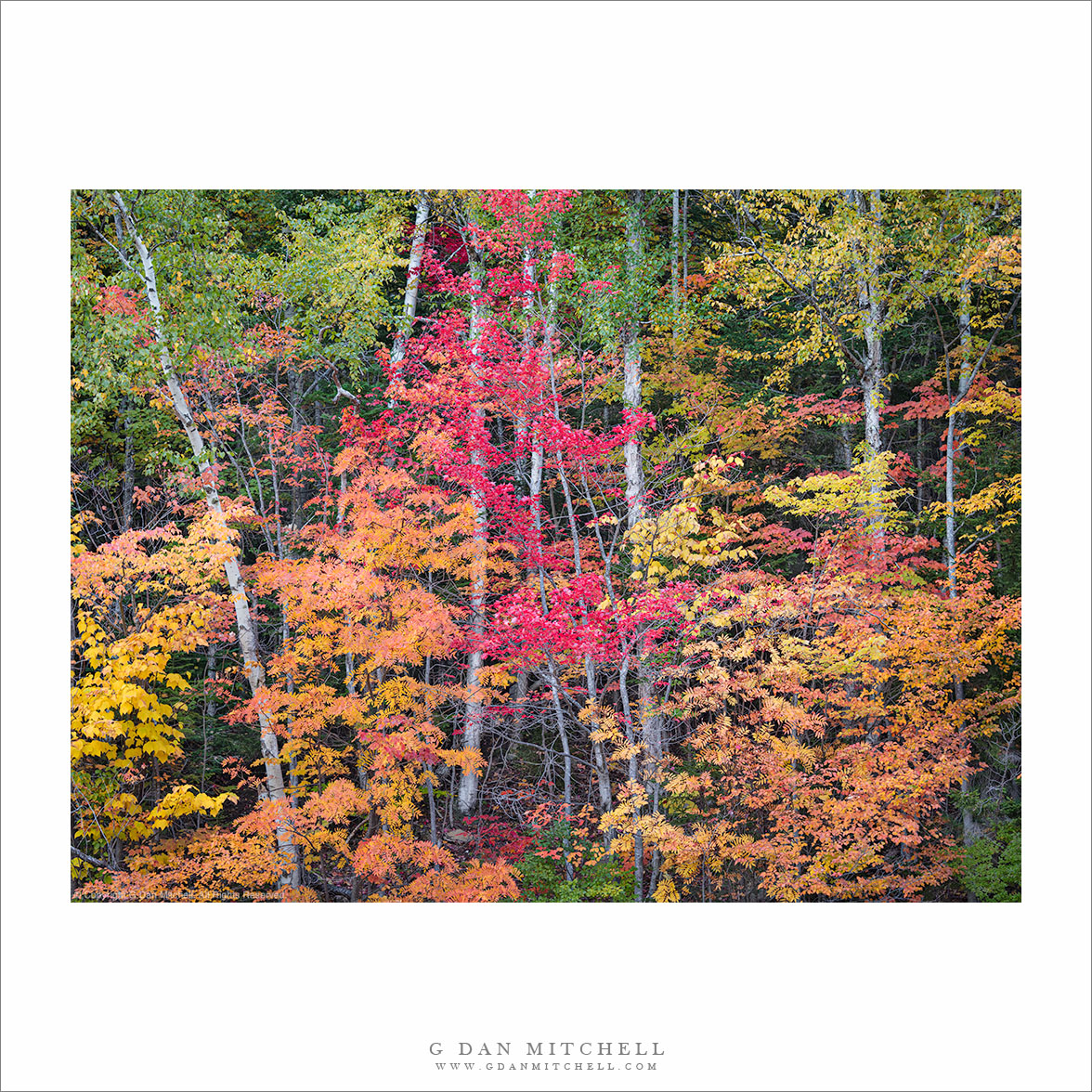
“Forest Colors, Autumn” — Wildly colorful autumn trees in New England.
As a long time California fall color photographer — hey, I wrote a book on that! — I noticed a few significant differences when we photographed New England fall color. For one thing, wildly varied colors often appear in close proximity, as in this photograph. Another big difference is that the colors seem to go on forever, draped across entire mountain ranges almost without break. (In California they tend to be more localized and uniform.) Another difference? There are far more people there to see the colors! I thought that it got crowded at popular California spots on fall weekends, but it is nothing like what we saw in New England!
This photograph comes from one of those popular areas, the Kancamagus Parkway. This two-lane road crosses one of the more spectacular fall color areas, and people flock to it in huge numbers. But there is so much color everywhere that you can stop at almost any point and find something to photograph, especially if you like making compositions out of complex forest scenes.
G Dan Mitchell is a California photographer and visual opportunist. His book, “California’s Fall Color: A Photographer’s Guide to Autumn in the Sierra” is available from Heyday Books, Amazon, and directly from G Dan Mitchell.
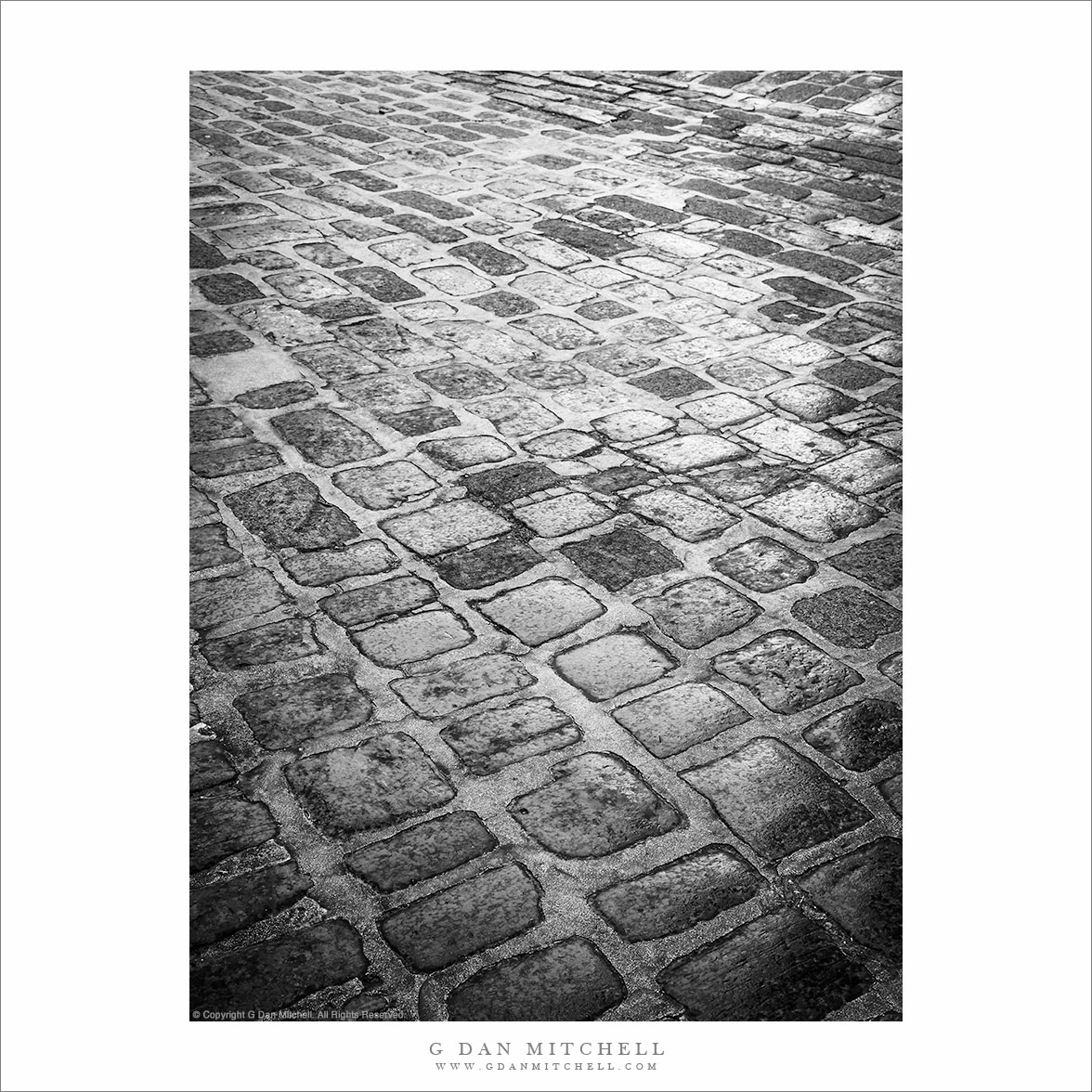
“Cobblestones in Rain, York” — Rain-slicked cobblestones in York, England.
The weather was rather varied during our brief early June stay in York, England. As I share photographs from the visit, you’ll see some made in lovely sun and others, like this, in more challenging weather. We were out for a wander on this day and clouds eventually turned to rain as we walked near the Yorkminster Church. As the light rain started — and before we decided to beat a retreat to a nearby restaurant for shelter and lunch — I paused to make this photograph of a cobbled street.
Photographs of particular places can suggest them to varying degrees. Clearly a photograph of a specific, iconic feature ties the image to the location with precision. Other photographs may work more subtly, perhaps capturing something of the mood of the place without shouting its name. And others may not be location-specific at all — like this one, which features a small scene that you could probably find on a rainy day in many places.
G Dan Mitchell is a California photographer and visual opportunist. His book, “California’s Fall Color: A Photographer’s Guide to Autumn in the Sierra” is available from Heyday Books, Amazon, and directly from G Dan Mitchell.
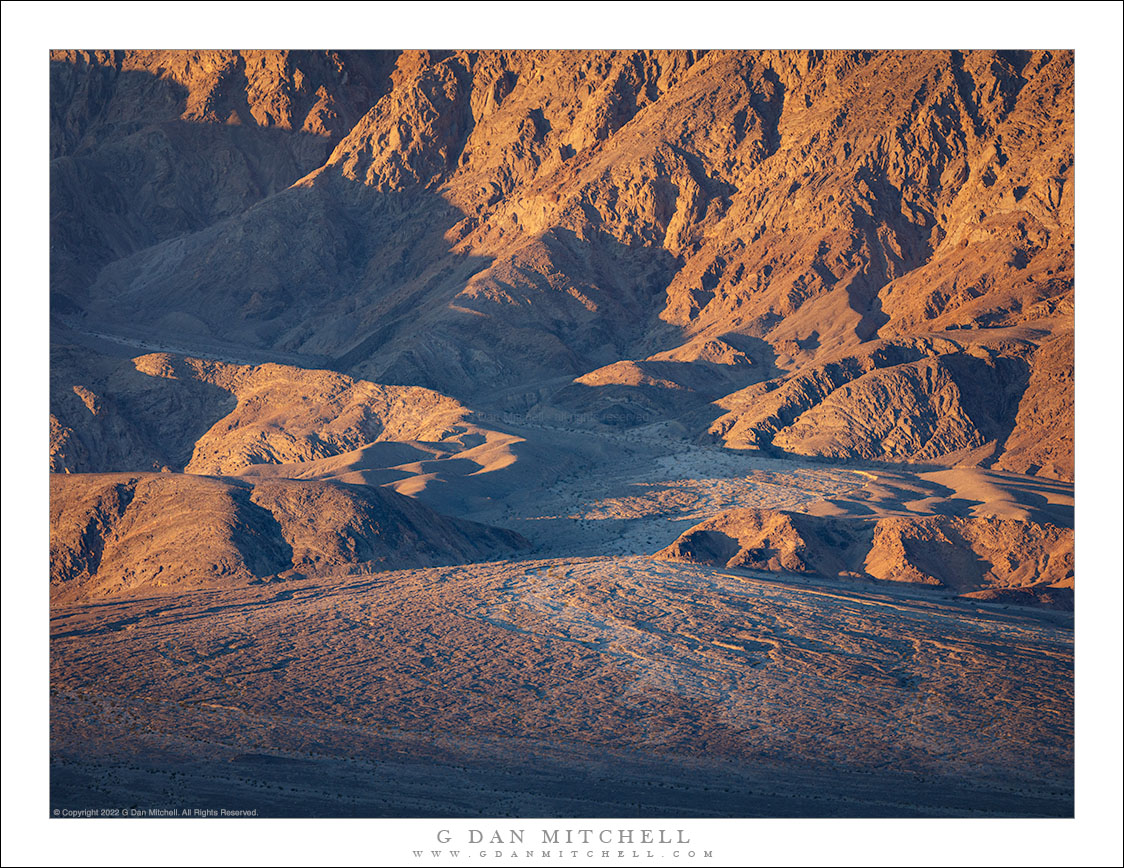
Morning light on a gigantic alluvial fan at the base of desert mountains, Death Valley National Park.
This morning I am waking up in a place that is almost literally on the other side of the world from my “home country” of California. As I look out the window from a home in Kosovo toward high mountains at the start the day I am thinking about the storm impacting my state today, and the deserts regions such as Death Valley are especially on my mind as I read reports of tropical storm Hilary.
Our natural impression of places like Death Valley National Park (the part of California’s desert terrain that I know best) is of dryness, heat, aridity… of places where little grows and where challenges human visitors. It isn’t quite that simple, but there is truth to this. Our biggest concerns in such places are often the heat and the scarcity of water.
But I have long been impressed by the fact that there are few locations where the impact of water is more clearly visible than in the desert, especially in the rugged terrain of places like Death Valley. The valley was once a lake. Remnant water from that lake still appears and flows there. The tremendous mountains on either side of the valley were eroded and formed by water, and monumental alluvial fans flow out of side canyons everywhere. Deep watercourses cut through rock, and a close look at stones reveals that they were moved by water.
Even when we recognize the landscape-forming power of water, we still think of the landscape as now being static — formed by forces that worked in the past but now have left a stable geography. A few rocks fall, occasionally a wash overflows and takes out a small section of a road, a playa may fill temporarily with water… but soon everything is back to “normal” as it was.
But this morning it sounds like we may experience much more profound changes as Hilary sweeps though, the sort that occur at intervals measured centuries. Those of us who love this landscape may find our access cut off and that much changes after this storm. I’m both excited by and fearful of these effects — but in any case this is a powerful reminder of the scale of the forces at work in these places we love.
G Dan Mitchell is a California photographer and visual opportunist. His book, “California’s Fall Color: A Photographer’s Guide to Autumn in the Sierra” is available from Heyday Books, Amazon, and directly from G Dan Mitchell.
Photographer and visual opportunist. Daily photos since 2005, plus articles, reviews, news, and ideas.
Manage Consent
To provide the best experiences, we use technologies like cookies to store and/or access device information. Consenting to these technologies will allow us to process data such as browsing behavior or unique IDs on this site. Not consenting or withdrawing consent, may adversely affect certain features and functions.
Functional
Always active
The technical storage or access is strictly necessary for the legitimate purpose of enabling the use of a specific service explicitly requested by the subscriber or user, or for the sole purpose of carrying out the transmission of a communication over an electronic communications network.
Preferences
The technical storage or access is necessary for the legitimate purpose of storing preferences that are not requested by the subscriber or user.
Statistics
The technical storage or access that is used exclusively for statistical purposes.The technical storage or access that is used exclusively for anonymous statistical purposes. Without a subpoena, voluntary compliance on the part of your Internet Service Provider, or additional records from a third party, information stored or retrieved for this purpose alone cannot usually be used to identify you.
Marketing
The technical storage or access is required to create user profiles to send advertising, or to track the user on a website or across several websites for similar marketing purposes.