
Category Archives: Photographs: Nature

Winter Evening Sky, Panamint Range, Death Valley

Winter Evening Sky, Panamint Range, Death Valley

Winter Evening Sky, Panamint Range, Death Valley. Death Valley National Park, California. February 18, 2011. © Copyright G Dan Mitchell – all rights reserved.

Winter clouds fill the evening sky above the eastern slopes of the Panamint Range in Death Valley National Park.

After the long drive from the San Francisco Bay Area I arrived at Stovepipe Wells in Death Valley and set up my camp in the mid afternoon and hung out a bit, thinking about the prospects of late afternoon and evening shooting. Because a weather front was coming in (the forecast called for a chance of rain in the Valley and pretty much certain light snow over the passes) the clouds were increasing, in many directions heading past the point of “picturesque” and more towards “socked in.” I was hoping for some evening light – or early rain? – but it seemed less promising as evening approached. In circumstances like these I may come up with a few possible shooting alternatives ahead of time, watch as conditions develop, and make a last-minute decision about where to go based on observations and hunches.

So, late in the afternoon I stopped near Death Valley Dunes and worked to line up some long shots that filled the background of the dunes with the rugged shapes of the Grapevine Mountains, and then headed towards the junction with the road to Scotty’s Castle to try to figure out if the light held more promise to the north or the south. It didn’t look totally promising in either direction, but I thought that I might be able to make something out of the haze to the south as the ridges on both sides of the Valley receded, especially if a bit of glow in the sky turned up right at sunset. So, south it was.

I drove just a little ways in that direction to a point where the road curves a bit towards the east to travel around the northernmost area of salt flats in what I think of as the lower valley – this is the area a bit south of the Salt Creek cutoff. From here there is a fairly open view all the way down to the end of the Valley, and it looked like the clouds were going to evolve in some interesting ways. It didn’t look like I would see a gaudy, brilliantly colorful sunset, but something more subtle and quiet looked like it might happen. As the light began to fade I made a series of photographs whose subject was largely the sky and the atmospheric recession along the Panamint Range (shown here) on the west side of the Valley and the mountains just beyond Furnace Creek.

G Dan Mitchell Photography | Flickr | Twitter | Facebook | Email
Text, photographs, and other media are © Copyright G Dan Mitchell (or others when indicated) and are not in the public domain and may not be used on websites, blogs, or in other media without advance permission from G Dan Mitchell.

Death Valley, the Panamint Range and Zabriskie Badlands

Death Valley, the Panamint Range and Zabriskie Badlands

Death Valley, the Panamint Range and Zabriskie Badlands. Death Valley National Park, California. February 20, 2011. © Copyright G Dan Mitchell – all rights reserved.

Morning light on the badlands of Zabriskie Point, Death Valley, and the Panamint Range – Death Valley National Park, California.

I just returned from a four-day shoot in Death Valley in rather “interesting” conditions for the most part. While it isn’t supposed to be as hot in Death Valley at this time of year as it will be later on, it was a bit more wintry than one might usually expect – nothing out of the realm of the ordinary, but in many ways closer to one of the sharp points at the end of the bell curve. On the first two nights it snowed in the peaks around the valley, perhaps down to 4000′ of elevation or even a bit lower. And it was cold even during the day when I drove up into the surrounding ranges – I experienced quite a bit of weather in the low thirties and drove through some light snow on several occasions.

The weather is part of the story behind this photograph, and it is also one of several I made on this trip that reminded me how important serendipity is in landscape photography. I don’t mean to imply that planning doesn’t matter, or that if you just make enough photographs that eventually you’ll get lucky. What I mean is that there are so many variables at work in the living landscape that a photographer would have to be semi-deluded to think that we can actually be successful purely on the basis of careful planning. (OK, I’ll accept the notion of “preparing for serendipity.”) As prepared as we can be, once “out there” in the landscape there are so many unpredictable and uncontrollable elements that an important part of what we do, I think, is to take advantage of fleeting opportunities before they pass – a combination of being aware of them when they occur, being technically and otherwise ready to work with them, and then acting quickly and relatively intuitively.

The story on this morning is roughly as follows. I woke up well before dawn with a general plan of taking a look at what I could see of the weather in complete darkness and then picking from one of several morning possibilities that I had thought about then night before. I got up and drove a ways to where I had a broad view of the Valley in both the north and south direction and tried to figure out what might happen. It was quite cloudy – it had rained and snowed a bit overnight and the precipitation wasn’t over with yet. It look a little lighter to the south, so I thought that I’d see what was happening up at Dantes View, where a grand vista of Death Valley is available in clear weather. I had this image of a dusting of snow on the peak as the sun broke through the clouds at dawn to reveal panoramic views.

Reality didn’t quite cooperate. I drove out on the road to Dantes View and it wasn’t getting any clearer. In fact, the peaks were still quite socked in. As I got closer it began to snow, and before long it was cold enough that the snow on the road was sticking. I soon arrived at the last section of the climb, which claims to feature 15% grades, and thought better of driving up this slick road… in falling snow… and into thick clouds. The odds of sunrise light were essentially zero. So I turned around with a vague idea of heading down the way I had come until I found some light. A couple miles down things cleared enough that I could get some shots of distant snow covered ridges in morning light, and a bit further on I was able to make a stitched panorama of the Valley.

I kept going. I had vowed that I would not go near Zabriskie Point on this trip unless something really interesting or unusual happened, but I stopped in the parking lot when I reached it just to take a look around. It was past the standard and popular dawn light period (not that there had been any!) and most photographers were leaving as I arrived. But I’ve shot here before enough to know that sometimes interesting stuff happens later, and I thought that the cloud shadows on the Panamints across the Valley looked like they were starting to thin. I wanted to photograph one particular wash on the Panamints, but it was obscured by intervening hills so I wandered a bit to the north looking for a better view of the spot. I finally found it and had a long lens focused on a tight shot of this area when all of a sudden shafts of light came through the clouds and lit up the folds in the gully right below me just as the first light was hitting the flats on the far side of the Valley. I quickly moved to a shorter focal length and recomposed to include this gully, and made this photograph in the minute or so of this light.

If I claimed that this is the shot I planned to produce when I started out early on this morning… I would be lying.

G Dan Mitchell Photography | Flickr | Twitter | Facebook | Email
Text, photographs, and other media are © Copyright G Dan Mitchell (or others when indicated) and are not in the public domain and may not be used on websites, blogs, or in other media without advance permission from G Dan Mitchell.
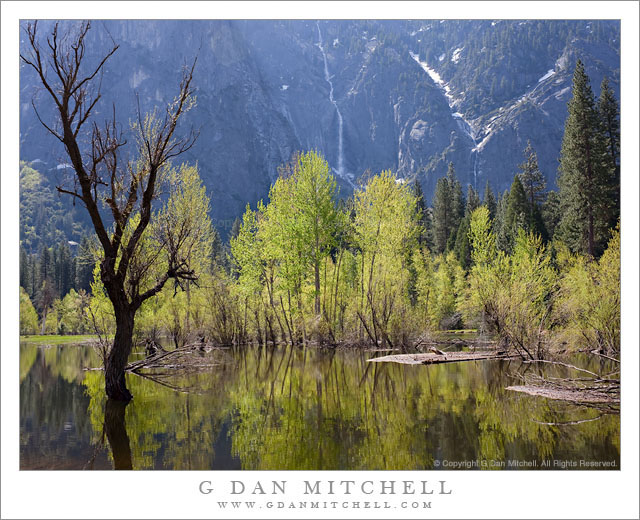
Tioga Lake, Late Spring

Tioga Lake, Late Spring

Tioga Lake, Late Spring. Near Yosemite National Park, California. June 5, 2010. © Copyright G Dan Mitchell – all rights reserved.

Late spring at icebound Tioga Lake below Tioga Pass with Mammoth Peak and the Kuna Crest beyond in afternoon light.

I made and shared a slightly different photograph of this scene last summer, but when I did my annual end-of-year traverse of the year’s raw files I returned to the original set of images and wondered how I missed this one. In a lot of ways it is similar to the one I selected earlier, though the foreground light and shadow patterns are a bit different and, more importantly, I like the position of the clouds in this one more than what I had in the original. So, there are now two versions of this scene floating around…

After several fairly dry years in California, the winter of 2009-10 produced much more precipitation, as rain in the lowlands and as snowpack in the Sierra. Because of the heavier snow, Tioga Pass opened just a bit later than average, and when it opened there was still a lot of snow in the high country. Since this afforded a rare chance to cross the Yosemite Sierra in conditions not usually seen by drivers I made it a point to get up there as soon as the road opened.

On the drive there was snow along almost the entire length of Tioga Pass Road, and in many places it looked more like winter than like spring. At the same time, it was spring, and the melting of the snowpack was fully underway. While lakes like Tioga Lake, as seen in this photograph, were still ice-covered… the ice was thinning quickly, and everywhere the melting snow was creating creeks and cascades. The high country, especially at the elevation of the road, was filling with water – water in ponds, water in overflowing lakes, water in rivers, water in cascades and waterfalls. I was waterfalls along the road in places where I had not even suspected that there were creeks!

This photograph shows Tioga Lake, just east of and below Tioga Pass, the eastern entrance to Yosemite. The pass itself is in the low saddle just above the meadow ascending the hill at the end of the lake. Beyond, and inside the park, is massive Kuna Crest with white, snow-capped Mammoth Peak in full sun at the right end of the ridge.

G Dan Mitchell Photography | Flickr | Twitter | Facebook | Email
Text, photographs, and other media are © Copyright G Dan Mitchell (or others when indicated) and are not in the public domain and may not be used on websites, blogs, or in other media without advance permission from G Dan Mitchell.

Cascade, Reflected Sunlight

Cascade, Reflected Sunlight

Cascade, Reflected Sunlight. Yosemite National Park, California. June 28, 2010. © Copyright G Dan Mitchell – all rights reserved.

Sunlight reflects on granite ledges next to cascades on Tenaya Creek.

In this iteration of the “blurry-fast-moving-water-in-Sierra-creek” photograph, I was looking to cram a variety of elements into the frame – as you can see, the entire photograph is not filled with water. There is a transition from white water with flashes of sunlit light at the tops of the waves, through the water with smaller areas of foam, to water reflecting the golden late afternoon light from a cliff face on the other side of the creek, to some bits of streamside granite slabs along the lower right edge of the frame. To me, these areas of shallow water and wet rock reflecting more distant light almost have a molten quality.

One of the trickiest things about this photograph for me was dealing with the strong contrast between very blue tones in the shaded parts of the water and the very warm tones of the reflections. As every photographer knows, the light in shade can be very blue, especially when the subject is supposed to be white and is lit almost entirely by the blue sky, as is the case in parts of the turbulent water. Adjustments are necessary in order to make it look realistic and conform with the colors that our eyes tell are are there. (Our vision system is remarkable… but it is not objectively accurate!) But adjustments to the blue water, if applied to the warm tones of the reflecting granite, can end up looking bizarre and overdone in the opposite direction!

G Dan Mitchell Photography | Flickr | Twitter | Facebook | Email
Text, photographs, and other media are © Copyright G Dan Mitchell (or others when indicated) and are not in the public domain and may not be used on websites, blogs, or in other media without advance permission from G Dan Mitchell.