
Category Archives: Photographs: Southern California

Organic Landscape

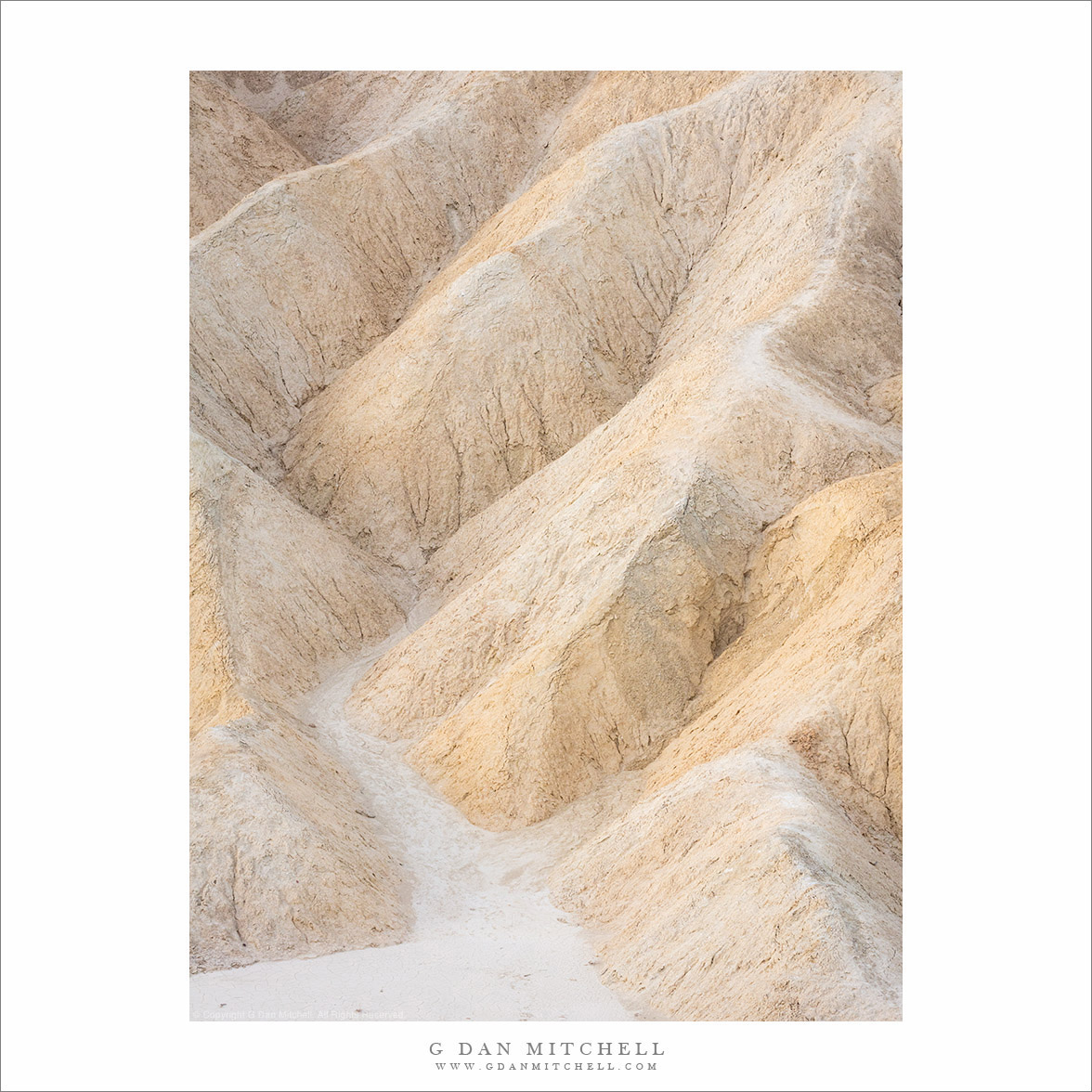
Organic Landscape, Death Valley
“Organic Landscape” — Erosion patterns in a desert landscape, Death Valley.

Believe it or not, I am getting to the end of the photographs I made on this year’s winter visit to Death Valley National Park. I go every year during the cool months, sometimes more than once. When I returned at the end ofFebruary I wasn’t sure if I had gotten many keepers, but since then I have managed to find more than a few. This is a typical situation — I often don’t immediately see the potential in image files, and it takes a while to get to know them.

This photograph includes a small section with details of a portion of Death Valley “badlands” terrain. I photographed it in the early morning, before the direct sunlight arrived. The soft light and the curving shapes remind me of forms we see in living things, hence the “organic” title.

G Dan Mitchell is a California photographer and visual opportunist. His book, “California’s Fall Color: A Photographer’s Guide to Autumn in the Sierra” (Heyday Books) is available directly from him. Blog | Bluesky | Mastodon | Substack Notes | Flickr | Email

Join the discussion — you are welcome to leave a comment or question. (Comments are moderated and may not appear immediately.)

This site uses Akismet to reduce spam. Learn how your comment data is processed.

(All media © Copyright G Dan Mitchell and others.)
Reflected First Light, Panamint Mountains

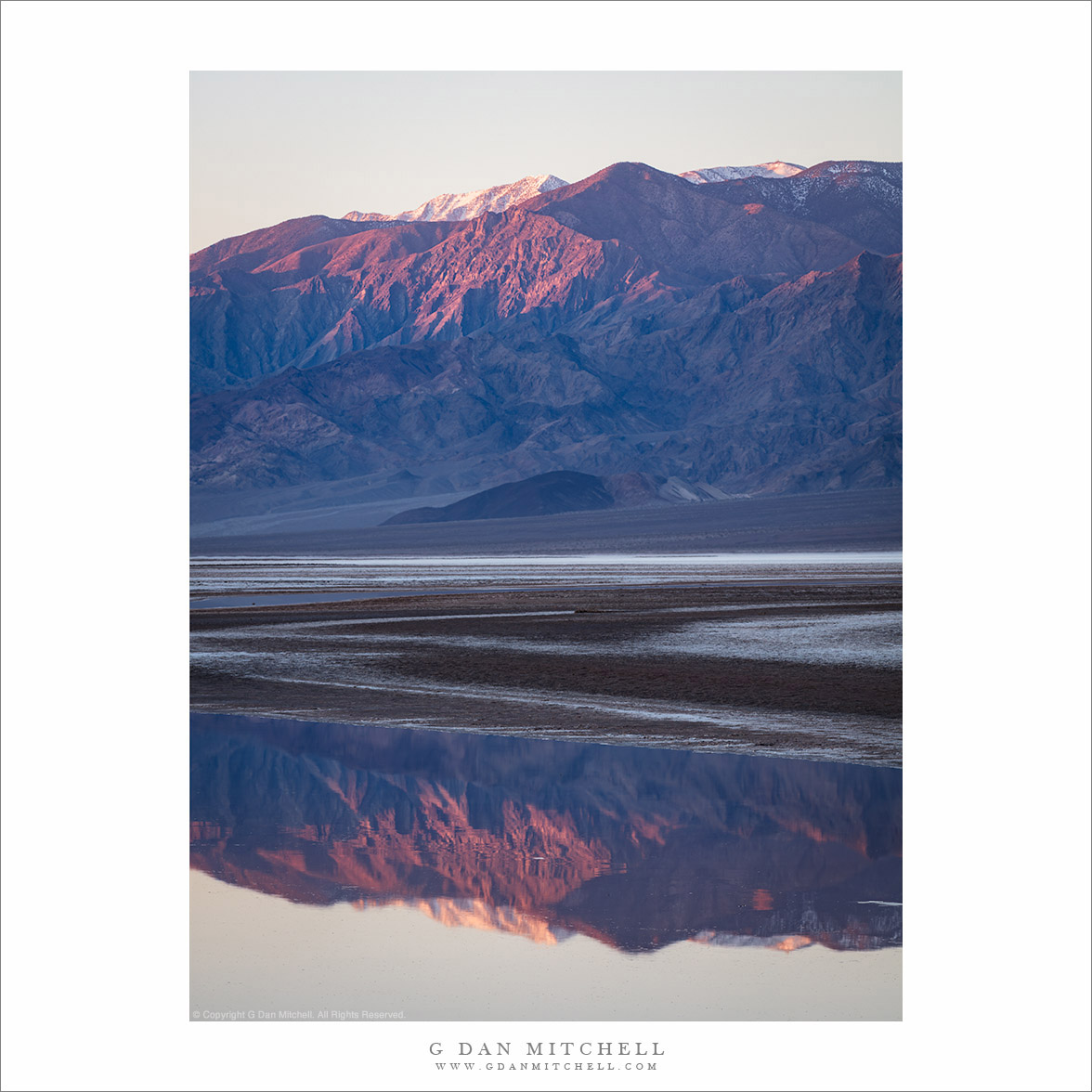
Reflected First Light, Panamint Mountains
“Reflected First Light, Panamint Mountains” — Shallow salt flat water reflects the first light on the Panamint Mountains.

During my late-February visit to Death Valley National Park, I spent two early mornings photographing the Panamint Mountains in the first light, with the salt flats and shallow water in the foreground. The water is not the ephemeral “Lake Manly” phenomenon that we saw in 2024. This is a slow, shallow flow of water that seems to continue all year, regardless of conditions. It is just enough water to produce these reflections.

These days I photograph almost exclusively with a full frame digital system. (Sometimes I use a smaller APS-C system, often for my street and travel photography.) I usually use a pretty straightforward set of lenses that work well for my landscape photography, but occasionally I bring out an adapted medium format zoom lens and mount it using the Mirex tilt/shift adapter — yes, movements with a zoom lens! That was pretty useful for this photograph given the low light and the extreme distance between the foreground and the distant mountains.

G Dan Mitchell is a California photographer and visual opportunist. His book, “California’s Fall Color: A Photographer’s Guide to Autumn in the Sierra” (Heyday Books) is available directly from him. Blog | Bluesky | Mastodon | Substack Notes | Flickr | Email

Join the discussion — you are welcome to leave a comment or question. (Comments are moderated and may not appear immediately.)

This site uses Akismet to reduce spam. Learn how your comment data is processed.

(All media © Copyright G Dan Mitchell and others.)

Desert Holly, Dry Wash

Desert Holly, Dry Wash, Death Valley
“Desert Holly, Dry Wash” — A desert holly plant, either dead or dormant, in the middle of a dry wash, Death Valley.

Desert Holly must be one of the must adapted and tenacious plans in Death Valley National Park. It grows in some of the least likely spots — places where there is barely any soil, where the sun bakes the land, and where water is rare. Desert Holly plants can occasionally put out a beautiful cover of pale green leaves, but more often the plant looks dormant or dead, with many dead leaves and very dry branches.

This specimen grew in a desert wash, where water occasionally passes through this very dry area. It has to rely on fairly rare flows of water. Plants grow in much of Death Valley, but few do in this location. While a few further up the wash had green foliage, I saw only dry, desiccated leaves on this one.

G Dan Mitchell is a California photographer and visual opportunist. His book, “California’s Fall Color: A Photographer’s Guide to Autumn in the Sierra” (Heyday Books) is available directly from him. Blog | Bluesky | Mastodon | Substack Notes | Flickr | Email

Join the discussion — you are welcome to leave a comment or question. (Comments are moderated and may not appear immediately.)

This site uses Akismet to reduce spam. Learn how your comment data is processed.

(All media © Copyright G Dan Mitchell and others.)
Base of the Red Cliffs

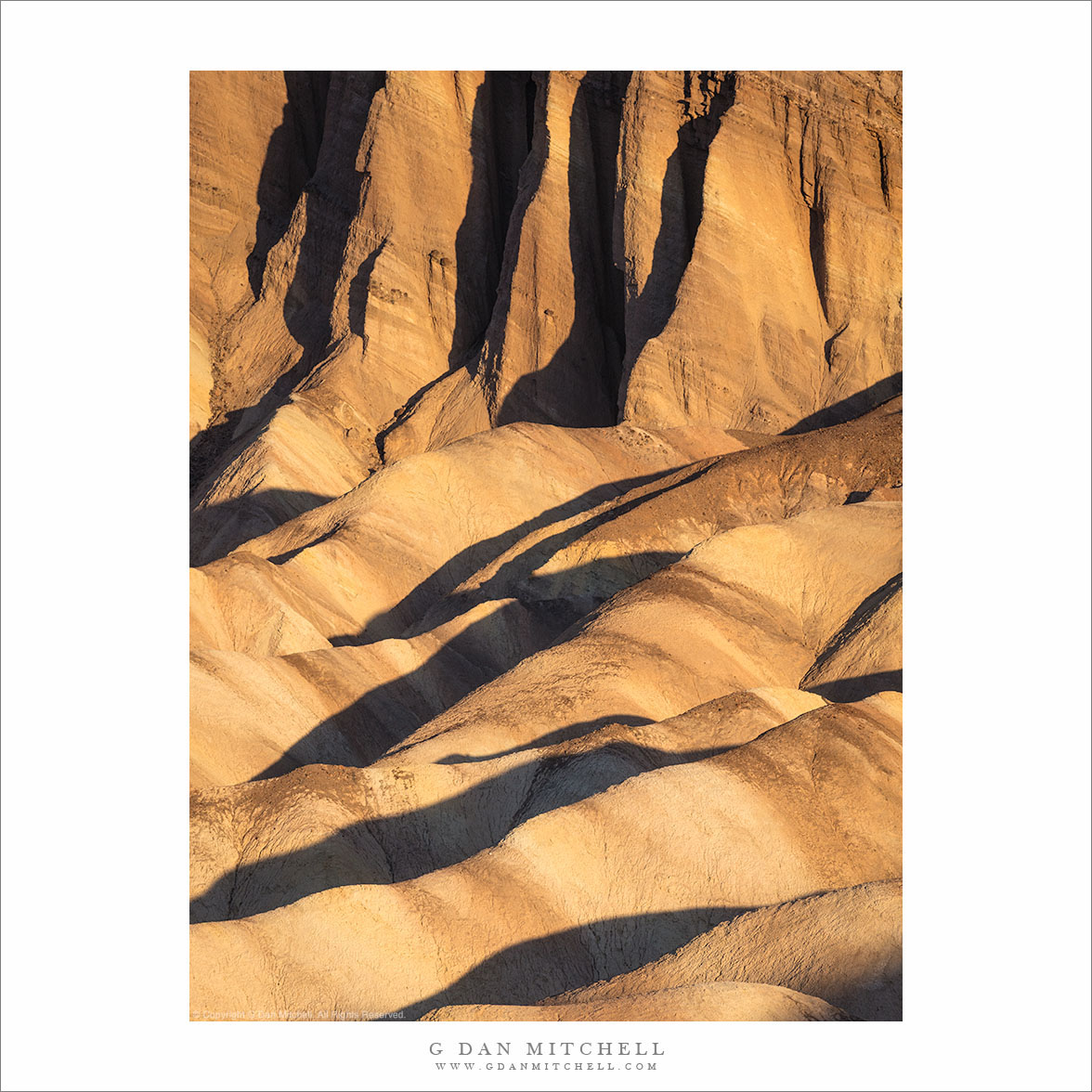
Base of the Red Cliffs. Death Valley
“Base of the Red Cliffs” — Gullies, folds, strata, and morning shadows at the base of the Red Cliffs.

The title says “Red Cliffs,” but you might be thinking, “They don’t look very red to me!” In more neutral light the formations in the upper part of the photograph, and even more so the formations above the margins of the photograph, do have the familiar red rock quality — though it would be fair to say that they are as much brown as red. But in this stark early morning light, just after sunrise, the colors are warmed so much that they are more yellow or orange.

In many ways the geology of Death Valley produces a blank canvas for photographers who want to work with varied light. For the most part, Death Valley’s colors are subtle. The lighter portions of the formations in this photograph are a sort of muted tan in midday light. But as with so many other subjects here, this muted, neutral quality allows them to pick up the colors of sunrise/sunset, twilight, colorful clouds, and reflections from nearby formations.

G Dan Mitchell is a California photographer and visual opportunist. His book, “California’s Fall Color: A Photographer’s Guide to Autumn in the Sierra” (Heyday Books) is available directly from him. Blog | Bluesky | Mastodon | Substack Notes | Flickr | Email

Join the discussion — you are welcome to leave a comment or question. (Comments are moderated and may not appear immediately.)

This site uses Akismet to reduce spam. Learn how your comment data is processed.

(All media © Copyright G Dan Mitchell and others.)