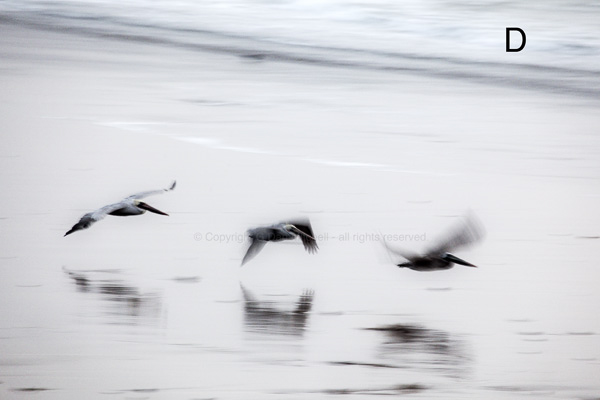
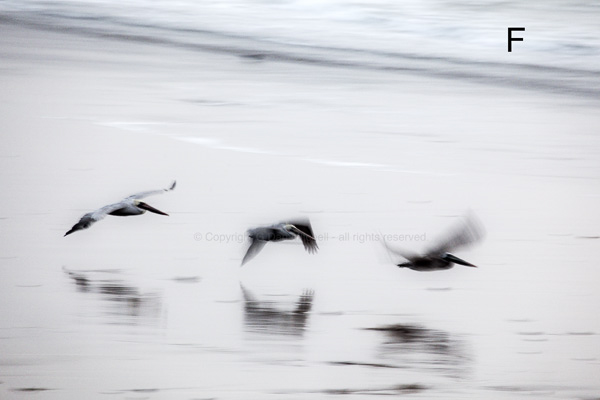
Evening cloud forms above the Pacific Ocean coastline near Davenport, California.
This is the second of a pair of abstract images of evening clouds that I photographed earlier this week along the California coastline north of Davenport. The photographs were shot with fairly long focal lengths and then converted to black and white in post, where additional modifications to the original images were also made.
This photograph is not in the public domain and may not be used on websites, blogs, or in other media without advance permission from G Dan Mitchell.
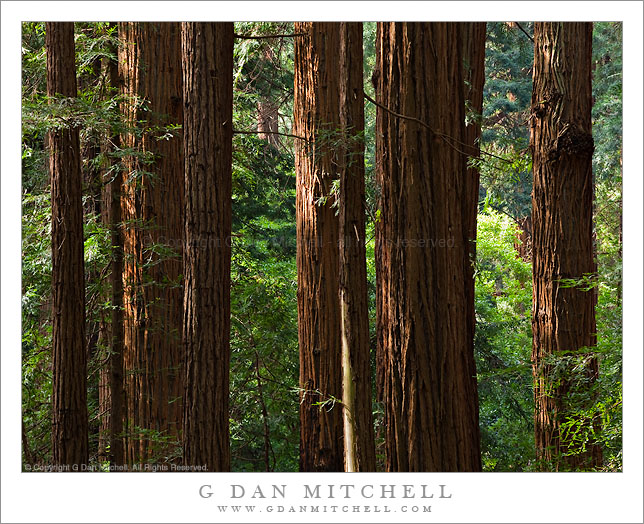
Morning light slants though the trunks of tall redwood trees near Bohemian Grove, Muir Woods National Monument, California.
I was surprised by somewhat sunny conditions on this mid-April visit to Muir Woods National Monument north of San Francisco, California. When I left my home in the South Bay very early in the morning it was quite cloudy, and the forecast was for even cloudier (and more persistently cloudy) conditions north of the Golden Gate Bridge. But as I drove through the City the clouds cleared to the north and by the time I was across the Golden Gate it was almost clear, with just a bit of nice high cloudiness to diffuse the light a bit.
I arrived at Muir Woods early enough that I got a parking spot in the closest lot. (Those who visit the place often and who are familiar with the crush of tourists later in the day understand what this means… ;-) As I usually do, I wanders slowly up the trail alongside Redwood Creek, taking in as much of the scene (visual, auditory, olfactory, etc.) as I looked for photographs. Eventually I made it to the bridge (Bridge #2) that crosses the creek just above the old Bohemian Grove. This is a spot where I often photograph if the crowds aren’t too bad – there is a lot to see right here! There are some deciduous trees whose leaves can catch the filtered light in interesting ways; the creek flows through, in places with ferns right down to the waterline; and there are lots of very tall redwood trees. I’ve been working on some photographs in landscape orientation that show groups for the trees, focusing primarily on their massive and parallel trunks – in fact, one from the series on this visit consists of a stitch of something like five horizontal frames. This one is more conventional and is a single exposure.
This photograph is not in the public domain and may not be used on websites, blogs, or in other media without advance permission from G Dan Mitchell.
Detail of kelp and other debris (“wrack”) washed up by winter storms at Weston Beach, Point Lobos State Reserve, California.
Perhaps putting more trust in the words of the weatherman than was appropriate, I slept in on this morning, having heard the night before that it was going to rain. But when I got up the sun was shining, and I realized that I should have been out shooting! After taking care of a few morning chores, I managed to get away and drive down to the coast. I didn’t have a specific plan besides “the coast,” but as I drove I kept an eye on the sky since the weather from was starting to come ashore and high clouds were beginning to diffuse the light.
As I got near Monterey I figured I might as well take a look at Point Lobos, even though it seemed like the clouds might be starting to build along the coast – I figured that if it turned out to be too cloudy there I could just come back by way of Moss Landing. At Point Lobos the seas were fairly high and very choppy and the high clouds still hadn’t thickened so much as to cut off the light – although at times it got a bit murky, in between there was soft light diffused by high, translucent clouds. I started shooting the more distant landscapes from low bluffs near Weston Beach, working in the wind and the spray from the high surf. After doing this for a while I decided that I’d head a bit south before the time for my short visit ran out. As I walked around the curve of the edge of Weston Beach (which still seems to me like it really should be called Weston Cove – there isn’t much of a “beach” there at all) I saw that a lot of seaweed and kelp debris had been washed up by earlier high surf, and I decided to wander around there for a bit looking for interesting compositions that included the sandstone rocks and the kelp.
This photograph is not in the public domain and may not be used on websites, blogs, or in other media without advance permission from G Dan Mitchell.
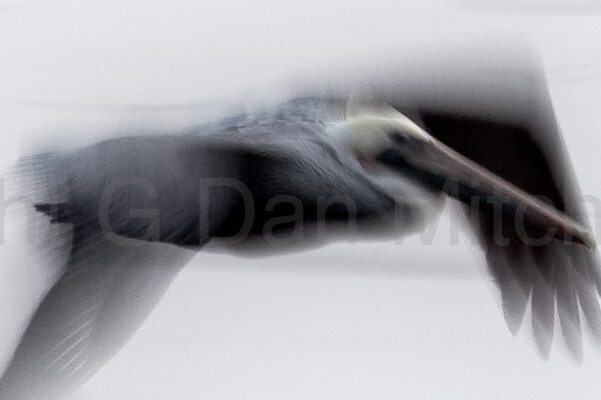
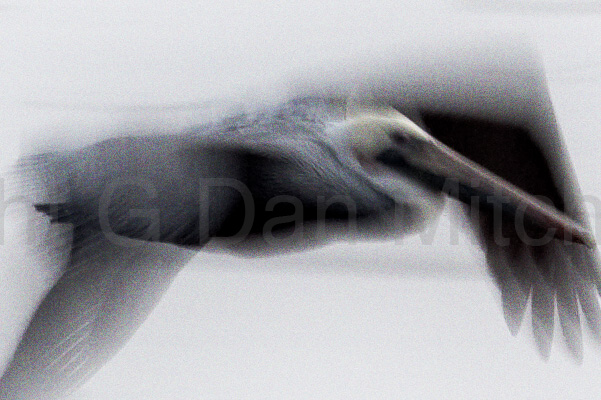
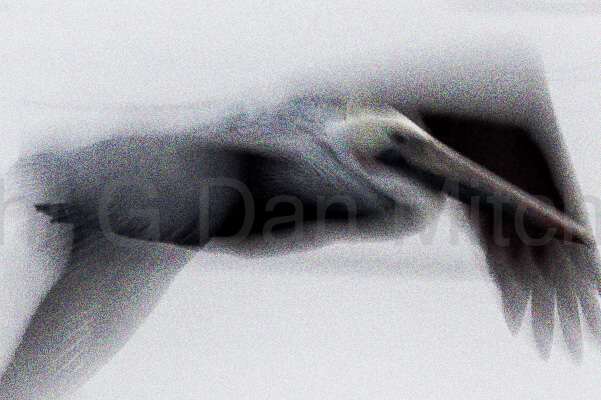
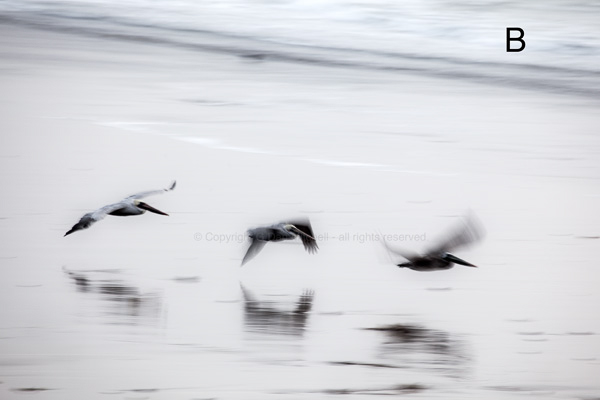
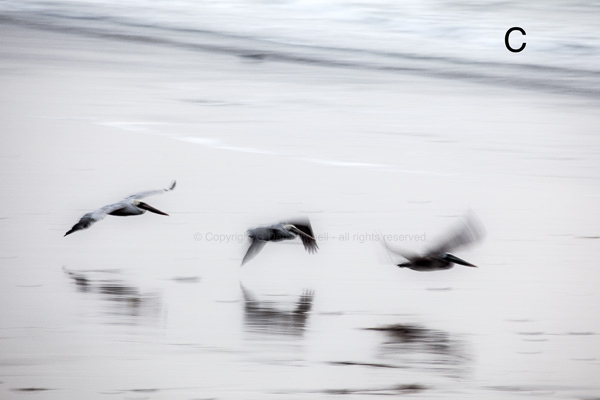
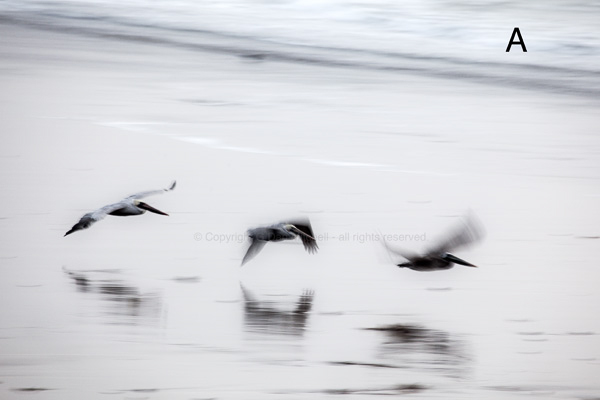
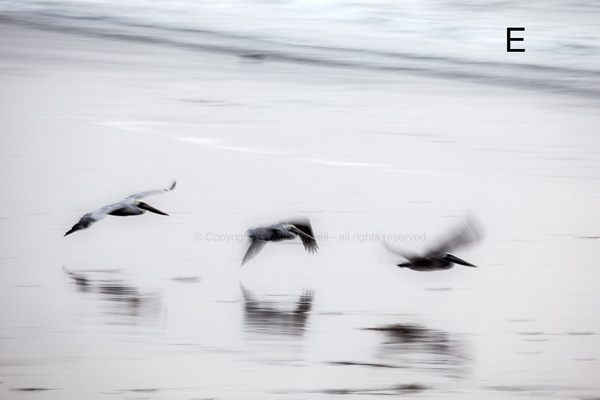
Yesterday I posted “Experiment #2: What do you see?,” in which I shared six image files comprised of three identical pairs of images and asked volunteers a) whether they saw any differences among them when viewed in their web browsers, b) to describe any differences that they noticed, and c) to try to identify the pairs of identical images. As describe in the original post, all of the images came from the very same source file – e.g from a single exposure – and were processed identically with the exception of one variable that was not identified.
Here are the 100% magnification crops from the three source images:
The differences among them are obviously in the amount of noise that was added to the image. No noise was added to the first image – any noise there was in the original capture. 10% level “Uniform” noise was added to the second image in Photoshop. 20% “Uniform” noise was added to the third image in the same way.
While I could have varied camera ISO to produce actual camera-generated noise, doing so would have also produced other variations in the images that would have given secondary and possibly misleading cues as to the differences between images. This most certainly would have affected part c) of “the question” as outlined above. While recognizing that noise added in post is not going to be exactly the same as noise produced in camera, I did try to ensure that the noise would at least be of a type and level that would clearly cause concern if the camera did produce it.
The soft photograph was chosen to avoid masking the noise with a lot of other sharp detail – this image provides very smooth gradients from black to white, where noise is typically easier to detect. I also chose this image because it is nearly – but not quite – monochromatic. This meant that I could increase the effect of the noise by using color noise rather than limiting to monochromatic noise – and that the color noise would tend to be more visible against the nearly monochromatic background.
While quite a few folks reported that they didn’t see any difference among the image when viewed in their web browsers – and, frankly, this did not surprise me – some did report noting differences. Test subjects have been known to both correctly identify real differences… and to think they have seen real differences where none existed. With that possibility in mind, I was interested to see how accurate the “perceptions of difference” might be, hence the challenge to find the pairs of identical images. The idea here is that if one can really see differences between images that one should then be able to categorize the images accurately based on those differences. I won’t comment here on whether any individuals were right or wrong, but here are the six images grouped as identical pairs.
No noise added:
10% noise added:
20% noise added:
A good number of readers asked, “What is the point?” A few even were upset at a test of something they regard as settled – e.g. that noise and other small artifacts become imperceptible when a large image is reduced to typical web sizes. (In this case each pixel in the jpgs is the average of close to 100 pixels in the original file.) However, I can say for sure that this issue is not resolved in the minds of all photographers nor in the minds of many who are making purchase decisions about cameras for themselves or for others.
My thesis was essentially that very significant amounts of noise that would be clearly visible in large original files at 100% magnification will be indistinguishable from files that have far less noise but are otherwise identical when the files are reduced for typical web site use.
A direct “point” might simply be that if you reduce 21MP full frame photographs containing large amounts of noise to 600 pixel width high quality jpg files viewers of the images on the web seem unable to reliably notice the differences in noise levels. You could reasonably extrapolate from this that if your main reason for shooting photographs is to share them on the web, noise levels in the camera may not be an important decision point for you as you shop. Though you cannot extrapolate the following directly from this test, I believe that shooters who mainly share jpg images or perhaps make letter-size prints will not see any significant image quality benefits from getting really high-end cameras. If noise levels as different as those found in this experiment cannot be discerned then the quite small differences in noise between two brands or models of camera are likely to be completely insignificant in images viewed online at typical dimensions. (If you make very large prints on a regular basis then your issues will be different.)
For my part, even though I created the images, I cannot reliably tell them apart by looking at them! When I look up my record of which image was treated which way I think I can see the difference, but I’m pretty certain that if I had to try to pair the identical images I would be unsuccessful. (Note: if you view the images one above other on this page you will think they are different due to viewing angle differences on your monitor. Go to the original post to see them displayed successively in the same location on the screen.)
(Experiment #1 tried something similar, though in that case the variable was the “sharpness” of the original image file.)
Photographer and visual opportunist. Daily photos since 2005, plus articles, reviews, news, and ideas.
Manage Consent
To provide the best experiences, we use technologies like cookies to store and/or access device information. Consenting to these technologies will allow us to process data such as browsing behavior or unique IDs on this site. Not consenting or withdrawing consent, may adversely affect certain features and functions.
Functional
Always active
The technical storage or access is strictly necessary for the legitimate purpose of enabling the use of a specific service explicitly requested by the subscriber or user, or for the sole purpose of carrying out the transmission of a communication over an electronic communications network.
Preferences
The technical storage or access is necessary for the legitimate purpose of storing preferences that are not requested by the subscriber or user.
Statistics
The technical storage or access that is used exclusively for statistical purposes.The technical storage or access that is used exclusively for anonymous statistical purposes. Without a subpoena, voluntary compliance on the part of your Internet Service Provider, or additional records from a third party, information stored or retrieved for this purpose alone cannot usually be used to identify you.
Marketing
The technical storage or access is required to create user profiles to send advertising, or to track the user on a website or across several websites for similar marketing purposes.