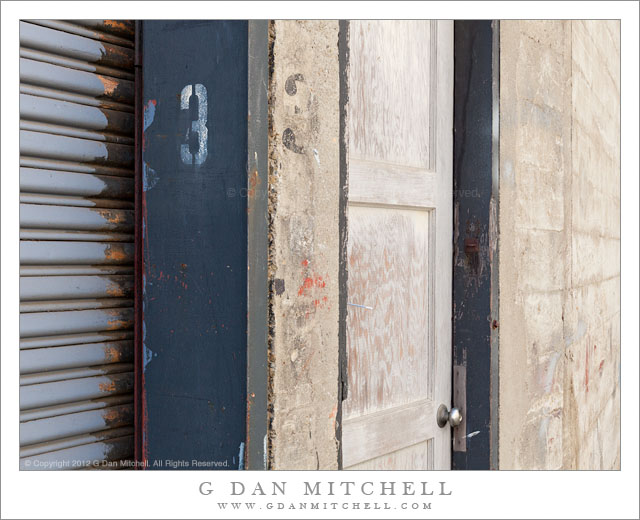
A loading dock door (#3) and a dilapidated and worn side door in a concrete wall, San Francisco.
There is not a whole lot to write about this photograph, except that it is another in a sequence of photographs that I made in a small alley off of the Embarcadero in San Francisco, an alley that extends between buildings toward the waterfront and which has often been locked up when I have walked by there previously. Since it and several similar alley ways were open on this morning, I took the opportunity to wander into them and photograph some of the old buildings that sit on these waterfront piers, focusing mostly on small details.
G Dan Mitchell is a California photographer whose subjects include the Pacific coast, redwood forests, central California oak/grasslands, the Sierra Nevada, California deserts, urban landscapes, night photography, and more. Blog | About | Flickr | Twitter | Facebook | Google+ | 500px.com | LinkedIn | Email
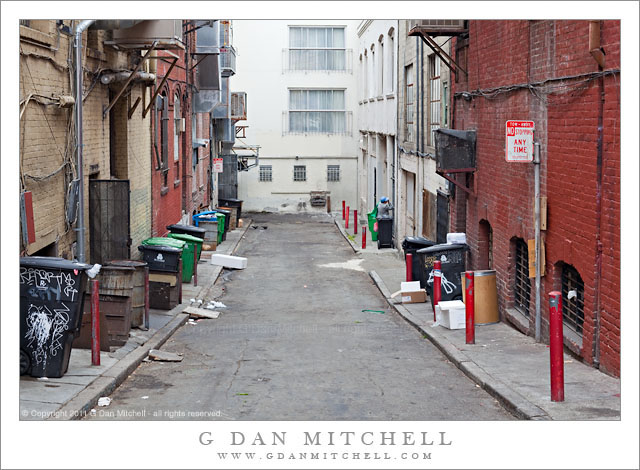
A nearly deserted Chinatown alley lined with trash cans, San Francisco.
On this mid-July morning as I walked from the Caltrain station to the Bay near North Beach, I passed through parts of San Francisco’s Chinatown district. I was there early enough that many of the shops on the short section of Grant Street that I visited were not open, and after making a few photographs there I headed west to Stockton Street where the real action is happening in the early morning. While I’m definitely the outsider here (most people seem to ignore me, though a few seem a bit amused by this guy with the camera), I enjoy visiting and photographing this area far more than the tourist zone down on Grant.
In the morning the place is intensely busy. Trucks line the street and disgorge boxes and boxes of produce and many people seem to be doing their shopping. Crowds line up at the bus stops, and every grocery store and market seems very busy. I don’t take too many photographs, most often focusing on architecture and colors. As I walked along the busy sidewalk and passed this side alley, several things caught my attention. First, unlike Stockton Street, it was almost deserted – a couple of people were walking down the alley and by the time I framed my photograph only one remained. (You’ll have to look closely.) While my first impression was that this was a dilapidated and messy place, upon further thought and observation it is actually very ordered. Considering the number of people in the area and that the alley is used at least partially for loading in and out of shops, there is actually very little litter. Small ramps have been set up in the gutter in a few places and the receptacles are lined up along the sidewalk. I wonder what the meaning is of the two pieces of cardboard stuck behind the pipes on the red wall at the right?
The light was also conducive to shooting here. On this typical San Francisco summer day – e.g. cold and windy and foggy! – the overcast softened the light and allowed it to fill the shadows and intensify some of the colors.
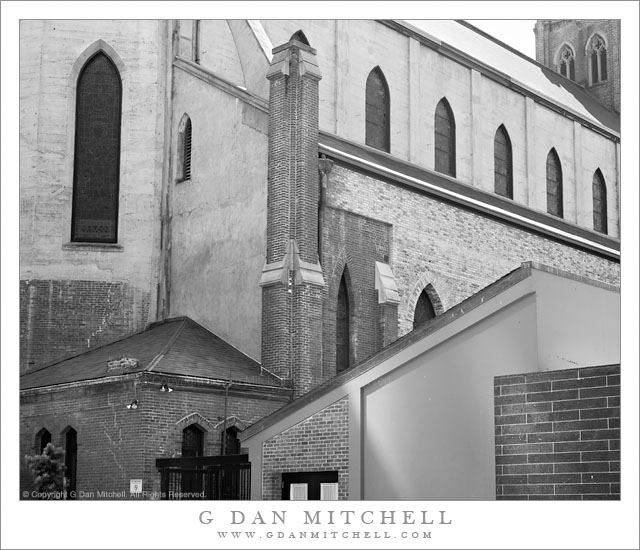
Black and white photograph of walls, windows, and roof lines of the side of Saint Patrick’s Church, San Francisco.
I don’t know the full history of this church in downtown San Francisco, but I do know that it is visually interesting. It has the appearance of an old cathedral, with the emphasis on old. Parts of the structure appear to be made of reinforced concrete, parts of brick, and a few sections of newer construction. Bits and pieces of all of that appear in this photograph, with some rather old and weathered materials in much of the structure, but with a much more modern-looking outbuilding at lower right.
While there is a large park (Yerba Buena Park) right across the street, much of the other surrounding architecture is quite modern for the most part. Most striking is the deep blue cubic structure of the Contemporary Jewish Museum right next door, but all around much taller and vastly more modern buildings are found. (Some of the light filling the shadows in this photograph is reflected from those buildings.)
I think that this photograph has a lot in common with a number of my photographs of mountains, especially the Sierra Nevada. In fact, I don’t think it is too hard to find parallels to some of the recent photographs of Mount Conness towering above the shorter Polly, Pywiack, and Medlicott Domes near Tenaya Lake along Tioga Pass Road.
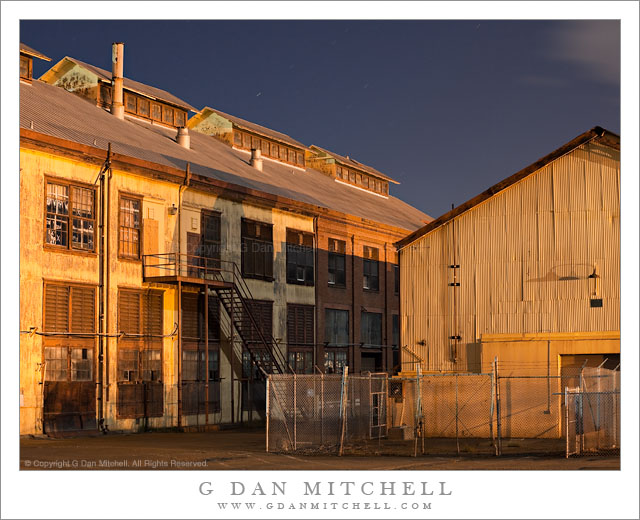
Night photograph of abandoned industrial buildings from the historic Mare Island Naval Ship Yard.
The building on the left is sometimes known as the “UFO Building” – not because of anything that might be stored inside, but because of a shadow in the shape of a “flying saucer” that forms on one of its walls. I thought it was the only one until I took this photo in which you might spot another saucer-shaped shadow on the wall of the building at the right.
This scene is not a particularly unusual one at the historic Mare Island Naval Ship Yard, a place that is full of old industrial buildings left over from the long ship-building history on this island. Many of the old buildings are now in a state of somewhat arrested development, but they certainly show the signs of age and lack of care – lots of boarded up buildings, peeling paint, warnings about hazards of various kinds, and so forth.
Most of the light in this photograph comes from a bank of strong security lights on the exterior of a more modern nearby building, and the yellow color is a result of the type of lighting that is used. There is also a bit of full moon light in the shadows and on the bit of cloud at the upper right, and this also explains the lighter coloration of the sky. When making night photographs in a place like this, I feel comfortable about not really trying to “capture” an objective reality of the place. To be blunt, that is pretty much impossible. First of all, it is actually so dark in many of these places that it takes a while for your eyes to get used to it. Secondly, there are so many varied light sources with so many different colorations that it is essentially impossible to “color correct” the scene – though I’m not even quite certain what it would mean to do that in a scene that we really can’t “see” with our own eyes.
The idea in my night photography is not often to capture the scene as it “is,” but instead to reflect the way “the camera sees,” a way of seeing that is quite different from our native modes of seeing. Things that occur over long periods of time (exposures measured in minutes) appear in a single frame, sometimes objects lose their definition as shadows move and wind blows, stars create streaks in the sky and passing clouds blur, and the colors are far from “natural.”
Photographer and visual opportunist. Daily photos since 2005, plus articles, reviews, news, and ideas.
Manage Consent
To provide the best experiences, we use technologies like cookies to store and/or access device information. Consenting to these technologies will allow us to process data such as browsing behavior or unique IDs on this site. Not consenting or withdrawing consent, may adversely affect certain features and functions.
Functional
Always active
The technical storage or access is strictly necessary for the legitimate purpose of enabling the use of a specific service explicitly requested by the subscriber or user, or for the sole purpose of carrying out the transmission of a communication over an electronic communications network.
Preferences
The technical storage or access is necessary for the legitimate purpose of storing preferences that are not requested by the subscriber or user.
Statistics
The technical storage or access that is used exclusively for statistical purposes.The technical storage or access that is used exclusively for anonymous statistical purposes. Without a subpoena, voluntary compliance on the part of your Internet Service Provider, or additional records from a third party, information stored or retrieved for this purpose alone cannot usually be used to identify you.
Marketing
The technical storage or access is required to create user profiles to send advertising, or to track the user on a website or across several websites for similar marketing purposes.