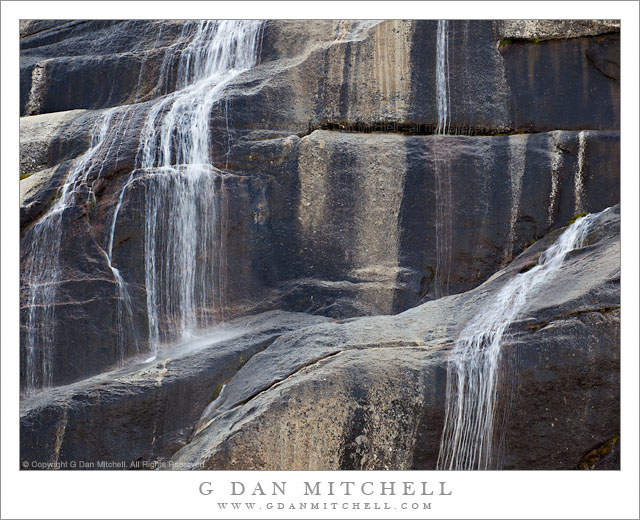
A seasonal spring cascade falls across the granite face of Polly Dome, Yosemite National Park.
I know that the chance to see the high country in winter-like conditions is part of what draws people to the opening of Tioga Pass Road, especially after a heavy snowfall season like this one. But for me the water is at least as much of a draw. The high country comes alive in ways that are not seen during the rest of the year. Because of the long and warmer days, the rate of snow melt accelerates, and when the snowpack is as deep as it is this year, that sets loose an amazing amount of meltwater.
I find full-flowing creeks in places where I didn’t even realize that water flowed. Creeks become raging torrents that threaten to jump their banks. In many places they do rise high enough to flood large expanses of meadow. Seasonal water falls and cascades appear almost everywhere you look.
I spotted this slender cascade high on the granite slopes of Polly Dome, above Tenaya Lake. My first idea was to make a photograph in which a longer stretch of the fall would appear, dropping perhaps several hundred feet. But as often happens, the more I worked this scene the more I wanted to eliminate extraneous material – and I ended up shooting at 400mm to edit out as much of the surround as I could.
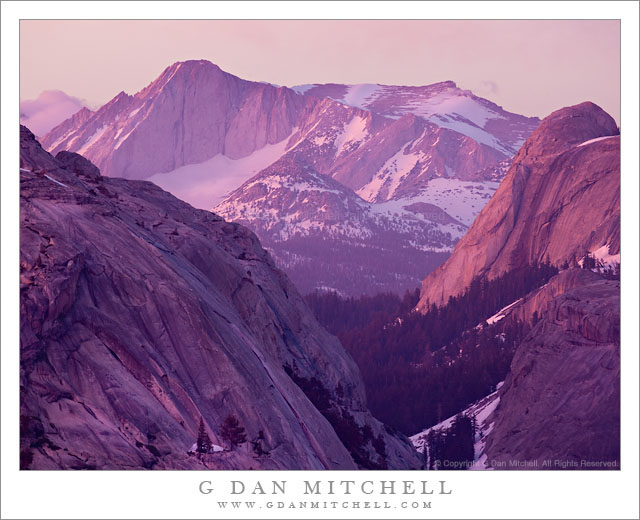
The last evening light illuminates domes near Tenaya Lake and the summit of Mount Conness with briilliantly colorful alpenglow, Yosemite National Park.
The tall peak at upper left is the summit of Mount Conness, one of the highest peaks in Yosemite National Park. The peak is located on the park boundary and the Sierra Nevada crest a bit north of Tioga Pass, and is visible from many places in the Tuolumne/Tioga high country. It is also a popular destination for peak baggers. The left foreground granite dome is the lower face of Polly Dome, which drops to the shoreline of Tenaya Lake. The left slope of Pywiak dome is visible in the shadows at lower right and beyond is the more brightly illuminated Medlicott dome.
I forgive you if you don’t believe the colors that you see in this photograph. I barely believe them myself, and I was (obviously!) there for the show. What happened on this evening was a near perfect example of a light phenomenon that Sierra photographers watch for and are occasionally lucky enough to experience. I have learned to see the signs that indicate that this light is possible, but also to understand that even when the conditions offer this potential that they rarely deliver.
On certain cloudy evenings in the Sierra it appears that there will be no sunset color – everything is hazy and drab and washed out. But if things play out just right, this very set of drab conditions (that induce some photographers to put away their gear too soon!) can produce some of the most striking and intense color possible if a few things fall into place just right. On this evening I had stopped for a moment at Olmsted Point, thinking to photograph ice-covered Tenaya Lake with a long lens and including the mass of Mount Conness in the distance. When I arrived there, things were about as unpromising as they could possibly be. A dull, greenish-blue haze hung in the air, overcast washed out the light, and Conness was obscured by clouds. I had actually put my gear back in the car when I looked back up and noticed that the summit of Conness had briefly poked through the clouds, accentuating its bulk and the sense that it towered over the foreground mountains. The light was still awful (I have the photos to prove it! ;-) but I thought I’d see if I could get something with the peak emerging from its shroud.
But still nothing much happened. I turned the camera to photograph some nearby trees and a blackbird that was looking for snacks. Then I noticed that there was some brighter light to the southwest and I began to consider the possibility that the cloud cover might end a bit to the west – and that is requirement #1 for the light conditions I’m describing. If the cloud deck ends to the west, as the sun reaches the horizon it may briefly break under the clouds and send brilliantly colorful light up into the clouds in the Sierra from below, creating a miles-wide light panel of the most astonishing colors. But still, it was hazy and the peaks were shrouded in clouds. But then I noticed that the clouds around Conness were beginning to drift off to the east and thin a bit. I mentioned (knock on wood!) to one of the other photographers that there was a possibility of “miracle light,” but that I wasn’t making any promises!
Then the thinning clouds began to pick up a slight pink tinge and the left side of Conness began to get some light directly from the west. Then, within a minute or so, the colors went absolutely crazy. People around me were audibly gasping as the color changed. At one point several of us spontaneously looked up to the west when we noticed the light suddenly increase out of the corners of our eyes. At the same time, the clouds almost completely dissipated from the area around the peak and because the whole sky was filled with brilliantly colorful clouds, this light began to suffuse even the depths of the canyon and slopes facing away from the sunset with this amazing light.
Never put your camera away until the last light is gone. :-)
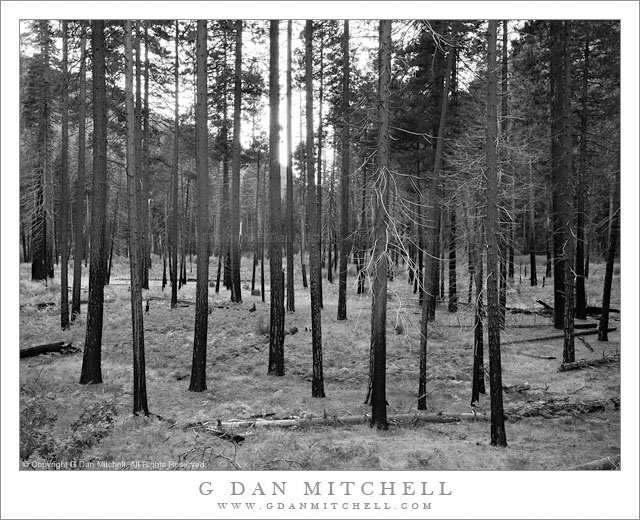
Evening light in a burned section of the forest on the floor of Yosemite Valley.
I’ve been sitting on this photograph for a while, so I figure I’ll post it now. I made it last fall – on Halloween, actually! – during a fall color trip to the Valley. Late on my final evening I finally stopped and walked out across the old terminal moraine that crosses the lower Valley not far upstream from Pohono Bridge. (When you drive into the Valley, the road splits, and before long you’ll see the south end of this feature to your left as you go up a short climb.) I started at the north end and as I walked south looking for a photograph it was a very quite, still, and cold evening.
I finally found a spot where I could go down the lower side of the hill just a bit and find a relatively clear shot through the trees that wasn’t blocked by foliage closer to my position. This area has been burned, and I assume that it is the result of one of the management burns that often occur late in the season. These fires attempt to strengthen the forest by reintroducing the natural process and cycles of fire. The result is interesting charring patterns along the lower portions of the trees, temporary burned undergrowth, and then as the recovery takes place a much more open and airy sort of forest as you see in this photograph.
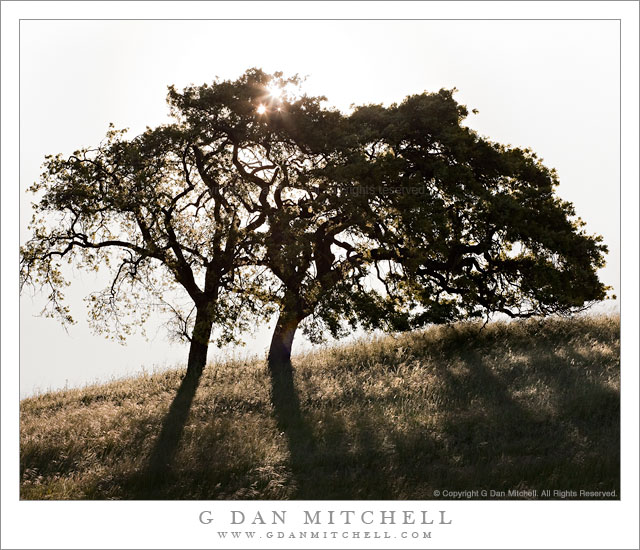
The springtime morning sun shines through a pair of oak trees in the Calero Hills south of San Jose, California.
On the final day of April and for the first time this season, I found to go for a hike at my favorite local park, a place where I have walked just about every available trail (and invented a few routes of my own) and photographed for a number of years. The park would not seem like anything all that special by comparison to some of the other places I visit, but it is close and I’ve gotten to know it in a way that makes it more special. The place is called the Calero County Park, part of the Santa Clara County Parks system.
The entrance to the park is in a broad valley that is largely occupied by stables. (Or, used to be – it looks like the stables must have closed since last season.) Rising from this valley are the typical grass-covered hills of central and northern California, with oaks and other trees scattered around and, in places, thicker trees and brush. At this time of year, the hills turn what I call “impossibly green” – and if you have seen them on a late-winter or early spring morning you know what I mean.
I started this hike a bit after dawn, so the golden hour light was more or less gone. I had a general idea of photographing some wildflowers (which didn’t happen – it was too windy) and some oak trees that grow alone or in small groups on the grass-covered hills. I passed a small lake – where a single egret often hangs out, but not on this morning – and topped a rise and descended into a small valley from which I have made quite a few photographs of oaks. It didn’t look too promising at first, but at the far end of this area I noticed that a pair of trees were still obscuring the sun and that I might be able to shoot straight into the sun with the trees blocking its disk, and get a photograph including the tree shadows on the hillside grasses.
This turned out to be another of those all-too-common ephemeral photographs in that the sun was starting to rise above the top branches of the tree and would soon be “out in the open,” making it much too bright for what I had in mind. So I worked quickly to set up tripod and camera and select a lens, then frame a composition, focus, and make a series of exposures that might be needed to deal with the huge dynamic range between direct sun and backlit tree trunks. By the time I had everything set up and was ready to shoot the sun had already risen above the upper branches, so I ended up looking for a slightly better shadow and putting the tripod down very low – and this gave me must enough time to make the series of exposures I figured I would need.
In the end, I got lucky. One single shot somehow managed to not blow the sun out too badly yet hold enough detail in the grass that a bit of work in post could bring it back. With all of the potential for lens flare – which I had to some extent in every shot – this one only had two small bits of it, and they were easily dealt with.
Photographer and visual opportunist. Daily photos since 2005, plus articles, reviews, news, and ideas.
Manage Consent
To provide the best experiences, we use technologies like cookies to store and/or access device information. Consenting to these technologies will allow us to process data such as browsing behavior or unique IDs on this site. Not consenting or withdrawing consent, may adversely affect certain features and functions.
Functional
Always active
The technical storage or access is strictly necessary for the legitimate purpose of enabling the use of a specific service explicitly requested by the subscriber or user, or for the sole purpose of carrying out the transmission of a communication over an electronic communications network.
Preferences
The technical storage or access is necessary for the legitimate purpose of storing preferences that are not requested by the subscriber or user.
Statistics
The technical storage or access that is used exclusively for statistical purposes.The technical storage or access that is used exclusively for anonymous statistical purposes. Without a subpoena, voluntary compliance on the part of your Internet Service Provider, or additional records from a third party, information stored or retrieved for this purpose alone cannot usually be used to identify you.
Marketing
The technical storage or access is required to create user profiles to send advertising, or to track the user on a website or across several websites for similar marketing purposes.