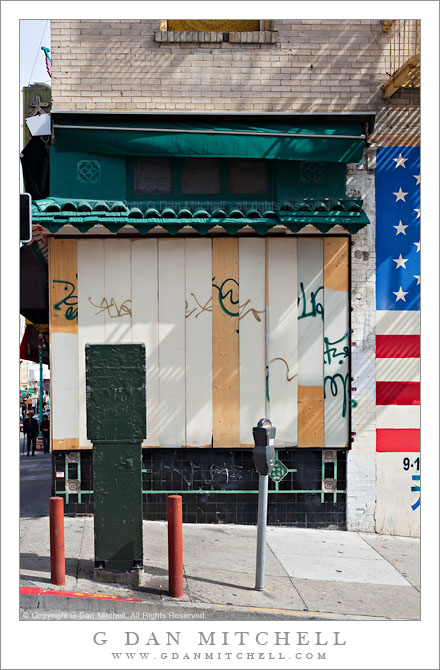
A corner store with boarded-up windows in the Chinatown district of San Francisco.
There probably isn’t a whole lot to say about the subject of this photograph other than it is a boarded-up corner store in the Chinatown area of San Francisco, photographed in morning light last July. The components of the scene are kind of odd, I think: a bit of a flag, green awnings and painted wall, the slanting sidewalk with some poles and boxes, and the layers of older and newer boards and graffiti over the windows. I also though the light was interesting, partly because it was short period when the San Francisco fog is breaking up and the light is brighter but still soft, and partly because of the diagonal shadows cast across the vertical and horizontal shapes of the wall.
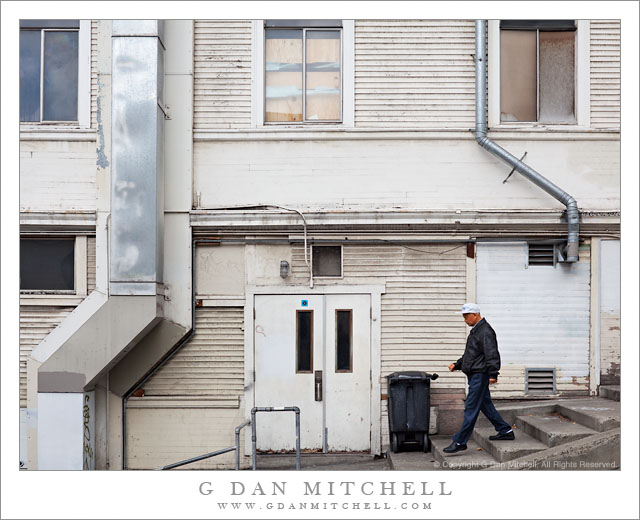
A man descends the Peter Macchiarini steps past worn and dilapidated buildings in downtown San Francisco.
I photographed this rather bleak scene on a side street in San Francisco last summer. I first walked up this street to photograph the “Peter Macchiarini Steps” that ascend steeply here in place of a normal sidewalk. Then I saw the opposing shapes of the large square ductwork and the smaller round pipes against the weathered and dilapidated exterior of the buildings. Finally, I found that the occasional person descending the steps might add a point of interest, so I waited…
When I look at a photograph like this one I see layers of different things – but maybe that’s just me! :-) At one level it is just a slightly gritty little street scene, presented in a pretty unvarnished manner. (I did some work to straighten angles and so forth in post – I generally don’t get to use tilt/shift lenses when I shoot street!) Then I see several interesting-to-me geometries in the scene. I mentioned above the opposing bends of the pipes and ducts and their relative positions on the wall. I also see a collection of rectangular shapes throughout the frame: the lighter area of wall behind the figure, the doors in the lower center, the small window above the doors, the three upper windows, and the sections of wall between them. Then there are a bunch of horizontal components: the large lighter band across the upper center, the very small patterns of the siding, the sequence of upper story windows against siding, the lower edge of the siding. And within these separate layers of order there are things that don’t quite fit. The man of course, wearing black and in motion with one foot suspended in mid-step, but also the trash can in front of him – also black, the bits of conduit running in odd directions, the small section of pipe in front of the door, and the concrete sidewalk steps.
Of course, you are free to see a picture of some guy walking down the steps…
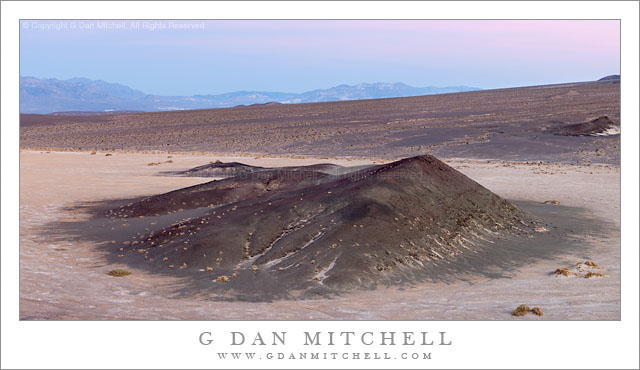
Dusk light above a hill near Mesquite Flat in Death Valley, backed by a large alluvial fan from Tucki Mountain.
At the end of this day I was shooting from the top of a low hill in the Valley east of Stovepipe Wells, and there were interesting subjects throughout almost the entire 360 degree panorama around this elevated position. With this in mind, I had chosen to use the long 100-400mm zoom so that I could have some flexibility in composing elements of this huge scene.
I was mainly working with things that were in the large arc to my west (dunes and Cottonwood mountains and base of Tucki Mountain), north (the main Valley and transverse dunes), and east (the mountains running along that edge of the Valley) since the further subjects of the lower Valley were more or less out of sight beyond the alluvial fan that appears in the photograph. But I kept being intrigued by the low, dark hill on the flats below the similar hill on which I was standing. There is a row of them stretching from near the Devils Cornfield area up and across this alluvial fan. As the evening light transitioned towards post-sunset light I saw that the glow from clouds (a bit of which is visible in the distance above the Black Mountains) was lighting this hill and the surrounding flats in an interesting and colorful way.
But I had a little problem. I was still working a number of subjects and once and I really needed to keep shooting that 100-400. 100mm was still too long for this scene, but I didn’t have time to remove it and put on a shorter lens. I figured that I could simply change the camera to vertical orientation, very carefully level the tripod, and include the whole scene in four panning vertical frames that I could stitch together later. People often do this so that they can produce extremely high-resolution image, but that wasn’t my goal at all. In any case, it worked, and not only did I manage to get the shot that needed a wider lens, but as a bonus it is a very high-resolution shot.
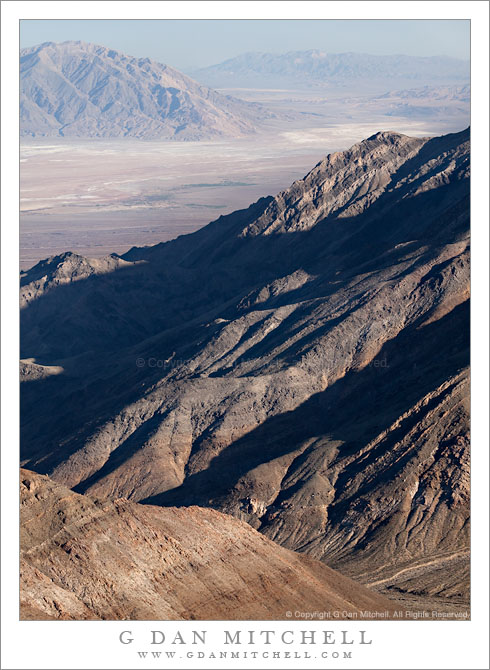
Afternoon shadows fall across the lower slopes of Wildrose Peak above Trail Canyon and below Aguereberry Point, with Death Valley and the Black Mountains beyond.
The view from Aguereberry Point (and from this location close to the point) is spectacular and expansive, taking in everything from Death Valley itself, stretching almost 180 degrees from left to right, to the Green, Black, and other mountains beyond. To the south and north other ranges merge with the atmospheric haze. The peaks of the Panamint range lie behind, and in places where the view is clear you can look down on the rugged terrain of the east face of the Panamint Range with its rugged ridges and deep canyons dropping towards the Valley. This photograph looks roughly southeast towards the lower end of Death Valley in the area around Ashford Mill. The deep foreground canyon, the bottom of which is just visible at lower right, is Trail Canyon. I understand that a four-wheel-drive road used to come up to Aguereberry Point via that canyon, but that parts have washed out and it can no longer be driven. I think that you can hike it, but that would be one heck of a climb since the base of the canyon can’t be more than a few hundred feet above Death Valley (which is below sea level in this area) and the Point is well above 6000′. The lower slopes of Wildrose Peak rise beyond the canyon.
Surprisingly, this view presents several photographic challenges. Because of the haze that appears when such great distances are part of the scene, I chose to use a polarizing filter for this shot. Timing is important here, too. Arrive a bit too early and the light is harsh and flat. Arrive a bit too late and the foreground ridges are quickly enveloped in shadows as the sun drops behind the crest of the Panamint Range. (Yes, I have made both mistakes in the past.) Knowing this, I arrived a bit earlier than I might have usually arrive to shoot evening light and I managed to photograph the scene before that Panamint Range shadow obliterated the foreground light.
Photographer and visual opportunist. Daily photos since 2005, plus articles, reviews, news, and ideas.
Manage Consent
To provide the best experiences, we use technologies like cookies to store and/or access device information. Consenting to these technologies will allow us to process data such as browsing behavior or unique IDs on this site. Not consenting or withdrawing consent, may adversely affect certain features and functions.
Functional
Always active
The technical storage or access is strictly necessary for the legitimate purpose of enabling the use of a specific service explicitly requested by the subscriber or user, or for the sole purpose of carrying out the transmission of a communication over an electronic communications network.
Preferences
The technical storage or access is necessary for the legitimate purpose of storing preferences that are not requested by the subscriber or user.
Statistics
The technical storage or access that is used exclusively for statistical purposes.The technical storage or access that is used exclusively for anonymous statistical purposes. Without a subpoena, voluntary compliance on the part of your Internet Service Provider, or additional records from a third party, information stored or retrieved for this purpose alone cannot usually be used to identify you.
Marketing
The technical storage or access is required to create user profiles to send advertising, or to track the user on a website or across several websites for similar marketing purposes.