
Tag Archives: boulder

The Visitor

The Visitor
An anomalous white rock rests against dark rock deep in a Death Valley canyon.

The Visitor. © Copyright 2019 G Dan Mitchell – all rights reserved.

An anomalous white rock rests against dark rock deep in a Death Valley canyon.

Desert canyons, especially in an arid place like Death Valley, are refuges from the harsh environment. Not that they are entirely gentle and friendly places, being periodically scoured out by floods and left covered in rocks. But they offer shade, sometimes sources of moisture, and occasional plants. The deepest and narrowest are quiet and still places.

They are transitory landscapes, on time scales that range from annual to much longer. Cut through by flowing water and weaknesses in the rock, they reveal strata from long ago. That flowing water inexorably moves material down from the peaks toward the playa, and almost anything we come across in such canyons will only be there temporarily. I don’t know enough geology to offer too many facts about this rock, but its light color against the surrounding dark rock was striking, as was its upright position.


G Dan Mitchell is a California photographer and visual opportunist. His book, “California’s Fall Color: A Photographer’s Guide to Autumn in the Sierra” is available from Heyday Books and Amazon.

Blog | About | Flickr | Facebook | Email

Links to Articles, Sales and Licensing, my Sierra Nevada Fall Color book, Contact Information.

Scroll down to leave a comment or question.


All media © Copyright G Dan Mitchell and others as indicated. Any use requires advance permission from G Dan Mitchell.
Talus, Cliff, Shoreline

Talus, Cliff, Shoreline
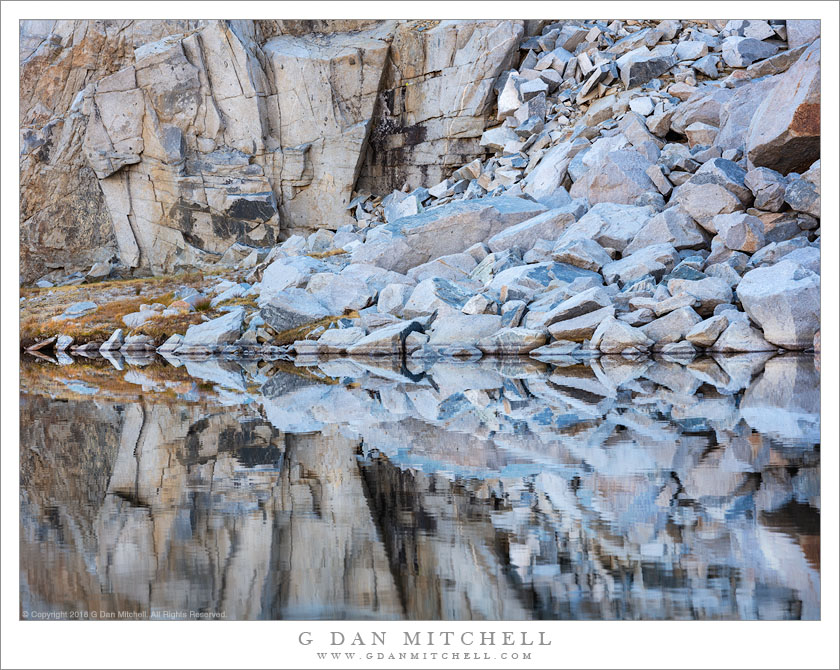
A talus field of giant boulders tumbles to the edge of an alpine lake at the foot of a cliff

Talus, Cliff, Shoreline. © Copyright 2018 G Dan Mitchell – all rights reserved.

A talus field of giant boulders tumbles to the edge of an alpine lake at the foot of a cliff

There are multiple ways to look at this photograph. One is to think of it as a record of a specific place at a particular time. That is perhaps important to me and to the others with whom I shared this week in the Sierra Nevada backcountry, but I think it is far less important to others who may view it. Another way to view it is as an example of a particular kind of landscape — the subalpine terrain of the eastern slope of this mountain range — and to note the cliff face at the left, the base of the talus field that reaches to the shoreline, and the lake itself. Sierra travelers probably have their own collection of memories of similar places.

A third way to view it is to try to step back from the seeming objective reality of location and subject, and to try to look at it as a structure of colors and forms and textures. This isn’t always easy, and it perhaps it isn’t for every viewer… though the elements mirrored in the reflective surface of the lake may encourage a viewer to try. In fact, this gets a little closer to how I see such things and such places. Yes, I do respond to them a real locations and as examples of the Sierra terrain I love. However, in most cases that isn’t enough for a photograph, at least not to me. I’m always looking for shape and texture and color and relationships in these subjects. (Of the recent photographs of talus slopes, water, and soft light, this may be my current favorite.)


See top of this page for Articles, Sales and Licensing, my Sierra Nevada Fall Color book, Contact Information and more.

G Dan Mitchell is a California photographer and visual opportunist. His book, “California’s Fall Color: A Photographer’s Guide to Autumn in the Sierra” is available from Heyday Books and Amazon.
Blog | About | Flickr | Twitter | Facebook |
Email


All media © Copyright G Dan Mitchell and others as indicated. Any use requires advance permission from G Dan Mitchell.

Red Boulder, Evening

Red Boulder, Evening
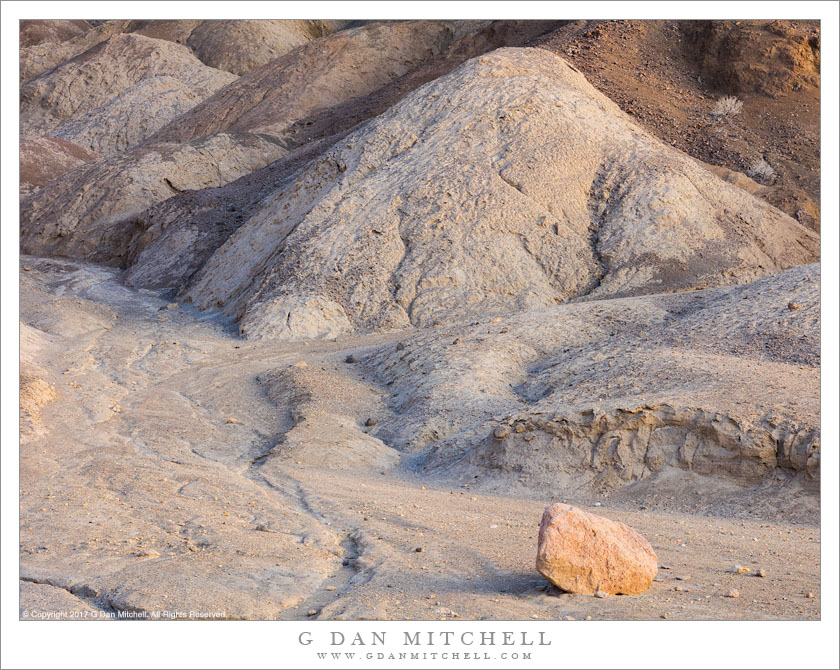
A red boulder sits in a desert wash next to eroded mud hills in evening light

Red Boulder, Evening. © Copyright 2018 G Dan Mitchell – all rights reserved.

A red boulder sits in a desert wash next to eroded mud hills in evening light

There are many things to like about the desert landscape, but in some places (including large areas in Death Valley National Park) I enjoy the fact that the landscape lies exposed to view, not covered or disguised by forest or even much in the way of plant life. I’m also continuously amazed by how obvious it is that water played a big role in shaping this Death Valley landscape — from the shorelines of ancient lakes, to boulder-strewn washes, to playas, the evidence is everywhere.

On this evening I had walked up a quiet — and not too visually exciting — slot canyon, and just before sunset I headed back the way I came and emerged into the wider valley of the wash and then headed towards the valley itself. Along the sides of this was were remnants of landscape modified by flowing water, including this large reddish rock, either deposited here by moving water or perhaps eroded out of the soil on site.


See top of this page for Articles, Sales and Licensing, my Sierra Nevada Fall Color book, Contact Information and more.

G Dan Mitchell is a California photographer and visual opportunist. His book, “California’s Fall Color: A Photographer’s Guide to Autumn in the Sierra” is available from Heyday Books and Amazon.
Blog | About | Flickr | Twitter | Facebook | LinkedIn | Email


All media © Copyright G Dan Mitchell and others as indicated. Any use requires advance permission from G Dan Mitchell.
Patterns In Granite

Patterns In Granite
Patterns in a section of Yosemite Valley granite

Patterns In Granite. © Copyright 2018 G Dan Mitchell – all rights reserved.

Patterns in a section of Yosemite Valley granite

Of all the things that characterize and define Yosemite, rock may be the most important. The Valley itself is lined with huge granite* forms in the shapes of domes and cliffs and more, carved by water, glaciers, and slow erosion. Wandering about the Valley one eventually becomes aware that the granite “moves,” and that giant chunks have fallen from the surrounding heights and sometimes managed to travel a good distance into the valley — a sobering thought. This rock continues into the high country, where some of the same features are found, along with others — the glacial “erratics” left behind as ice retreated, places were rivers flow across smooth rock, meadows dotted with boulders.

The character of granite on the large scale is hard to miss, but its character close up is also fascinating. Many years ago, for a few years, I was a bit of a rock climber. As a climber one gets “up close and intimate” with rock, learning (and remembering the tactile qualities) of the rock — smooth, straight cracks, rough, covered by lichen, disintegrating, marked by water, and more. That may explain why this little spot caught my attention. Quite a few stories are in this rock. It lies at the base of some very large cliffs, suggesting its source. It is covered by lichen, part of the reason for the color variations. Stained streaks produce vertical lines, and one odd section, which must be harder than the rest, angles up from left to right.

  • A geologist friend has pointed out to me in the past that “granite” is not a technically correct blanket description for the rock of Yosemite. I’m using the term in the casual and familiar sense. And for those who get this far, did you notice a compositional link to the recent redwing blackbird photograph? :-)

G Dan Mitchell is a California photographer and visual opportunist. His book, “California’s Fall Color: A Photographer’s Guide to Autumn in the Sierra” is available from Heyday Books and Amazon.
Blog | About | Flickr | Twitter | Facebook | Google+ | LinkedIn | Email


All media © Copyright G Dan Mitchell and others as indicated. Any use requires advance permission from G Dan Mitchell.