
Tag Archives: brush

Cook Bank Ruins, Rhyolite

Cook Bank Ruins, Rhyolite - The ruins of the Cook Bank in the ghost town of Rhyolite, Nevada, with barren desert hills under a pre-sunrise sky.
The ruins of the Cook Bank in the ghost town of Rhyolite, Nevada, with barren desert hills under a pre-sunrise sky.

Cook Bank Ruins, Rhyolite. Rhyolite, Nevada. January 3, 2012. © Copyright 2012 G Dan Mitchell – all rights reserved.

The ruins of the Cook Bank in the ghost town of Rhyolite, Nevada, with barren desert hills under a pre-sunrise sky.

This was the closest to the winter solstice that I’ve visited Rhyolite, so I shouldn’t have been surprised by several things. First, the sun came up not only later, but also a bit further south along the horizon – and the light that would usually strike these ruins at sunrise was blocked for a while by a large hill that sits next to the town. Second, it was cold! Third, no one else was there at sunrise! This is a bit unusual since in the Death Valley high season (which arrives a bit later in the year), Rhyolite can be a pretty popular place… for a ghost town… in the middle of the desert… in Nevada. :-)

Because I have photographed here several times before and for the reasons mentioned above, I took a bit of a different approach to photographing the place this time. The winter light, some high clouds, and the different point along the horizon of the sun rise meant that the light was quite different from what I’ve occasionally had to work with in the past. At first I was a bit disappointed to realize that the direct dawn light was not going to strike the old Cook Bank and other nearby buildings. But when some clouds to the east obscured the direct light and high, thin overhead clouds begin to pick up color and fill in the shadows, I saw that other interesting lighting was going to make up for it. At the moment that I made this photograph, those clouds to the east (right) of my position beautifully softened what might otherwise have been some stark and harsh light on the pinnacles beyond the town. They also created an unusual and beautiful quality of light for a few moments – a reddish-pink quality from the light reflected from the clouds but with a few soft quality.

I decided to shoot from a distance with a long lens so as to control the position of the ruins against the background hills, and the longer focal length makes these hills more prominent than they would be if I shot the building with a shorter focal length from a closer position. This also allowed me to more carefully eliminate some distracting elements that invariably appear at old sites like this. (The first times I visited, access to most of the ruins was quite unimpeded. Now fences have been erected around some of them. Part of me regrets the loss of access, but the greater part of me understands that this will allow these buildings to be around longer so that more people will get to see them. I stayed behind the fences.) If you look around on the web a bit, you can find some wonderful old photographs of this town when it was a bustling place with thousands of residents, and when the Cook Bank was a very impressive and modern-for-the-time building.

G Dan Mitchell is a California photographer whose subjects include the Pacific coast, redwood forests, central California oak/grasslands, the Sierra Nevada, California deserts, urban landscapes, night photography, and more.
Blog | About | Flickr | Twitter | FacebookGoogle+ | 500px.com | LinkedIn | Email

Text, photographs, and other media are © Copyright G Dan Mitchell (or others when indicated) and are not in the public domain and may not be used on websites, blogs, or in other media without advance permission from G Dan Mitchell.
Petroglyphs

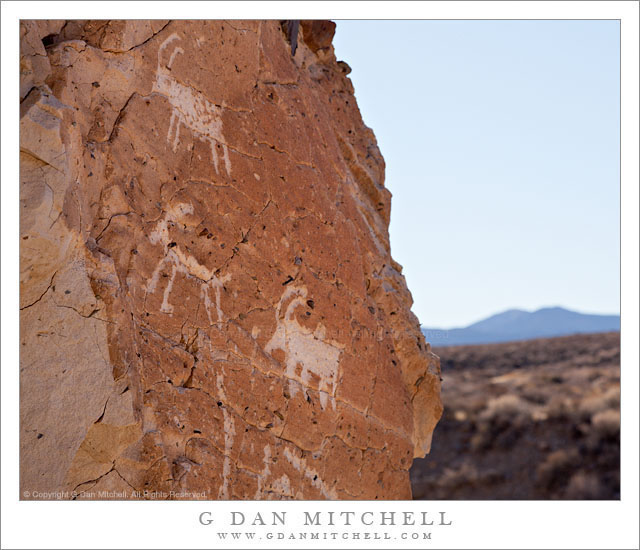
Petroglyphs - Petroglyphs on a rock face overlooking desert terrain
Petroglyphs on a rock face overlooking desert terrain

Petroglyphs. Death Valley National Park, California. January 5, 2012. © Copyright 2012 G Dan Mitchell – all rights reserved.

Petroglyphs on a rock face overlooking desert terrain.

Encountering these very old and very mysterious traces of people who lived in this desert terrain many, many years ago is always a special experience. Perhaps you have read the following story here before, but I think of it every time I encounter these things. Well over a decade ago I was camped in a place in Death Valley National Park that lies somewhere between popular and the anonymous wild spaces far out in the back areas of the park. I was with a group of other people. In the morning I wandered away from the place where we were camped. I crossed a wash and walked up onto the base of a great alluvial fan, found a suitable “sitting rock,” and just sat there for a while taking in the immense space and silence. I happened to look down at the rocky ground and I an oddly shaped rock caught my attention. I’m no expert on these things, but it seemed completely clear to me that this rock had been shaped by human hands. (I later came to understand that it was probably a “knife,” perhaps one designed for scraping.)

At the moment I saw and then picked up and held this rock, the place was transformed from a semi-wilderness of rock and scattered plants into a very different sort of thing – a place that had been the home of people, many years before I sat there on my rock. My thoughts turned from the landscape around me to try to imagine the person who had created and held this rock – who was this person? what was it like to live in such a place in such a time? what had happened to them? I returned the rock to the desert floor and walked back to my camp.

The petroglyphs in the photograph are located in another place in the park, and I have visited and photographed them more than once. These are perhaps the most precious and among the most fragile things in this desert, which is why I never write about the specifics of their locations. (I also have photographs of petroglyphs that have been defiled by thoughtless morons.) If you know where these are, let’s keep it to ourselves, OK?

The first time I photographed these examples of rock art, I simply shot them straight on so that the shapes were as clear and large as possible. Since then I had been thinking of trying to photograph them in a way that might reveal them in the context of the larger surroundings – perhaps as the person or people who made them might have seen the place.

G Dan Mitchell is a California photographer whose subjects include the Pacific coast, redwood forests, central California oak/grasslands, the Sierra Nevada, California deserts, urban landscapes, night photography, and more.
Blog | About | Flickr | Twitter | FacebookGoogle+ | 500px.com | LinkedIn | Email

Text, photographs, and other media are © Copyright G Dan Mitchell (or others when indicated) and are not in the public domain and may not be used on websites, blogs, or in other media without advance permission from G Dan Mitchell.

Autumn Tamarisk

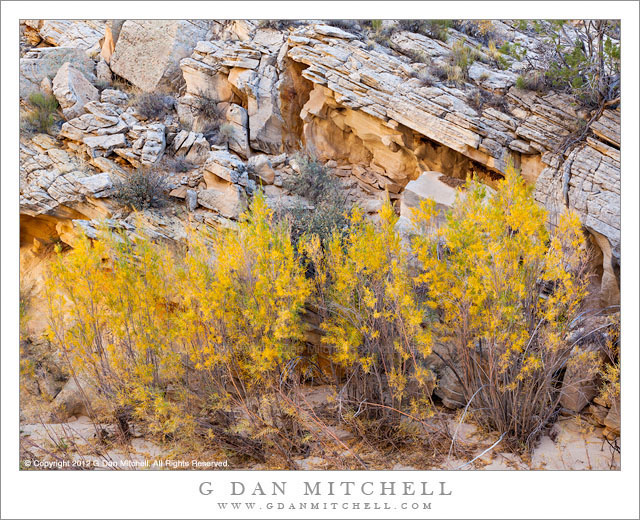
Autumn Tamarisk - Tamarisk plants with autumn foliage on the banks of a desert stream, Grand Staircase-Escalante National Monument
Tamarisk plants with autumn foliage on the banks of a desert stream, Grand Staircase-Escalante National Monument

Autumn Tamarisk. Grand Staircase-Escalante National Monument, Utah. October 24.2012.© Copyright 2012 G Dan Mitchell – all rights reserved.

Tamarisk plants with autumn foliage on the banks of a desert stream, Grand Staircase-Escalante National Monument

I photographed these tamarisk plants with autumn colors on a cold and extremely windy day in the Grand Staircase-Escalante National Monument – most likely, if memory serves, during a brief lull in the wind. It was a beautiful and invigorating day – but certainly not one that was conducive to photographing autumn foliage! We did spend the better part of the day in this canyon, but the wind increased and by the end of our work it was almost strong enough to occasionally stop us in our tracks on the hike out… and then it started to rain!

Tamarisk plants can offer some of the most varied colors of almost any plant, though they are often overlooked because they can easily look drab, especially in daytime light, and because their form is not classically tree-like. But depending on the season and the lighting they can have almost every color imaginable: reds yellow, purple, blue, tan, green. This small group of plants was, obviously, sporting brilliant autumn colors. But, in addition, it was lit by the reflected glow of warm colored light coming from a nearby cliff face in full sun.

G Dan Mitchell is a California photographer and visual opportunist whose subjects include the Pacific coast, redwood forests, central California oak/grasslands, the Sierra Nevada, California deserts, urban landscapes, night photography, and more.
Blog | About | Flickr | Twitter | FacebookGoogle+ | 500px.com | LinkedIn | Email

Text, photographs, and other media are © Copyright G Dan Mitchell (or others when indicated) and are not in the public domain and may not be used on websites, blogs, or in other media without advance permission from G Dan Mitchell.
Peninsula and Trees, Morning

Peninsula and Trees, Morning

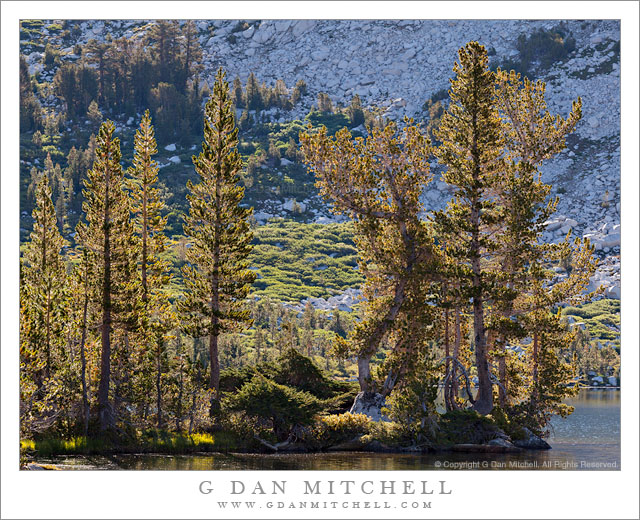
Peninsula and Trees, Morning. Yosemite National Park, California. September 18, 2011. © Copyright 2011 G Dan Mitchell – all rights reserved.

Morning light on a tree-covered peninsula along the edge of a subalpine lake with a talus slope backdrop, Yosemite National Park.

I think that the primary thing that first caught my attention in this little scene was the very twisted and curving tree about 1/3 of the way in from the right edge of the frame. I wonder why one tree ended up growing in such an odd way when its neighbors seem to have managed to grown in a straight and conventional manner? The light on these trees was coming from almost directly behind them, as the sun had just topped the ridge above and out of the frame. Because the talus slope is fairly steep, portions of it remain in shade.

This photograph posed a few interesting challenges, and they are probably not all immediately apparent. One that may be visible to those who are familiar with such scenes is the fact that back-light like this can create some very bright highlights that can “blow out” in a digital camera exposure. In fact, these highlights are what determine the exposure for such a scene. If accommodating the bright highlights makes the shadows too dark, I can either work a bit in post to bring back some shadow detail or I can make a separate exposure for the shadows and blend the two in post. That wasn’t necessary here – I was able to capture the scene in a single exposure. The second odd little problem was that swarms of mosquitos were flying just above the water all around the shoreline of the lake. Although you cannot see them in this small jpg, there were many, many little traces of the bugs in the air – so many, in fact, that I had to somewhat laboriously clone out a good number of the most obvious of them.

G Dan Mitchell is a California photographer whose subjects include the Pacific coast, redwood forests, central California oak/grasslands, the Sierra Nevada, California deserts, urban landscapes, night photography, and more.
Blog | About | Flickr | Twitter | FacebookGoogle+ | 500px.com | LinkedIn | Email

Text, photographs, and other media are © Copyright G Dan Mitchell (or others when indicated) and are not in the public domain and may not be used on websites, blogs, or in other media without advance permission from G Dan Mitchell.