
Tag Archives: clouds

Mount Conness and Ragged Peak, Forest

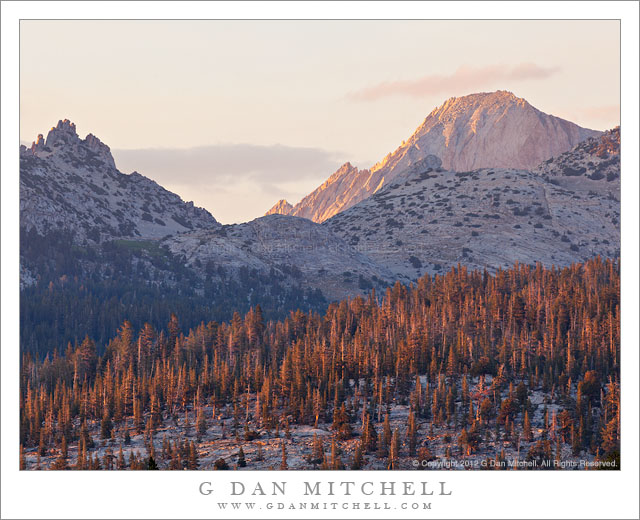
Mount Conness and Ragged Peak, Forest - Evening light slants across forest below Ragged Peak and Mount Conness, Yosemite National Park, California.
Evening light slants across forest below Ragged Peak and Mount Conness, Yosemite National Park, California.

Mount Conness and Ragged Peak, Forest. Yosemite National Park, California. July 11, 2012. © Copyright 2012 G Dan Mitchell – all rights reserved.

Evening light slants across forest below Ragged Peak and Mount Conness, Yosemite National Park, California.

This photograph was made from the Tuolumne Meadows area with a long lens, and it includes the heights of Mt. Conness at the far right, the lesser prominence of Ragged Peak at the left, a shaded ridge running above the Young Lakes basin, and a closer bit of typical Yosemite forest mixed with a bit of dome-like granite, with sunset light slanting across from the left. By the way, I wondered for some time where the name “Mt. Conness” came from. I finally looked it up during the past year, and I found out that the namesake was Senator Conness, one of the two California senators during roughly the Civil War period – Conness was responsible for the legislation that initially set parts of the current Yosemite National Park aside for protection and preservation. All in all, a person deserving of a peak with his name.

Although photographed here from some distance, I know parts of the landscape encompassed by this photograph quite well, including the visible portions and some that are hidden from sight in this photo. For a number of years I have made a habit of visiting the Young Lakes area at least once each season, often late in the season when the summer crowds have dissipated – though I have also visited very early in the season, and I have the mosquito stories to prove it! Young Lakes lie on the other side of the shaded ridge traversing the center of the photograph, and I’ve often looked up at that ridge from the lakes. I have also hiked up into the valley on this side of the ridge. The trail to Young Lakes crosses the wooded area beyond the sunlit trees and passes through a beautiful semi-meadow area below Ragged Peak, a place where beautiful lupine flowers may be found at the right time of the year and from where one can obtain some panoramic views of a lot of high Yosemite Peaks. On one of my first visits to Young Lakes, it was so late in the season that the backcountry ranger who was patrolling the area apparently had little to do, and one morning we ended up having a very long conversation along the shore of one of the lakes. I remarked that a particular little gully in roughly the area of Ragged Peak looked like it might be interesting, and he shared enough information about the route that I chose to use it rather than the regular trail on my return to the trailhead. Mt. Conness, here the only peak or ridge still fully in sunlight, towers above everything else in this area. I have not climbed it, though I have investigated some trail less areas around its base and I’ve looked at it from almost every side.

G Dan Mitchell is a California photographer whose subjects include the Pacific coast, redwood forests, central California oak/grasslands, the Sierra Nevada, California deserts, urban landscapes, night photography, and more.
Blog | About | Flickr | Twitter | FacebookGoogle+ | 500px.com | LinkedIn | Email

Text, photographs, and other media are © Copyright G Dan Mitchell (or others when indicated) and are not in the public domain and may not be used on websites, blogs, or in other media without advance permission from G Dan Mitchell.
Home Bay, Drakes Estero

Home Bay, Drakes Estero
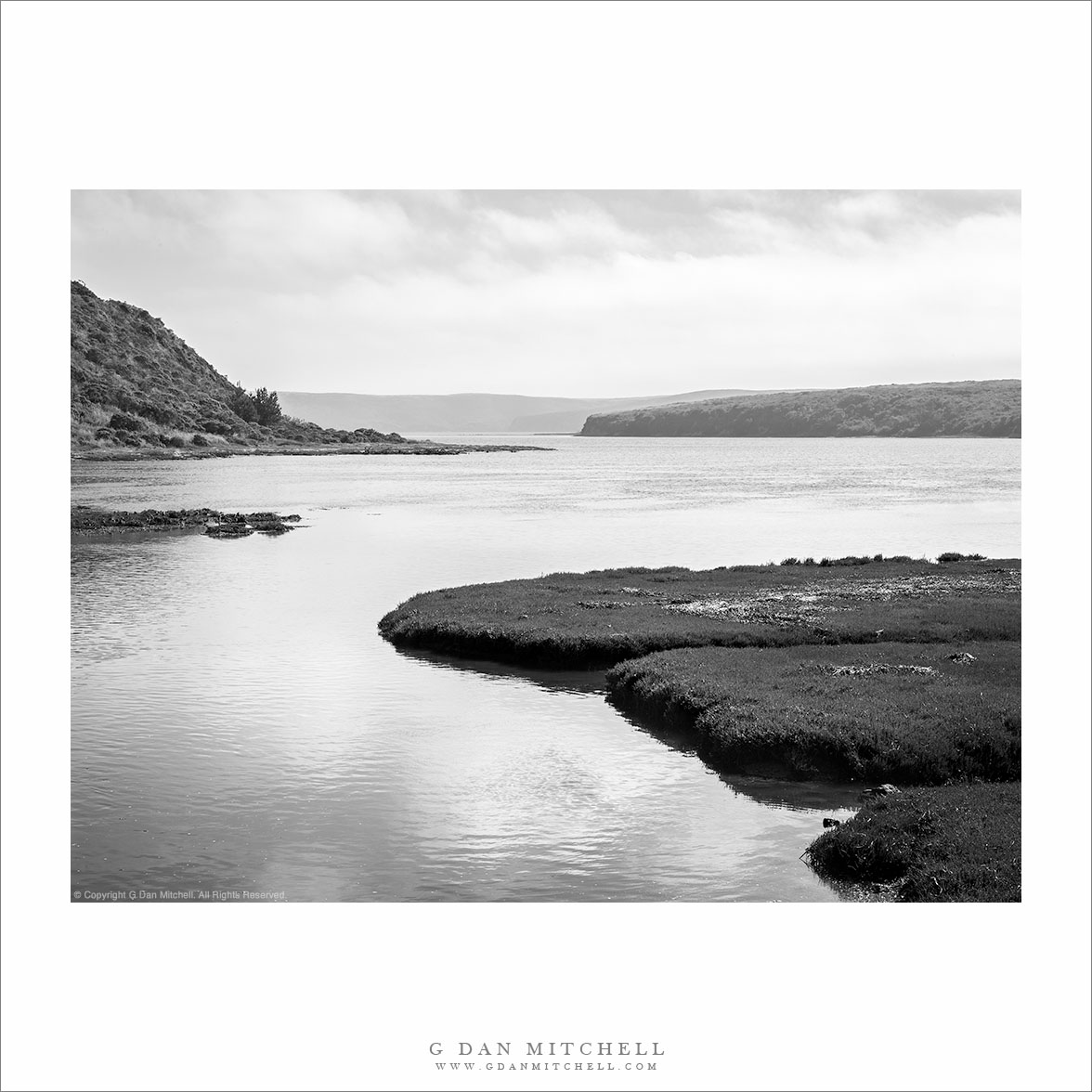
“Home Bay, Drakes Estero” — Fog rolls in over Drakes Estero beyond Home Bay, Point Reyes National Seashore

This quick late-July visit to Point Reyes was an opportunity to re-learn a few lessons about going out to make photographs. I drove up to San Francisco, where my wife was to be involved in a music performance — the plan being to drop her off and then drive on over the Golden Gate Bridge to Point Reyes. It is often cold and windy there, even in the summer, but this was a very warm period and it looked like the coast might be clear of fog. With this in mind, I planned to either visit the Limantour Beach or else hike out towards Drakes Bay.

I should have sensed that things were about to evolve in ways that I had not planned for when, during a brief stop at the Point Reyes visitor center, the rangers announced that the road to Limantour was closed since a fire had just started in the area! With that option gone, I figured that Drakes Bay would be my objective, and I had images of afternoon and evening light on this day of little or no fog. I drove on out to the Estero trailhead where it was, in fact, quite sunny, though a bit windy. I loaded up my camera pack with a few lenses and a tripod, and set out towards Drakes Head, thinking I might make it there for late afternoon light. Soon I saw the telltale puffs of incoming fog overhead, and I came around a bend in the trail to see that the fog had already moved in to the west and over Drakes Bay. Fortunately, iin most cases I would rather photograph in “interesting” weather than in supposed perfect blue sky weather.

At a point where the trail descended to cross a dike at the head of Home Bay, I saw this conjunction of near and far forms, with the distant bluffs under the incoming fog, so I stopped to make a few photographs before moving on. To make a potentially long story a bit shorter, the temperature quickly dropped and the wind picked up to levels that made photography increasingly difficult. I managed to work with one other scene that included a curving snag in front of the bay, but it was already becoming difficult to find a calm moment in the wind to click the shutter. I kept going, finally reaching the trail junction that heads off towards Drakes Head, only to realize that I would never get all the way out there in time to return before dark. Cutting the hike short after a bit more than an hour and a half of hiking, I began to retrace my steps back to the trailhead.

In the end, this is really the only photograph that I came away with – despite carrying that fully loaded camera pack out and back! But this reminded me of a first lesson, namely that it is worth the effort even if I only come back with a single shot that I like. This one, to me, evokes the relative isolation and quiet of this spot in the upper reaches of the calm waters of Drakes Bay, with the fog bank beginning to assemble across the distant bluffs. A second lesson is that sometimes on a photographic quest, it is OK to simply enjoy the surroundings. A practical photographer can remind himself or herself that scouting is a good thing, and that things not photographed this time may well be on a future visit. And a long-time hiker can – and did – remind himself that sometimes it is just fine to leave the camera in the pack and just enjoy the wind and the space.


Leave a comment or question using the form. (Click the title to see the full article and to comment if you are viewing it on the home page.)

G Dan Mitchell is a California photographer and visual opportunist. His book, “California’s Fall Color: A Photographer’s Guide to Autumn in the Sierra” (Heyday Books) is available directly from him. Blog | Bluesky | Mastodon | Substack Notes | Flickr | Email

All media © Copyright G Dan Mitchell and others.

Tuolumne River, Alpenglow

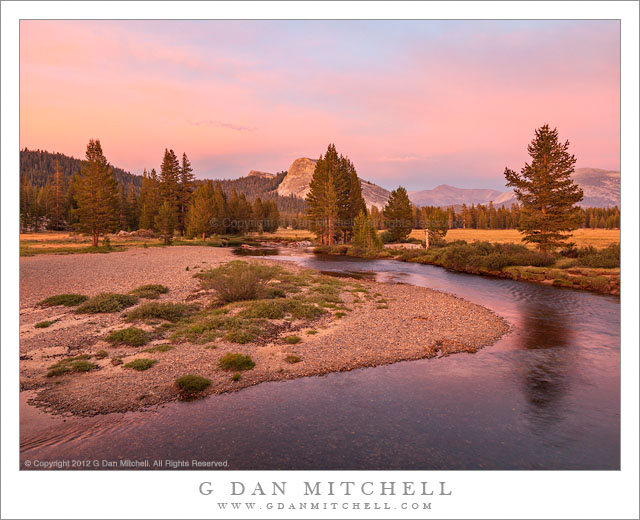
Tuolumne River, Alpenglow - The Tuolumne River curves through Tuolumne Meadows as alpenglow colors that landscape, Yosemite National Park.
The Tuolumne River curves through Tuolumne Meadows as alpenglow colors that landscape, Yosemite National Park.

Tuolumne River, Alpenglow. Yosemite National Park, California. July 7, 2012. © Copyright 2012 G Dan Mitchell – all rights reserved.

The Tuolumne River curves through Tuolumne Meadows as alpenglow colors the landscape, Yosemite National Park.

I have written previously about several topics that connect to this photograph. For one, I have described a certain type of atmospheric condition in the Sierra that may bring astonishingly intense evening colors when clouds above the mountains end to the west of the range, allowing the final sunset light to illuminate the clouds from beneath. On this evening it looked like all the pieces were in place for such a show, but I know that while these conditions make the light possible, they do not guarantee it – and on this evening there was a wonderful, subtle glow just after sunset… but not the imagined overwhelmingly brilliant light.

For another, I have written about scoping out a shot ahead of time, sometimes earlier the same day and sometimes weeks, months, or even years earlier. Earlier on this day I decided to take a walk in the meadow without my camera gear, with precisely the task of “scoping out” in mind. I wandered around somewhat aimlessly, following my nose this way and that to investigate lots of interesting things and places that I might have passed by on a more purposeful hike. Before heading back to camp for an early dinner I had selected three possible subjects that I thought might work well.

I have also written about how little control we have over our subjects when shooting landscape. We can anticipate and guess and be fortunate enough to be in the right place at the right time with the right gear and the skill to know how to use it, along with the ability to see what is happening – but in the end, in many ways, we take what we can find and work with it. When I arrived back in the evening an hour or so before the time of interesting light, I had a feeling that the first subject I had seen earlier might be the most promising. This was a scene that placed Lembert Dome between a couple of groups of trees and a bit of the river when viewed from the middle of a footbridge crossing the Tuolumne. I arrived and set up and began the planned wait for what I hoped would be very interesting light. However, as sunset approached, I could see that the shot I had planned was not going to work in the light that I found myself working with. So, on the spur of the moment and acting essentially intuitively, I picked up the tripod and camera and moved to a nearby spot and rather than making a tightly focused shot of the dome, I zoomed way out to include a gentle curve in the Tuolumne, a sandbar, and a line of foreground trees, and I made this photograph of the much subtler-than-expected post sunset light.

G Dan Mitchell is a California photographer whose subjects include the Pacific coast, redwood forests, central California oak/grasslands, the Sierra Nevada, California deserts, urban landscapes, night photography, and more.
Blog | About | Flickr | Twitter | FacebookGoogle+ | 500px.com | LinkedIn | Email

Text, photographs, and other media are © Copyright G Dan Mitchell (or others when indicated) and are not in the public domain and may not be used on websites, blogs, or in other media without advance permission from G Dan Mitchell.
Lee Vining Canyon and Mono Craters, Morning

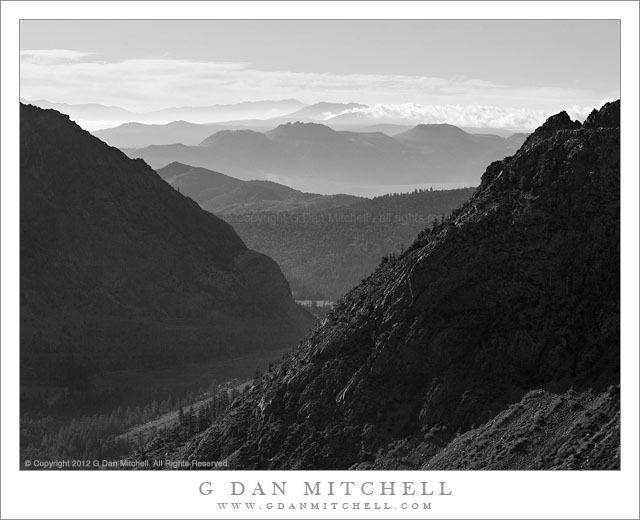
Lee Vining Canyon and Mono Craters, Morning - Morning clouds and haze over Mono Craters, as seen from the upper elevation of Lee Vining Canyon.
Morning clouds and haze over Mono Craters, as seen from the upper elevation of Lee Vining Canyon.

Lee Vining Canyon and Mono Craters, Morning. Eastern Sierra Nevada, California. July 14, 2012. © Copyright 2012 G Dan Mitchell – all rights reserved.

Morning clouds and haze over Mono Craters, as seen from the upper elevation of Lee Vining Canyon.

East of Tioga Pass, highway 120 (a.k.a. “Tioga Pass Road”) descends relatively gently past Tioga Lake and then Ellery Lake before it drop precipitously down the eastern escarpment of the Sierra Nevada through Lee Vining Canyon on its way to the junction with highway 395 just south of the town of Lee Vining. I’ve driven over it for years, going back and forth between my home in the San Francisco Bay Area and the east side of the Sierra, so I should be fairly nonchalant about it by now – but every so often as I pass over the route (most often looking down into the canyon from above) I wonder whatever possessed people to think that it would be a good idea to route a road across the talus fields and across the steep headway of this canyon.

During last week’s photographic trip to the Tuolumne Meadows area of Yosemite National Park I went over the pass twice. The first time was to scout out some possible shooting locations around Mono Lake – OK, and to get an espresso at Latte Da in Lee Vining – and the second was the following morning when I returned to shoot one of these locations. The night before I had moved my camp to Ellery Lake (it is a long story), which put me a bit closer to Mono Lake, so I was up well before dawn and at the lake before sunrise. After photographing my primary subject there right at dawn, I stuck around long enough to photograph the early morning light and haze above the lake, then headed back to break up my camp before heading home. As I crossed that headwall high up above Lee Vining Canyon, I looked east toward the Mono Craters. Looking that way is pretty much a habit, but I rarely find it to present anything that I want to photograph. This morning was different. I quickly found a turn-out and drove back to this spot. A nice haze filled the air (I like atmospheric haze for photography!), a few clouds clustered around ridges just beyond the volcanic Mono Craters, and a high line of clouds from monsoonal flow were in the far distance, with the steep walls of Lee Vining Canyon backlit and almost seen entirely in silhouette.

G Dan Mitchell is a California photographer whose subjects include the Pacific coast, redwood forests, central California oak/grasslands, the Sierra Nevada, California deserts, urban landscapes, night photography, and more.
Blog | About | Flickr | Twitter | FacebookGoogle+ | 500px.com | LinkedIn | Email

Text, photographs, and other media are © Copyright G Dan Mitchell (or others when indicated) and are not in the public domain and may not be used on websites, blogs, or in other media without advance permission from G Dan Mitchell.