Tag Archives: deep

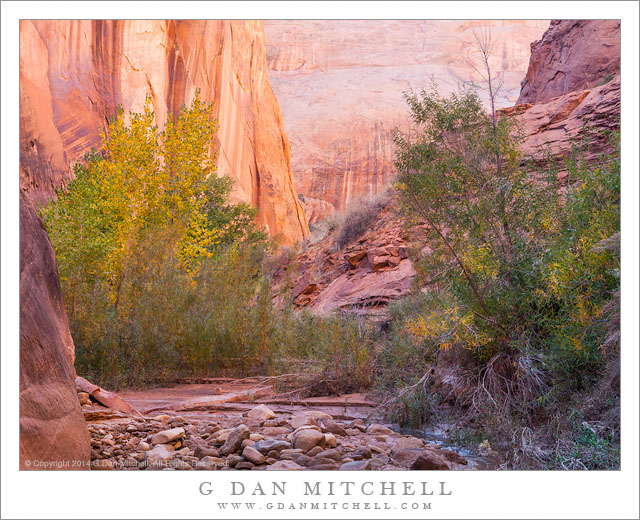
Glaciated Granite Landscape

Glaciated Granite Landscape

Glaciated Granite Landscape. Yosemite National Park, California. September 5, 2014. © Copyright 2014 G Dan Mitchell – all rights reserved.

Looking through evening haze into the depths of a deep canyon of glaciated granite, Yosemite National Park

Near a lake in the Yosemite backcountry where we camped for five nights were many examples of the common Yosemite glacial granite slab terrain, with sparse trees and glacial erratic boulders on top of both broken granite and smooth glacial polish. The highest nearby area of this sort attracted us and we visited it many times in both morning and evening hours.

This area, which featured a couple of low domes separated by a saddle of broken granite, sat near the edge of a very large river canyon that leads away to the west. The photographic possibilities here could keep one busy for many days — even more than the 5 or so days we had to work here. In the evening the light of the setting sun shone up the length of the canyon, causing the atmosphere within to glow and lighting all sorts of domes and ridges within the canyon. Sitting at the edge of this huge open area we also had extensive views of further and higher mountains. On this evening I climbed to the top of one of the domes and pointed my camera down into the depths of this canyon, shooting across the top of a nearby ridge on which scattered trees were still in the last light.


G Dan Mitchell is a California photographer and visual opportunist whose subjects include the Pacific coast, redwood forests, central California oak/grasslands, the Sierra Nevada, California deserts, urban landscapes, night photography, and more.
Blog | About | Flickr | Twitter | FacebookGoogle+ | 500px.com | LinkedIn | Email

Text, photographs, and other media are © Copyright G Dan Mitchell (or others when indicated) and are not in the public domain and may not be used on websites, blogs, or in other media without advance permission from G Dan Mitchell.
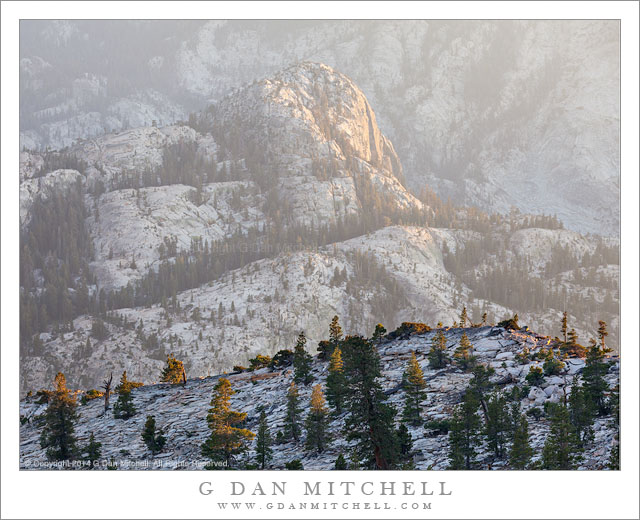
Erosion Patterns

Erosion Patterns
Erosion Patterns

Erosion Patterns. Death Valley National Park, California. December 10, 2013. © Copyright 2014 G Dan Mitchell – all rights reserved.

Deeply furrowed erosion patterns in early morning light, Death Valley National Park

I spent some time photographing Death Valley National Park in mid-December, during a very cold time of the year. It is not unusual for the place to be surprisingly cold in the middle of winter, but this was a period of exceptional cold and it got down to 25 degrees in the Valley and much colder in some of the places I visited in the surrounding desert mountains. I had arrived the evening before I made this photograph, and a sequence of events on the drive it suggest an inauspicious beginning to this visit. I usually come in through Ridgecrest and then up through Trona. I usually drive almost straight through to Ridgecrest and then take a long, late lunch break there – getting my last espresso until I come back out of the park, filling up the gas tank, and so forth. I killed pretty close to an hour taking care of these odds and ends, and then started out of town toward Trona.

Less than a mile up the road I ran into a flashing warning sign announcing that this entrance to the park was closed! This necessitated a bit of backtracking and then travel north up US 395 to then head east toward the park on highway 190. I had originally planned to arrive by mid-afternoon, set up camp, and then photograph in the evening… but by the time I finished all of this driving it was dark when I arrived and I simply pulled into the campground and slept in my car. Early the next morning, feeling just a bit disconnected, I drove over towards 20 Mule Team Canyon where I knew I should be able to find some nice morning light. In fact I did, and I soon found this beautiful miniature landscape of nearly parallel gullies in a hillside along the canyon. As the first light hit the edges off the ridges between the gullies I found a composition that mostly filled the frame with them. I finished shooting here and moved on. At my next location, I finally must have engaged my brain, and I checked the camera to find that it had been left on ISO 3200 from my previous work photographing musicians backstage at a concert in natural light. Groan! So this photograph is one that I managed to salvage from that little escapade… and I’m grateful for the relatively good performance of modern cameras… even when the operator is not paying attention!

G Dan Mitchell is a California photographer and visual opportunist whose subjects include the Pacific coast, redwood forests, central California oak/grasslands, the Sierra Nevada, California deserts, urban landscapes, night photography, and more.
Blog | About | Flickr | Twitter | FacebookGoogle+ | 500px.com | LinkedIn | Email

Text, photographs, and other media are © Copyright G Dan Mitchell (or others when indicated) and are not in the public domain and may not be used on websites, blogs, or in other media without advance permission from G Dan Mitchell.
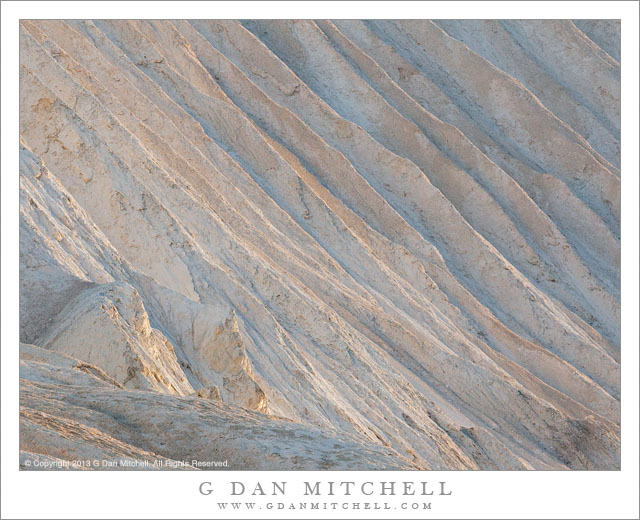
Room for the Big Deep Bend

Room for the Big Deep Bend
“Room for the Big Deep Bend” — Scowercroft’s Never Rip Overalls – Room for the Big Deep Bend

At about the time I made this photograph, we were staying in Torrey, Utah for a few days. Instead of doing the obvious thing and heading east to visit Capitol Reef National Park again, we headed west towards points unknown but including the Fish Lake area. We passed through small towns whose lives seemed more divorced from the tourist trade than others we had been through along route 12, and eventually turned off the main highway to head up to Fish Lake. It turned out that, at least partially as a result of my decision to not do too much research ahead of time, we had missed the main fall color season there and that, in fact, the whole place was pretty much shutting down for the season. We poked around a bit here before reversing direction and heading back to highway 24.

Rather than end our exploration quite so soon, we continued on along highway 24, soon turned off into the Valley where Koosharem is located. I cannot recall now what drove the decision to go there – perhaps the unusual name of the place or maybe the possibility of getting to mountains on the far side of the valley – but there we went. We initially pretty much drove right through Koosharem and on out into the country on the other side of town, but we soon stopped and decided that this was not the direction we really wanted to go. We turned around and headed back towards Koosharem. This time a few things caught our attention, including the plain architecture of certain buildings in the town and the surprising – to us, anyway – appearance of this antiquated looking, though clearly kept up, sign on the side of this building next to a leave littered parking area that also held an ATV and some sort of small trailer. I wondered about this sign and the advertising copy it contained, and I later found out that Scowercroft and Sons was a fairly large manufacturer of clothing centered in Ogden.


COMMENT OR QUESTION? Scroll down to the comment form.

G Dan Mitchell is a California photographer and visual opportunist. His book, “California’s Fall Color: A Photographer’s Guide to Autumn in the Sierra” (Heyday Books) is available directly from him. Blog | Bluesky | Mastodon | Substack Notes | Flickr | Email

All media © Copyright G Dan Mitchell and others.

Hikers, Titus Canyon

Hikers, Titus Canyon

Hikers, Titus Canyon. Death Valley, National Park. March 28, 2010. © Copyright 2011 G Dan Mitchell – all rights reserved.

Hikers in Titus Canyon, Death Valley National Park.

There are essentially two ways to get to this portion of Titus Canyon in Death Valley National Park – you can either do a very long drive from near Beatty on gravel roads or you can walk a short distance up from the base of the canyon along the eastern side of Death Valley itself. I’ve done both. The road is quite an experience – in any other park it would probably be regarded as a very special thing, especially the last portion above Death Valley where it twists and turns down a slot canyon that is in places barely wide enough to a vehicle yet so tall that it can be hard to see the tops of the canyon walls. (It is not exactly a bad road, but it isn’t trivial either. There are some very exposed sections where it crosses the mountain ridge and descends past Leadville. Although there are reports of people using lesser vehicles, take seriously the recommendations for reasonably high ground clearance and some from of all-wheel drive.)

However, on this visit I simply parked my car at the base of the canyon, shouldered my camera equipment, and walked up the canyon a ways. There is, of course, much that you probably won’t see if you enter the canyon this way, largely because the road is so long that you won’t likely cover much of it on foot. However, I think that you can more clearly sense the scale of the lower slot canyon when traveling of foot. I included two hikers who happened by to give a sense of that scale to the landscape.

G Dan Mitchell is a California photographer whose subjects include the Pacific coast, redwood forests, central California oak/grasslands, the Sierra Nevada, California deserts, urban landscapes, night photography, and more.
Blog | About | Flickr | Twitter | Facebook | Google+ | 500px.com | LinkedIn | Email

Text, photographs, and other media are © Copyright G Dan Mitchell (or others when indicated) and are not in the public domain and may not be used on websites, blogs, or in other media without advance permission from G Dan Mitchell.