

Tag Archives: eye

Great Egret Portrait

Great Egret Portrait
“Great Egret Portrait” — A “head shot” of a great egret.

Great egrets are a common sight here in California, from the coastline to inland wetlands and creeks. Their distinctive white plumage makes them stand out in almost any landscape. It doesn’t hurt that they are quite large, too — the largest of several different egret species. I photographed this one at a wetland area in California’s Central Valley on a foggy day that softened the light.

In some ways it is easy to photograph them, but in others it can be tricky. It is a bit easier to fill the frame with an egret since the birds are large. They also tolerate human presence… up to a point. So, it isn’t too hard to photograph them on the ground. Catching them in flight is a different matter. Most often they will be flying away from me, and when they take off they often do so suddenly and without much warning.


Leave a comment or question using the form. (Click the title to see the full article and to comment if you are viewing it on the home page.)

G Dan Mitchell is a California photographer and visual opportunist. His book, “California’s Fall Color: A Photographer’s Guide to Autumn in the Sierra” (Heyday Books) is available directly from him. Blog | Bluesky | Mastodon | Substack Notes | Flickr | Email

All media © Copyright G Dan Mitchell and others.
Window Formation, Desert Mountains

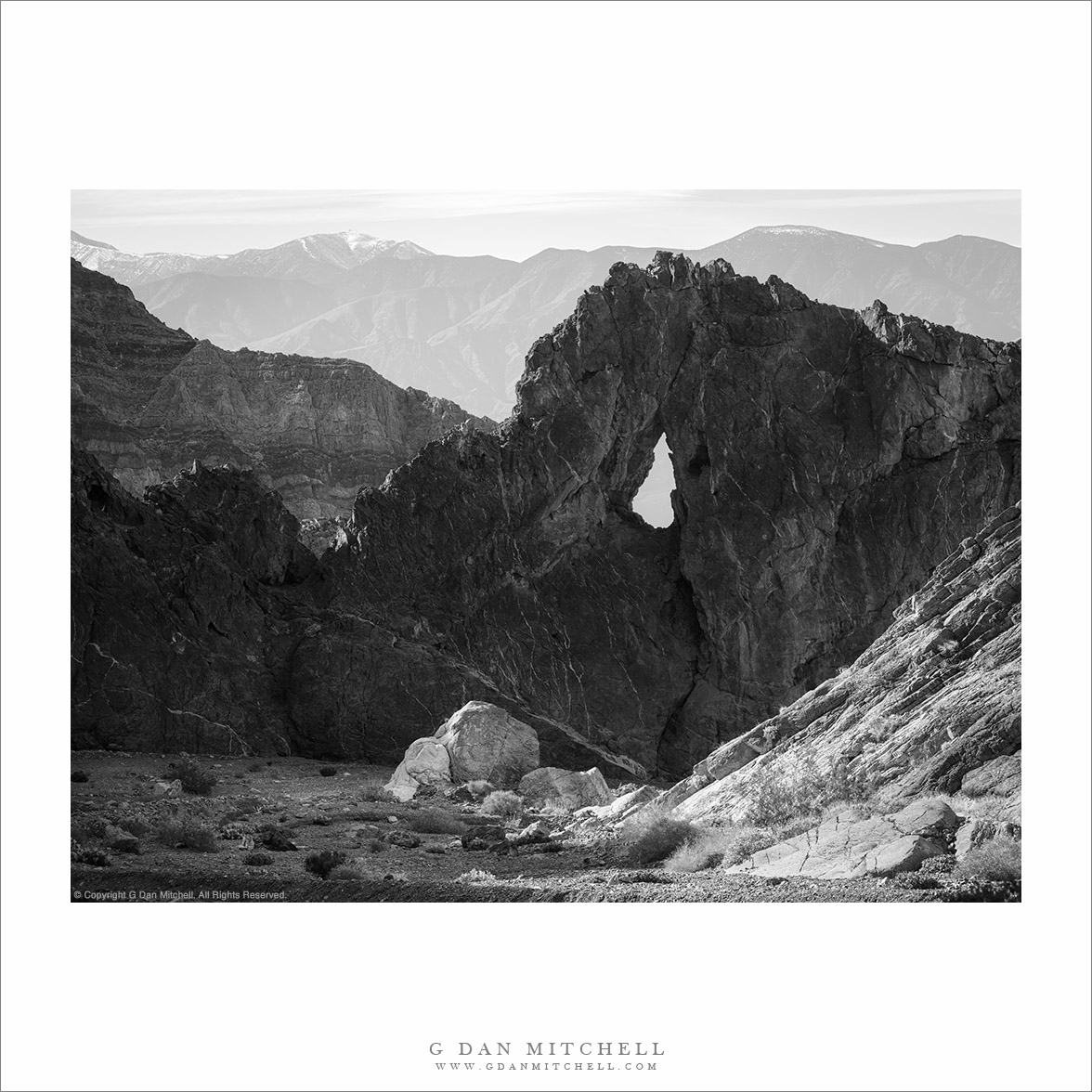
Window Formation, Desert Mountains
“Window Formation, Desert Mountains” — Desert mountains beyond a teardrop-shaped window in a rock wall, Death Valley.

Death Valley National Park is full of popular and famous attractions that are quite accessible — Mesquite Dunes, Badwater, Zabriskie Point, to name a few. But there’s far more to this immense park than the popular spots. There are equally worthy things to see everywhere, including in some rather remote locations. This is one of those sights, and the odds are that you would be alone here if you were to visit.

The feature is an impressive tear-drop shaped “window” in a wall of rock that stands on the inside of a sharp bend in the canyon. Beyond, further canyon walls rise above the wash, and in the far distance we see the highest peaks of the Panamint Range, including 11,000’+ Telescope Peak.


Leave a comment or question using the form. (Click the title to see the full article and to comment if you are viewing it on the home page.)

G Dan Mitchell is a California photographer and visual opportunist. His book, “California’s Fall Color: A Photographer’s Guide to Autumn in the Sierra” (Heyday Books) is available directly from him. Blog | Bluesky | Mastodon | Substack Notes | Flickr | Email

All media © Copyright G Dan Mitchell and others.
London Eye

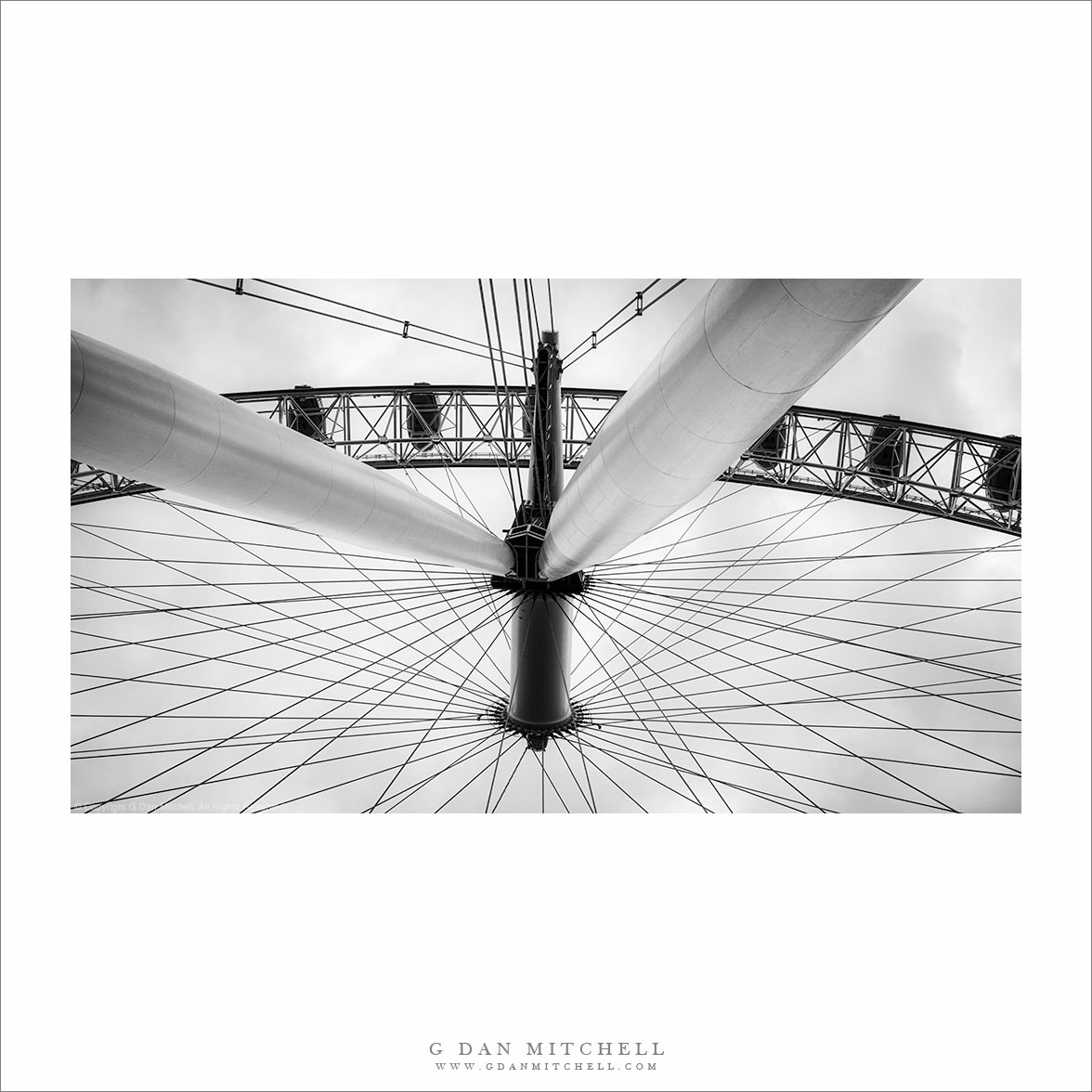
London Eye
“London Eye” — Looking upwards at the London Eye on a cloudy day.

I usually have a good sense of direction, and I can often navigate without maps. But I also have an occasional directional problem. When arriving in a new place I sometimes make an incorrect assumption about the compass directions. Once I do, it is darned near impossible for me to fix it. London is one of the places. For some reason, the first time I visited I reversed north and south, and I’ve struggled since then to get it right. I’ve gotten a lot better — when I look north across the River Thames these days it looks like it is north. But this photograph came about due to the residue of my prior confusion.

When we set out from our lodgings to walk to the nearby Borough Market, I went with my gut instead of logic and headed out confidently in the wrong direction. (To her credit, Patty suspected that I was going the wrong way, but went along.) We walked and walked and instead of finding the Market we were (or I was) surprised to walk up to the London Eye, which is in exactly the opposite direction!


G Dan Mitchell is a California photographer and visual opportunist. His book, “California’s Fall Color: A Photographer’s Guide to Autumn in the Sierra” is available from Heyday Books, Amazon, and directly from G Dan Mitchell.

Blog | About | Instagram | Flickr | Facebook | Threads | PostEmail

Links: Articles, Sales and Licensing, my Sierra Nevada Fall Color book, Contact Info.

Scroll down to share comments or questions. (Click post title first if viewing on the home page.)


All media © Copyright G Dan Mitchell and others as indicated. Any use requires advance permission from G Dan Mitchell.

Detached

No, not a feeling of detachment… a retinal detachment.

Some of you already know that I experienced a retinal detachment in my left eye late last week. To cut to the chase, the results of the medical procedure look good, and I’m very optimistic about the eventual outcome. Now that I’m recovering I thought I’d reply to all of the messages, questions, and support here in one place… and express gratitude for everyone’s concern and sympathy. Thank you!

So, what happened?

I’ve had the usual “floaters” in my eyes for a long time, so I didn’t pay much attention when I started seeing more of them in my left eye a while back — I figured it was just part of the typical process for aging eyes. However, late last week I noticed a dark “shadow” in the lower peripheral vision of my left eye, and it gradually expanded to become a significant dark area where I could not see. Since I helped my mother through an episode like this some years ago, I had a pretty good idea that  I was experiencing a retinal detachment, and I got to the doctor fairly quickly.

Retinal detachment is not uncommon, especially when the vitreous in our eyes detaches as we age, sometimes creating small tears in the retina. Fluid can then get beneath the retina, pushing it up from the structures underneath and cutting off blood flow, and then “turning out the lights” in that portion of the eye.

The first ophthalmologist quickly confirmed what I suspected and referred me to a senior ophthalmologist — who, it turned out, was the same doctor who had treated my mother many years ago. His exam confirmed the bad news that I did have a retinal detachment, but against that background there was quite a bit of relatively good news: the detachment was in the periphery of my vision and not beneath the macula, there appeared to be only a single tear in the retina, the detachment was in the upper half of my eye (things that appear “low” in our vision are projected on the upper part of the retina), we had likely caught it quickly enough, and I don’t have risk factors such as diabetes or previous eye surgery. Continue reading Detached