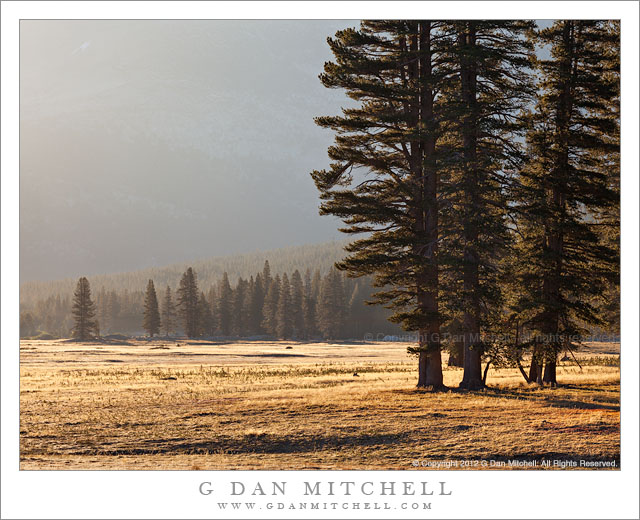
Late season golden morning light on trees at the edge of Tuolumne Meadows, Yosemite National Park.
It is probably no secret that there are certain kinds of light that especially appeal to me. Among my favorite is early morning sunlight, shining through a bit of atmospheric haze, and illuminating trees. On top of that, I’m a big fan of the warm golden-brown tones of September and autumn in the Sierra. With all of that in mind, how could I resist this subject?
I was in Tuolumne Meadows for a couple of nights in mid-September, with two main goals in mind. First, I wanted to spend a few days at altitude before heading over to the east side to meet friends for a short pack trip up into McGee Canyon. Second – or perhaps this should be first – I wanted to do some photography in the area along Tioga Pass Road between roughly Olmsted Point and the pass itself. I arrived late the first day, with just enough time to set up camp, grab something to eat, and head out to shoot the evening light. I was up reasonably early the next morning and out and about looking for subjects before the sun came up. I decided to stick fairly close to the meadows this time, and after heading to the west end and looking back I saw this beautiful warm light coming across the meadow as the sun topped the crest near Mount Dana, and silhouetting a small group of tall trees at the meadow’s edge.
G Dan Mitchell is a California photographer whose subjects include the Pacific coast, redwood forests, central California oak/grasslands, the Sierra Nevada, California deserts, urban landscapes, night photography, and more. Blog | About | Flickr | Twitter | Facebook | Google+ | 500px.com | LinkedIn | Email
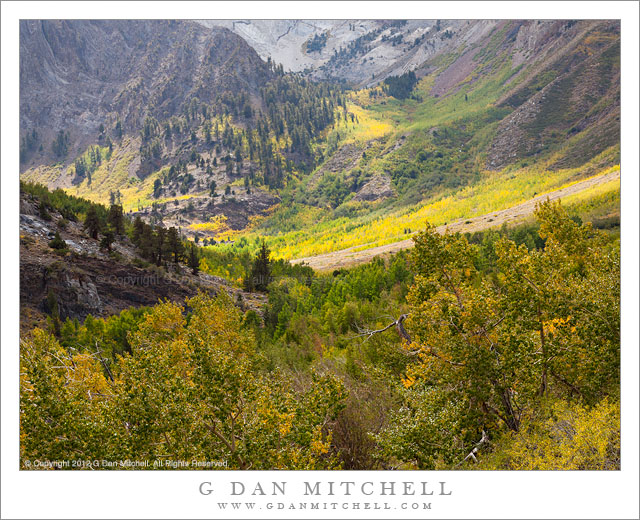
Early fall color comes to McGee Canyon in the eastern Sierra Nevada, California.
I’m going to use today’s post not only as the opportunity to share another daily photograph, but also to share some observations about the arrival of the fall aspen color season in the eastern Sierra Nevada range, where I spent a good part of the past week.
I made the photograph at the very end of a three-day backpack trip up into the McGee Creek drainage, where we settled in at a 10,000+” lake for a couple of nights to enjoy the late-season solitude. (Before starting the pack trip I had spent a couple of days in Tuolumne Meadows, and upcoming posts will concern that part of the trip.) McGee Canyon is an eastern Sierra “type” – a typical trailhead canyon that rises from the high desert, into forests, through increasing rugged and rocky country, and finally reaches the crest of the range at a pass. On this early afternoon we were fortunate to get a few clouds, moderating the intense sun and adding a bit of texture to the landscape. The photo was somewhat casual – still wearing my full pack, I shot hand-held.
About the onset of fall color… I have watched this transition carefully for a number of years. While I have learned a lot about how the process unfolds, I have also learned that many aspects of it defy precise prediction. Every September, those of us who chase eastern Sierra aspen color start to watch for signs that might provide clues about the nature of this season – the amount of snow during the previous winter, how late it remained before melting out, long-range weather forecasts, early color changes in many other plants that can show up even in late August, and more. But, truth be told, in the end every aspen season seems to hold surprises and defy out attempts to know in advance how it will play out. A season may start with early color up high, only to be interrupted by early storms. Or a season may start late and then move very quickly. Or poor early color in one part of the range may lower expectations… only to be followed by great low-elevation later on. Or there may be any number of other possible variations, too numerous to list.
All of this is my way of saying to take my observations with a suitable dose of salt. :-)
Several weeks ago I began to read the typical early September notes about “early color” here and there, especially in portions of the Rockies and some areas of the Southwest. I was intrigued, but not ready to believe it. I read and hear these reports of early color every season – and generally the correlation between what is written and what occurs in the actual event is weak.
This has been an odd summer season for me, for reasons I won’t go into here. As a result, I had not been to the Sierra since early July or so – a very large gap of time for me, since I rarely allow more that a couple of Sierra-free weeks to occur in the summer. I was not there at all during August – which is almost unheard of. I usually catch my first hint of oncoming autumn on one of those late-August visits. It is hard to put my finger on precisely what it is, but invariably (well, almost invariably, since it didn’t happen this year…) there will be a day when I sense “something” in the air that reminds me that summer will end very soon – whether it is a breeze, a quality of light, a change in the plants, I can never tell for sure. But I am sure when I experience it.
Soon there are more concrete signs. The golden-brown dried meadow areas start to expand, the wildflowers are harder to find, corn lily plants begin to turn golden-yellow, bilberry leaves turn dark red (and brilliant red when back-lit) and the leaves of willows near streams and lakes turn yellow. By mid-September all of this is typically underway, and at this point I start thinking about aspen color in earnest. Whether it is because we tend to go to different places to find our aspens or because we have experienced different seasonal variations, individuals will tell you to look for the aspen show to begin at somewhat varying times. I tend to look for real aspen color around the very beginning of October, and to expect a peak roughly a week into the month in the higher country. Except for watching for the odd tree with a branch full of yellow leaves, I don’t expect to seem much real color in September.
But… I just returned from a pack trip that was right in the middle of September… and I saw a significant amount of aspen color. As I drove over the Sierra crest on my way to the east side I was not expecting to see aspen color, and I did not see much. Despite the other sources of fall color, the aspens just east of Tioga Pass and down in Lee Vining Canyon were almost uniformly as green as I expected. When we arrived at our eastern Sierra trailhead, there were a few yellow leaves here and there, but nothing too out of the ordinary. However, a mile or two up the trail I was quite surprised to find large stands of aspens in which many trees were showing color – just a few leaves on some, but perhaps a quarter or a third of the tree in the most extreme cases. In my experience, this is unusually early – but at least a week and arguably perhaps a bit more. (Not all of the color in the photograph comes from aspens, by the way.)
What does this mean? I’m not sure. If I had a bit more time I would have investigated one or two other east-slope canyons to see what is going on elsewhere – it could be that this canyon is somehow out of sync with others. But I doubt it. All I’ll say is the following: Some aspen color is already beginning to appear in some areas of the eastern Sierra. While no one knows when the main show will arrive (or what it will look like), if I were making plans for a visit to the eastern Sierra to photograph aspen color, at this point I would lean toward going a little bit early rather than a little bit late. However, as always, realize that you cannot count on the timing or the quality of the display, and flexibility increases your odds of being there at a good moment.
More articles on Eastern Sierra aspen photography:
G Dan Mitchell is a California photographer whose subjects include the Pacific coast, redwood forests, central California oak/grasslands, the Sierra Nevada, California deserts, urban landscapes, night photography, and more. Blog | About | Flickr | Twitter | Facebook | Google+ | 500px.com | LinkedIn | Email
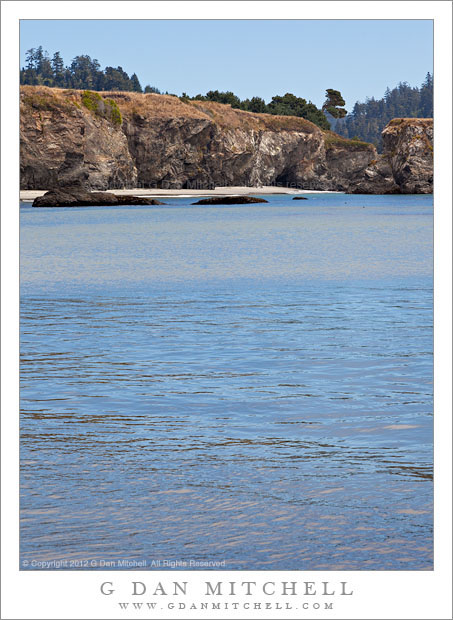
Beach and shoreline bluffs above the blue water of Mendocino Bay, California.
This photograph was made on the beach along the shoreline of Mendocino Bay, beneath the tall bluffs that line the area. The land extends to the west and curves a bit to the south, allowing me to photograph back along the curving beach, toward the inlet of the river that drains into the bay and the forested hills beyond. The light was interesting – fog was coming in along the coast and was overhead at my camera position, but clear just inland of me. This created soft and somewhat gray light on the foreground water, but allowed the further hills and forest to be in the light. It also made the interesting reflection on the calm water more visible.
G Dan Mitchell is a California photographer whose subjects include the Pacific coast, redwood forests, central California oak/grasslands, the Sierra Nevada, California deserts, urban landscapes, night photography, and more. Blog | About | Flickr | Twitter | Facebook | Google+ | 500px.com | LinkedIn | Email
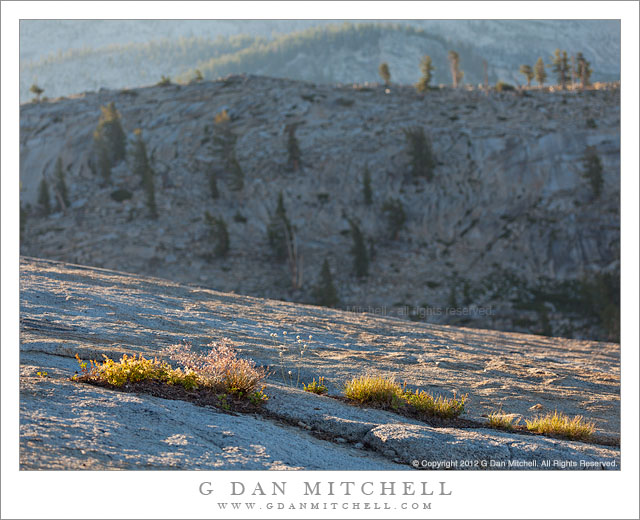
A few sparse plants grow in thin cracks in granite slabs, Yosemite National Park.
Portions of the Sierra high country in Yosemite have been heavily glaciated. The evidence is widespread and familiar in all of its variations: domes, U-shaped canyons, remnant glacial ice-fields and a few vestigial glaciers, glacial erratics everywhere, a terrain crossed with the remains of lateral, medial, and terminal moraines. And it places, such as this area along Tioga Pass Road, there are huge expanses of granite slabs, sloping and rounded nearly solid rock broken by cracks and dikes and surrounded by the debris of gradual erosion.
Lots of things managed to live on and in these slabs. The tiniest cracks collect sand, then dust and gravel, and soon small plants spring up and even wildflowers. In some places – including the more distant ridge in this photograph – large trees manage to sustain themselves by growing entirely in these cracks. In this photograph I juxtaposed the nearby small plants crowing in a couple of shallow cracks with the receding sequence of rolling dome-like ridges with shattered rock and a few trees, some of which catch the early morning sun, with details softened by the (perhaps unusual, for landscape photography) use of a small aperture to minimize depth of field.
G Dan Mitchell is a California photographer whose subjects include the Pacific coast, redwood forests, central California oak/grasslands, the Sierra Nevada, California deserts, urban landscapes, night photography, and more. Blog | About | Flickr | Twitter | Facebook | Google+ | 500px.com | LinkedIn | Email

 G Dan Mitchell is a California photographer whose subjects include the Pacific coast, redwood forests, central California oak/grasslands, the Sierra Nevada, California deserts, urban landscapes, night photography, and more.