
Tag Archives: fork

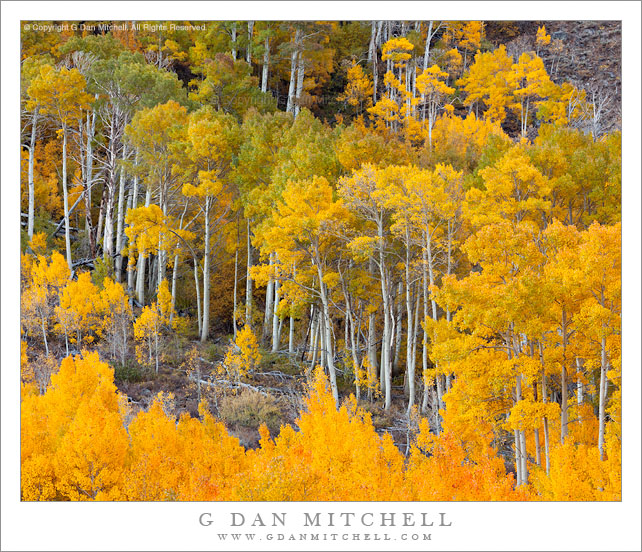
Aspen Color, South Fork Bishop Creek

Aspen Color, South Fork Bishop Creek

Aspen Color, South Fork Bishop Creek. Eastern Sierra Nevada, California. October 15, 2011. © Copyright 2011 G Dan Mitchell – all rights reserved.

Brilliant peak autumn color in aspen groves along the south fork of Bishop Creek, eastern Sierra Nevada.

One week earlier I had visited this same area only to find a mixture of trees that had lost their leaves during a series of early fall snow storms and trees that were essentially still fully green. What a difference a week made! This fall it seemed that once the color change started, it moved quickly. Not only were these middle elevation trees in full autumn color, but in many places the color extended all the way down to the edge of Owens Valley.

These trees are along the south fork of Bishop Creek, off of the road to South Lake, and not far from so-called “Mist” or “Misty” falls. (I’m skeptical about this waterfall – it gives every appearance of having been constructed by redirecting water to a place where it would not likely flow naturally. I’ll welcome accurate information about that.) Perhaps because these trees grow in a fairly open and wide valley, many of them have managed to grow rather tall and quite straight, in contrast to a number of other Sierra groves that consist of small and often twisted trees. The rows of trees angle up slopes from the creek in the valley bottom and seem to be arranged in diagonal groves that ascend the hillside.

G Dan Mitchell is a California photographer whose subjects include the Pacific coast, redwood forests, central California oak/grasslands, the Sierra Nevada, California deserts, urban landscapes, night photography, and more.
Blog | About | Flickr | Twitter | Facebook | Google+ | 500px.com | LinkedIn | Email

Text, photographs, and other media are © Copyright G Dan Mitchell (or others when indicated) and are not in the public domain and may not be used on websites, blogs, or in other media without advance permission from G Dan Mitchell.

Aspen Grove, Filtered Light

Aspen Grove, Filtered Light

Aspen Grove, Filtered Light. Bishop Creek Canyon, California. October 15, 2011. © Copyright 2011 G Dan Mitchell – all rights reserved.

Gentle light filters to the forest floor within an autumn aspen grove near the south fork of Bishop Creek.

This is yet another of my familiar and favorite aspen groves in the south fork of Bishop Creek Canyon. Despite the fact that the frame is completely filled with trees in this photograph, the grove is not all that large, being a lot longer than it is thick. Behind me there is a gravel road and then a creek, and at the far edge of these trees the landscape abruptly opens up to talus slopes leading towards tall peaks to the south.

I like this spot for several reasons. For one thing, it is a bit off the beaten path since you have to leave the main road in a not-that-obvious spot and then follow a one-lane dirt road that winds through the trees. In addition, there is nothing obviously special or scenically attractive about this exact spot – the first time I stopped in this exact location is was primarily because there was a wide spot along the dirt road to park my car! This is another of those aspen groves that consists of densely packed and rather small and spindly trees. The trees are close enough together that it is actually rather difficult to walk among them, and I had to twist and turn and duck to get into this spot.

Partly because of the filtered light and the density of the trees, and partly because I shot with a very wide-angle lens, it seems like the edge of the grove is a long ways off and quite indistinct. By the point at the edge – which is probably just barely visible in a print – the detail of trunks and branches and leaves is so dense that the boundary is very hard to see.

G Dan Mitchell is a California photographer whose subjects include the Pacific coast, redwood forests, central California oak/grasslands, the Sierra Nevada, California deserts, urban landscapes, night photography, and more.
Blog | About | Flickr | Twitter | Facebook | Google+ | 500px.com | LinkedIn | Email

Text, photographs, and other media are © Copyright G Dan Mitchell (or others when indicated) and are not in the public domain and may not be used on websites, blogs, or in other media without advance permission from G Dan Mitchell.
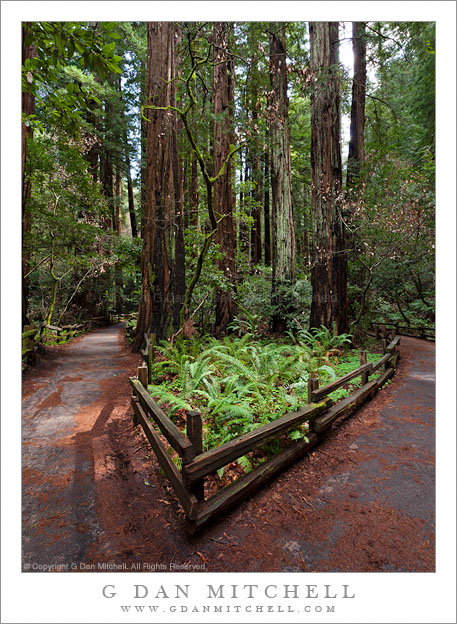
Trail Junction, Redwood Forest and Ferns

Trail Junction, Redwood Forest and Ferns

Trail Junction, Redwood Forest and Ferns. Muir Woods National Monument, California. March 8, 2009. © Copyright 2009 G Dan Mitchell – all rights reserved.

A bed of ferns grows at a trail junction under deep redwood forest cover at Muir Woods National Monument.

This photograph was made in the late winter of 2009, during that time of the year when the redwood forest is still very wet and cool, but when flowers are blooming and spring is clearly on the way. The location is along the very popular (and often quite busy) main trail along the creek through the central part of the park. No doubt I had to wait a bit for the combination of these beams of light and no other visitors on the trail!

G Dan Mitchell Photography
About | Flickr | Twitter | Facebook | Google+ | 500px.com | LinkedIn | Email

Text, photographs, and other media are © Copyright G Dan Mitchell (or others when indicated) and are not in the public domain and may not be used on websites, blogs, or in other media without advance permission from G Dan Mitchell.

(Basic EXIF data may be available by “mousing over” large images in posts when this page is viewed on the web. Leave a comment if you want to know more.)

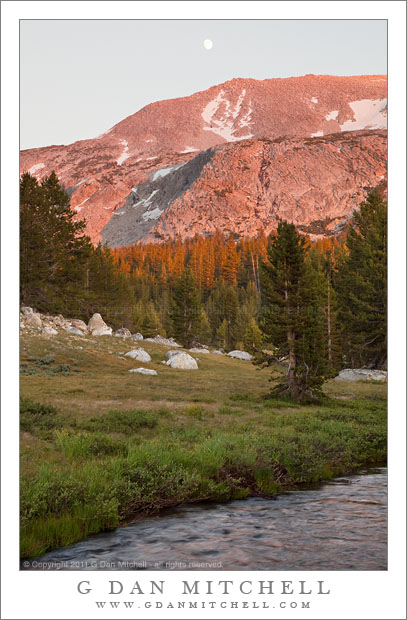
Sunset and Moonrise, Kuna Crest

Sunset and Moonrise, Kuna Crest

Sunset and Moonrise, Kuna Crest. Yosemite National Park, California. August 10, 2010. © Copyright 2011 G Dan Mitchell – all rights reserved.

The nearly- full moon rises above the sunset light on Kuna Crest, Yosemite National Park.

Kuna Crest runs up Lyell Canyon between the Lyell and Dana forks of the Tuolumne River with the Sierra crest at one end and Mammoth Peak at the other. (Mammoth Peak is the large peak straight in front of you as you top Tioga Pass entering Yosemite National Park.) This ridge can catch great sunset light during the summer, and as I came down from the pass, heading back toward my camp at Porcupine Flat, and saw the almost full moon appearing over the shoulder of the ridge I decided to quickly stop and make a few exposures as the last light was about to leave the forest and soon after the peaks.

If you have tried photographing a scene that includes the moon in the early evening you know that the exposure is a tricky thing. The moon is lit by daylight, so it isn’t too surprising that the “correct” exposure for the moon is close to a normal daytime exposure. But that is not the right exposure for the rest of the scene, which turns out to be quite a bit darker than daylight at this time of day. In this scene things were even more complicates as the very saturated red colors on the ridge were quite “hot,” while the foreground meadow and forest was in shade and both darker and cooler in color. Basically, the dynamic range between the moon and the foreground was too large for a single exposure… so I made several.

At the time of exposure I thought that I might need as many as three component images in the final photograph – they would be one exposed for the bright ridge and sky, one exposed for the rather dark and shadowed foreground, and possibly a third that correctly exposed the moon. To be on the safe side I bracketed four exposures. When I began to work on the image I figured out that in this case I could construct a final “believable” image from two exposures if I was careful and could make some additional adjustments during post.

This is an example of a shot in which the use of a graduated neutral density filter could have been problematic, but where exposure blending could work very well. (“Exposure blending” is one term for the process of manually combining two component exposures using masked layers in Photoshop. No, it is not the same thing as HDR photography.) One of the things that would have been quite tricking using graduated neutral density filters is that the division between the brighter upper half and the darker lower half is not linear. Instead, the roughly follows the curved boundary between the lower meadow and dark trees and the still sunlit trees and the peak and sky.

G Dan Mitchell Photography
About | Flickr | Twitter | Facebook | Google+ | 500px.com | LinkedIn | Email

Text, photographs, and other media are © Copyright G Dan Mitchell (or others when indicated) and are not in the public domain and may not be used on websites, blogs, or in other media without advance permission from G Dan Mitchell.

(Basic EXIF data may be available by “mousing over” large images in posts. Leave a comment if you want to know more.)