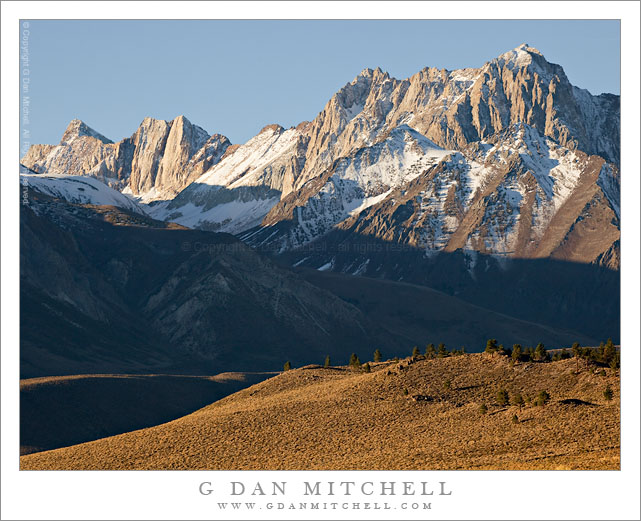
Early morning light on sagebrush covered Owens Valley hills and the Sierra crest near Mount Morrison.
I was out in this section of Owens Valley early on this October morning, initially to photograph at a small lake further out in the valley. However, knowing parts of this area pretty well from past visits, I wanted to try a photograph that included the foreground tree-covered ridge in morning light with the Sierra peaks in the background – so I headed back on a gravel road that travels a bit north of the paved road I had taken earlier in the morning. I found this scene with the early light illuminating the crest of the Sierra and the sagebrush-covered foreground hills, but with morning shadows still lying across the lower eastern face of the Sierra just south of Convict Lake.
The dusting of early season snow was left over from a week of early autumn storms. Mt. Morrison is the huge and impressive summit at the right end of the ridge. Mt. Baldwin is the small but very high summit near the left end. In between is a vertical rock face that appears to be split by a crack – I think it is called “the Great White Fang.”
This photograph is not in the public domain and may not be used on websites, blogs, or in other media without advance permission from G Dan Mitchell.
Basin Mountain and the Sierra Nevada crest rise above Round Valley on a hazy afternoon.
There is a certain kind of afternoon light in the eastern Sierra that is hard to photograph – looking up at the range from Owens Valley into the afternoon sun the haze can be bluish and decrease detail and the light can be very bright. But it is a part of the experience of the “east side” that we all know, I think. I can’t say that I’ve tried to photograph it very often, but I stopped just off of highway 395 in the Round Valley area on this early October afternoon when I saw the rugged foothills rising above the sagebrush towards the Buttermilks and Basin Mountain and the Sierra crest around Mount Humphreys beyond.
For me, this is one sort of classic eastern Sierra view. Imagine a very warm or even hot afternoon. You are driving through high desert sagebrush country – which often surprises people who are headed to the Sierra and are thinking about high mountains and cool temperatures. The mountains to the west rise precipitously from the floor of Owens Valley, with peaks that can be nearly 10,000 feet higher than the lowlands in some places. You see snow on the peaks and sometimes on the slopes of the mountains. You know that there are places up there where you can park a car and walk out in cool mountain air and head up a trail through meadows and forests and cross a ridge into the alpine world – but the terrain gives little hint of this from below. The light gleaming on snow fields and rock projected into the sky reminds you of this other world high above.
This photograph is not in the public domain and may not be used on websites, blogs, or in other media without advance permission from G Dan Mitchell.
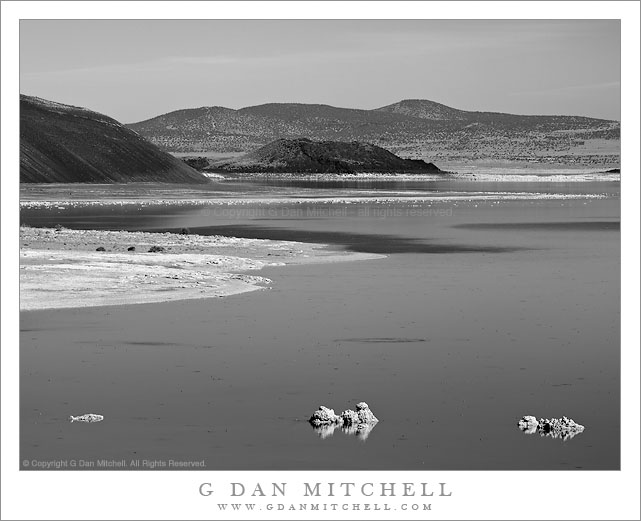
The north shoreline of Mono Lake leads from foreground offshore tufa past the base of Black Point to Negit Island and beyond.
You would never know it from this black and white photograph of the austere desert landscape around Mono Lake, but I was there to photograph… fall aspen color! Earlier in the day I had photographed further south along the eastern slopes of the Sierra, gradually working my way north with a plan of heading back to the “west side” over Tioga Pass at the end of the day after doing a last bit of fall color photography near Conway Summit and Dunderberg Road in late-afternoon light. By mid-afternoon I had made it to Lee Vining for an espresso stop at Latte Da and a break to check some email and so forth. Soon it was time to get into position for the low angle sun that would light the aspens a bit later, so I headed north out of town.
The road north from Lee Vining skirts the west shore of Mono Lake. Before leaving the lake there is a turn-off to another road that passes along the north shore of Mono Lake and can take you to places such as Black Point. I often stop at this turn-off since it provides a slightly elevated view of the larger terrain around the lake including the low hills to the east and Mono Craters and higher mountains to the south. On a typical blue sky mid-afternoon I might not make any photographs, but something about the light and the forms of the shoreline, Black Point, and Negit Island leading into the distance convinced me to make a few exposures, using a long lens to compress the distance.
This photograph is not in the public domain and may not be used on websites, blogs, or in other media without advance permission from G Dan Mitchell.
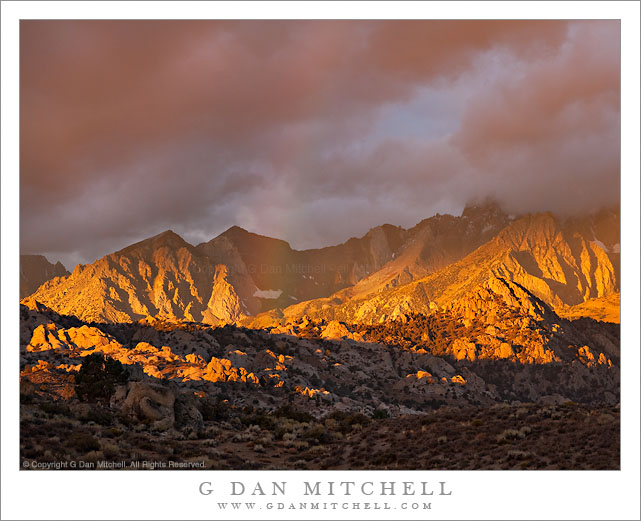
A faint rainbow briefly glows in dawn light on the eastern escarpment of the Sierra Nevada above the Buttermilks as an autumn storm builds.
Since I wrote previously about acting on a hunch to be in this spot in time to catch a few minutes of dawn light, I won’t recount the whole thing here – though I would like to describe the phenomenon a bit more and perhaps make a point or two about light and opportunities.
The photograph is of the eastern escarpment of the Sierra Nevada above Bishop, California and was made on an early autumn morning of a day that brought one of the first winter-like storms of the season. I found myself in this spot (as described at the link) for the very few minutes during which this light was present – and afterwards the light was simply gone and the rest of the day was overcast and rainy. The circumstances have me thinking about a few things about light and “being there” at the right moment.
Sometimes, even on a “poor light day” – though I like overcast conditions! – there can be a few brief moments of exceptional light. Catching them involves some combination of anticipating that these moments might occur, being there, and – let’s admit it! – dumb luck. In this case, all three were at work. I did not know that this light would occur, but I knew that the conditions offered a possibility. A clearing in the clouds along the eastern horizon allowed a horizontal beam of light to briefly hit the mountains right at dawn. It began by striking the clouds above the Sierra crest, soon hit the highest peaks, moved across the face of the range, and within minutes the show ended with light on the high desert. The band was so narrow that only one of these subjects was generally illuminated at a time – and the whole thing couldn’t have lasted more than five or ten minutes.
That description might make it sound like I’m saying that I’m just plain great at predicting such things and planning to be there. Not quite! If you had asked me a few minutes earlier, when I made the spontaneous decision to abandon my previous plans and high-tail it out to this spot, what the odds were that I’d see light like this I might have estimated them at perhaps 10% or less. In other words, if I repeated this little adventure 10 times, I’d guess that I’d fail to see light like this nine out of ten times. However, if I only go for “sure bets” (which I’ll take when I can get them!) I know that I’ll miss lots of special conditions that are not subject to prediction.
Which brings up the subject of luck. I often read that one should be able to know in advance what the photograph will look like, and that careful and full preparation will lead to good photographs. Well, sort of, but maybe not quite in the way that some imply. (There is an element of “preparation” in all of this that I’ll write about eventually, but that is a different thing.) Frankly, these subjects are too complex and too fleeting and too unpredictable to be subject to that sort of careful and precise planning in any sort of consistently useful way. The photographer cannot make that small band of open sky appear along the horizon on an autumn morning when a storm is building along the crest – but if everything goes right a photographer might be there at the right moment, prepared to make a photograph of it.
This photograph is not in the public domain and may not be used on websites, blogs, or in other media without advance permission from G Dan Mitchell.
Photographer and visual opportunist. Daily photos since 2005, plus articles, reviews, news, and ideas.
Manage Consent
To provide the best experiences, we use technologies like cookies to store and/or access device information. Consenting to these technologies will allow us to process data such as browsing behavior or unique IDs on this site. Not consenting or withdrawing consent, may adversely affect certain features and functions.
Functional
Always active
The technical storage or access is strictly necessary for the legitimate purpose of enabling the use of a specific service explicitly requested by the subscriber or user, or for the sole purpose of carrying out the transmission of a communication over an electronic communications network.
Preferences
The technical storage or access is necessary for the legitimate purpose of storing preferences that are not requested by the subscriber or user.
Statistics
The technical storage or access that is used exclusively for statistical purposes.The technical storage or access that is used exclusively for anonymous statistical purposes. Without a subpoena, voluntary compliance on the part of your Internet Service Provider, or additional records from a third party, information stored or retrieved for this purpose alone cannot usually be used to identify you.
Marketing
The technical storage or access is required to create user profiles to send advertising, or to track the user on a website or across several websites for similar marketing purposes.