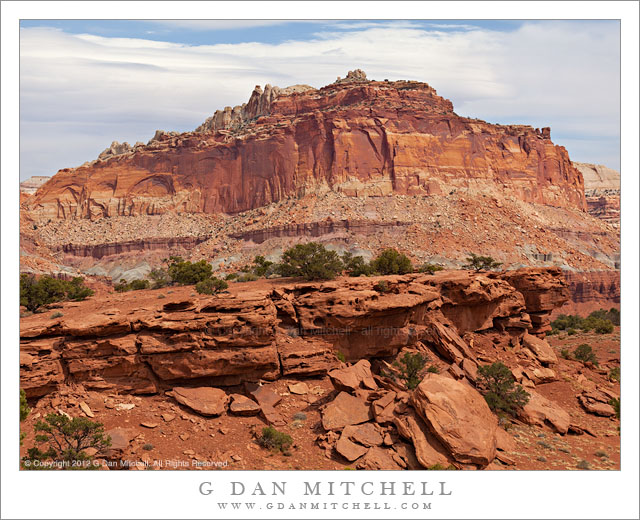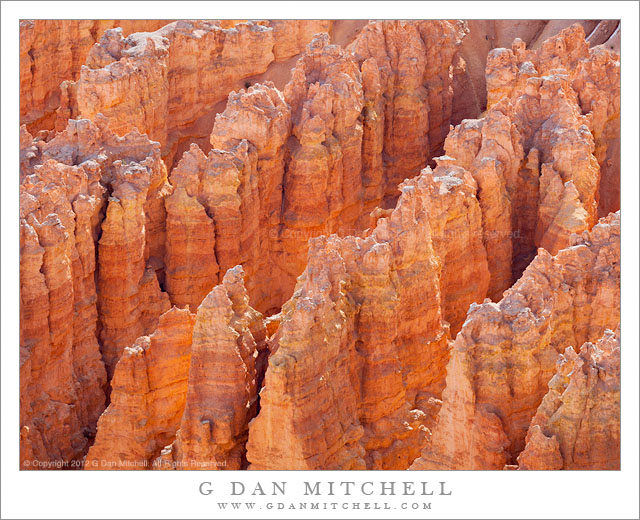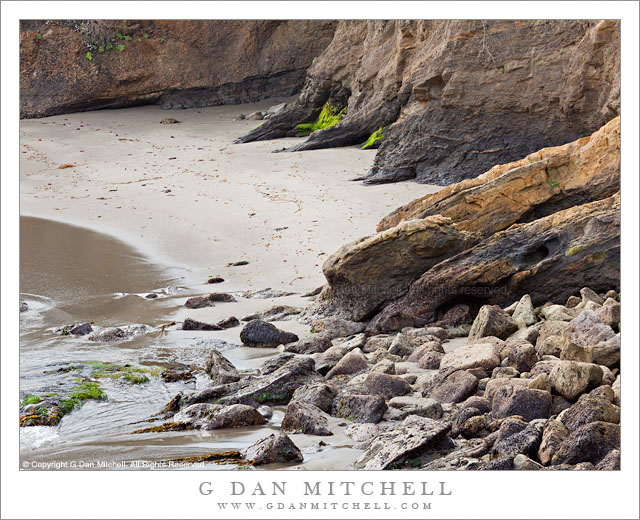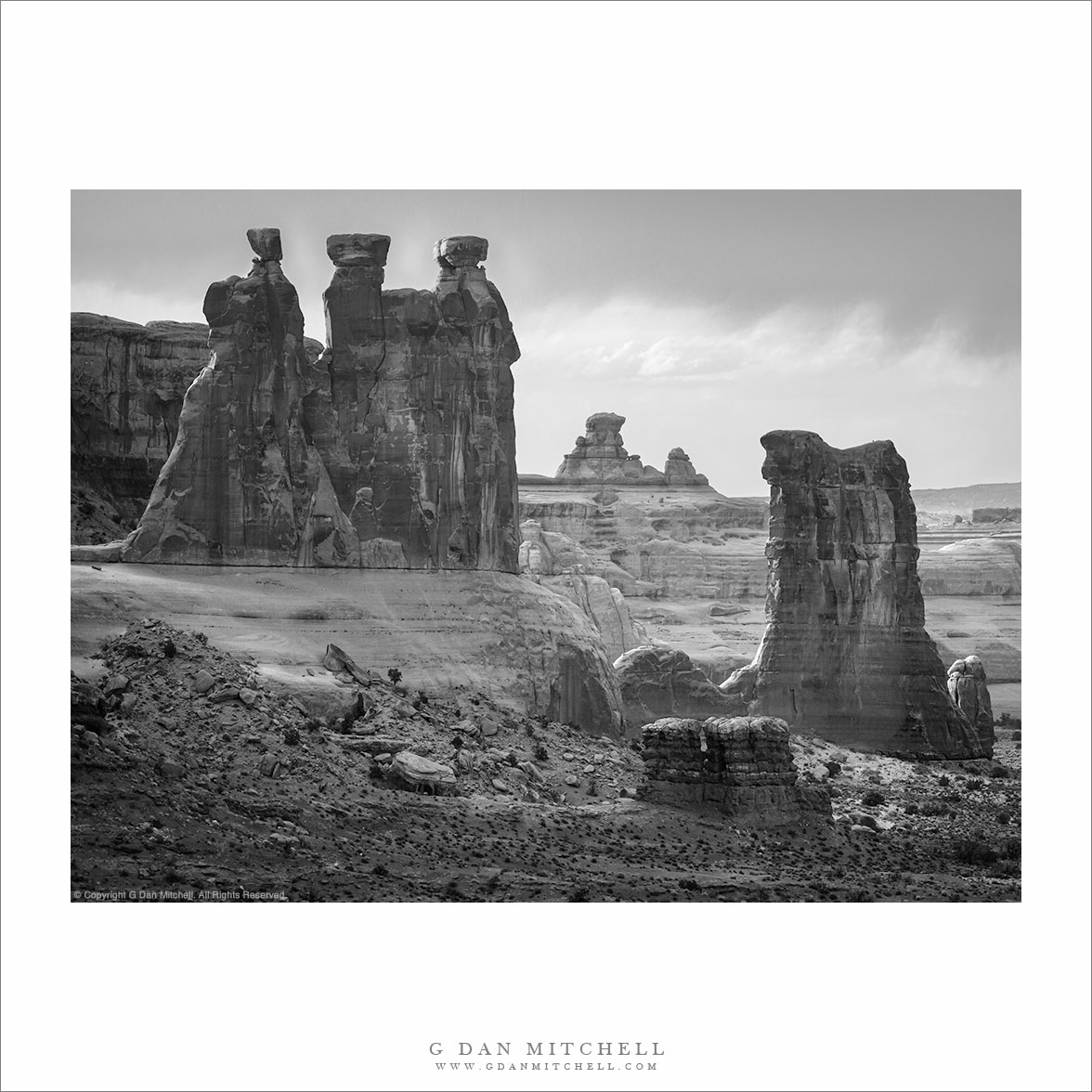
First morning light on the rugged landscape of the base of Tucki Mountain and the Panamint Range, Death Valley National Park, California
This photograph was made from a location a ways up from the bottom of Death Valley, from which I could look directly across at the lower slopes of gigantic Tucki Mountain as the first morning light worked its way down toward the lower ridges and the huge alluvial fan at the base of the mountain. At the moment I made the exposure the light was just beginning to fill this slanting area below the rugged mountains, and the light was softened by morning haze.
Tucki Mountain is a huge peak that almost seems to me to be large enough to count as its own minor mountain range. It rises above Stovepipe Wells, and extends a great distance east, south, and west of there. It is laced with deep canyons and its lower slopes are heavily eroded to reveal tilting and twisting strata. Another large valley lies on beyond the foreground spur ridge in this photograph, and beyond that the Panamint Range rises to its crest at 11,000+’ Telescope Peak.
G Dan Mitchell is a California photographer whose subjects include the Pacific coast, redwood forests, central California oak/grasslands, the Sierra Nevada, California deserts, urban landscapes, night photography, and more. Blog | About | Flickr | Twitter | Facebook | Google+ | 500px.com | LinkedIn | Email
UPDATE: As of 2020 I am no longer posting annual updates concerning this subject — and I am editing older posts on the subject in light of the need to be more responsible about not encouraging the onslaught. I also no longer recommend going to the Valley to see it. Unfortunately, too much exposure (yes, I played a part in it, unfortunately) has led to absurd crowds, traffic jams, littering, destruction of areas in the Valley where too many people go to see it… and the park has increasingly — and appropriately — cracked down. Parking options have been eliminated, at least one viewing location has been closed. Good news! The rest of Yosemite Valley is still there and often exceptionally beautiful at this time of year.
The silver strand of Horsetail Fall and water reflecting on surrounding cliffs in late afternoon light, Yosemite Valley.
This being February, it seems that Horsetail Fall has again (and more every year) become a hot topic. Horsetail Fall, sometimes referred to as the “Natural Firefall” has been popularized to an absurd and, frankly, dangerous level on social media and in the press. To be honest, I now recommend that you not go.
The conjunction of elements required to produce the most spectacular Horsetail Fall “event” is complex. First, it depends on the geological coincidences of the placement of the fall in a spot hight on the face of El Capitan that receives a narrow beam of sunset light during two brief periods each year. Second, the fall must be running – in roughly the middle of winter. The area supplying water to the fall is high enough to be snow-covered in a typical winter, but low enough that snow can melt and start the fall flowing even in the cold season – but this is not a sure thing. Essentially, there must be snow and then some warmth to melt it, or else some significant warm rain. Third, a series of meteorological events must play out just right. Obviously, the upper face of El Capitan must be clear of clouds. (Yosemite Valley fog and clouds ringing the cliffs are rather common in the winter season.) The sky west of the Valley must also be clear all the way to the horizon since the best color occurs just before the sun hits the horizon.
Most often the requirements do not align. Many of us can tell stories of light getting better and better, leading toward a brilliant finale… and then the “lights going out” just at the peak of color as the sun dropped behind clouds far to the west.
Hundreds and hundreds Thousands of photographers now show up to try to photograph the thing. I’ve done it in the past, though I’m no longer interested these days – partly because of the absurd crowds and partly because I’m often busy photographing other interesting things!
My best memory of photographing Horsetail was years ago when the park service was doing major road work on Northside Drive, the road along that side of the Valley. The road was completely closed as were the cross-valley roads that travel between Southside and Northside Drives. It had snowed and there was perhaps a foot or more of snow along this section of the Valley floor. I wanted to photograph the fall from a location on the north side of the Valley, so my only option was to put on lots of warm clothes, load up a pack of camera and other gear, and walk across the Valley in the snow. I arrived long before sunset, so I first walked west to El Capitan Meadow where I photographed in rare quiet and solitude on this car-free and carefree late afternoon. Later, I quietly walked back along the road to my shooting location and found perhaps three or four other people there. This quiet, peaceful, and relatively uncrowded experience became my touchstone for photographing Horsetail.
If you go today, there is no way that your experience will be even close, unfortunately.
In recent years, as more people have acquired digital cameras and become more serious about their photography and as the renown of the fall has increased, the crowds have also increased to the point that they have become unmanageable and are damaging the park. As I revise this article in 2020, the problem has become so acute that the park service has wisely put severe restrictions on access — there is no stopping allowed along large sections of nearby Valley roads and one of the popular locations has been completely closed due to damage to forest, meadows, and the river.
* Note: In a wonderful video about Horsetail Fall, Ansel Adams’ son Michael Adams speaks eloquently about his father’s early photographs of the phenomenon. I was intrigued by his comment that Ansel might not have photographed the fall the way we do now because he couldn’t – since he worked with black and white photography. Thinking of this, and being full of myself today, I thought that I’d post a black and white photograph of Horsetail Fall! :-)
G Dan Mitchell is a California photographer whose subjects include the Pacific coast, redwood forests, central California oak/grasslands, the Sierra Nevada, California deserts, urban landscapes, night photography, and more. Blog | About | Flickr | Twitter | Facebook | Google+ | 500px.com | LinkedIn | Email
Migratory birds fly through twilight skies above trees and ponds at the Merced National Wildlife Refuge.
On an early February Saturday evening, four of us converged on the Merced National Wildlife Refuge from far-flung locations – two from the San Francisco Bay Area and two from the Sierra Foothills – to photograph the evening fly-in of migratory birds. We arrived well before the golden light of evening and had plenty of time to get settled in and find birds and other things to photograph. The first “target” was a large, no make that huge, flock of geese that were in a pond of the far side of the road around the refuge. We photographed these birds, both in the water and as groups of them took off and flow (sometimes) over our position.
As the evening wore on the bird “action” began to slow down. Some of us wandered off to shoot other subject including the interesting trees and brush along the levees that separate the ponds. I can’t speak for the others, but I had decided that “the show was over,” and that we had probably seen as many of the large migratory birds as we would see that night. You can’t completely predict where and when they’ll show, so one has to be a bit philosophical about this. Then, without warning, we began to hear the calls of large numbers of birds from the south and moments later flock after flock began to fly right over us and then circle above the pond in front of us in huge groups. There was a bit of light still, and I managed a few photographs in this beautiful but marginal light before we pretty much stopped photographing and simply marveled at the spectacle.
G Dan Mitchell is a California photographer whose subjects include the Pacific coast, redwood forests, central California oak/grasslands, the Sierra Nevada, California deserts, urban landscapes, night photography, and more. Blog | About | Flickr | Twitter | Facebook | Google+ | 500px.com | LinkedIn | Email
A row of bare trees stands next to a pond in evening light at the Merced National Wildlife Refuge, Central Valley, California.
While photographing migratory birds in early February at the Merced National Wildlife Refuge in California’s Central Valley, just before sunset there was a lull in the “bird action,” and I realized that I had neglected to photograph much of anything besides the birds. With this in mind, I left the edge of the ponds where we had been shooting, and I took a short walk along a nearby trail that went out into some brushy areas that generally seemed sort of nondescript. Except… I’m fascinated by brushy, scrubby trees and brush and I’m always challenged when it comes to thinking about how to make photographic sense of this subject. In the right light the shapes and subtle colors can be quite interesting, but it can also be tricky to find a composition in the dense growth.
As I walked I passed along a small pond, and at first I noticed the reflection of a tree whose trunk was branching out in many different directions and its mirrored image in the water. Then I saw this row of barren trees, which I assume might have been planted along the levee as some sort of wind break. Their straight forms were tall and parallel, except that here and there this orderly form was broken up by a trunk or branch pointing off in some odd direction and creating a bit of visual dissonance. Since it was the lens I already had on the camera for photographing birds, I made this landscape photo with what might seem to be the least likely of landscape lenses, a 100-400mm zoom!
G Dan Mitchell is a California photographer whose subjects include the Pacific coast, redwood forests, central California oak/grasslands, the Sierra Nevada, California deserts, urban landscapes, night photography, and more. Blog | About | Flickr | Twitter | Facebook | Google+ | 500px.com | LinkedIn | Email
Photographer and visual opportunist. Daily photos since 2005, plus articles, reviews, news, and ideas.
Manage Consent
To provide the best experiences, we use technologies like cookies to store and/or access device information. Consenting to these technologies will allow us to process data such as browsing behavior or unique IDs on this site. Not consenting or withdrawing consent, may adversely affect certain features and functions.
Functional
Always active
The technical storage or access is strictly necessary for the legitimate purpose of enabling the use of a specific service explicitly requested by the subscriber or user, or for the sole purpose of carrying out the transmission of a communication over an electronic communications network.
Preferences
The technical storage or access is necessary for the legitimate purpose of storing preferences that are not requested by the subscriber or user.
Statistics
The technical storage or access that is used exclusively for statistical purposes.The technical storage or access that is used exclusively for anonymous statistical purposes. Without a subpoena, voluntary compliance on the part of your Internet Service Provider, or additional records from a third party, information stored or retrieved for this purpose alone cannot usually be used to identify you.
Marketing
The technical storage or access is required to create user profiles to send advertising, or to track the user on a website or across several websites for similar marketing purposes.