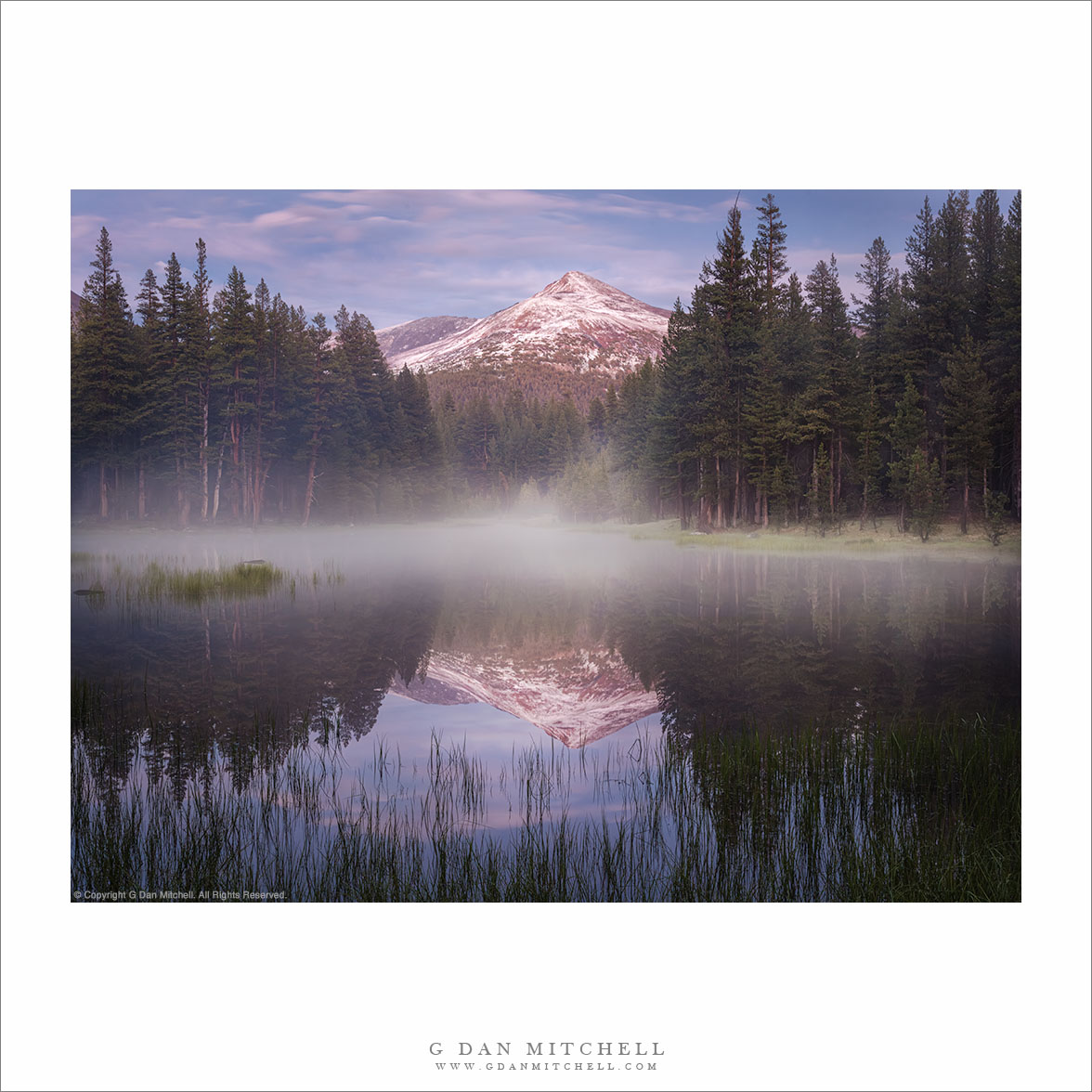
“Blue Hour: Lake and Fog” — Dusk fog rises from the surface of a subalpine lake reflecting a Sierra crest peak.
I had thought that I was done photographing for the evening when I passed this little lake and saw the fog rising in dusk light. The light was fading fast, so I quickly got out my tripod and set up for some relatively long exposures — this one was 15 seconds. The conditions arose after an afternoon and evening of rain ended and the skies began to clear, allowing fog to appear here and at every other similar body of water.
Photographs in these conditions — essentially twilight — test our understanding of what it means for a photograph to be “realistic.” The truth is that our eyes don’t see like this in extremely low light — so what you get here is a sort of “what the camera saw” image. (The eyes also do not interpolate drifting fog over a 15 second period!)
Join the discussion — leave a comment or question. (Comments are moderated and may not appear immediately. Links in comments may be removed.) Cancel reply
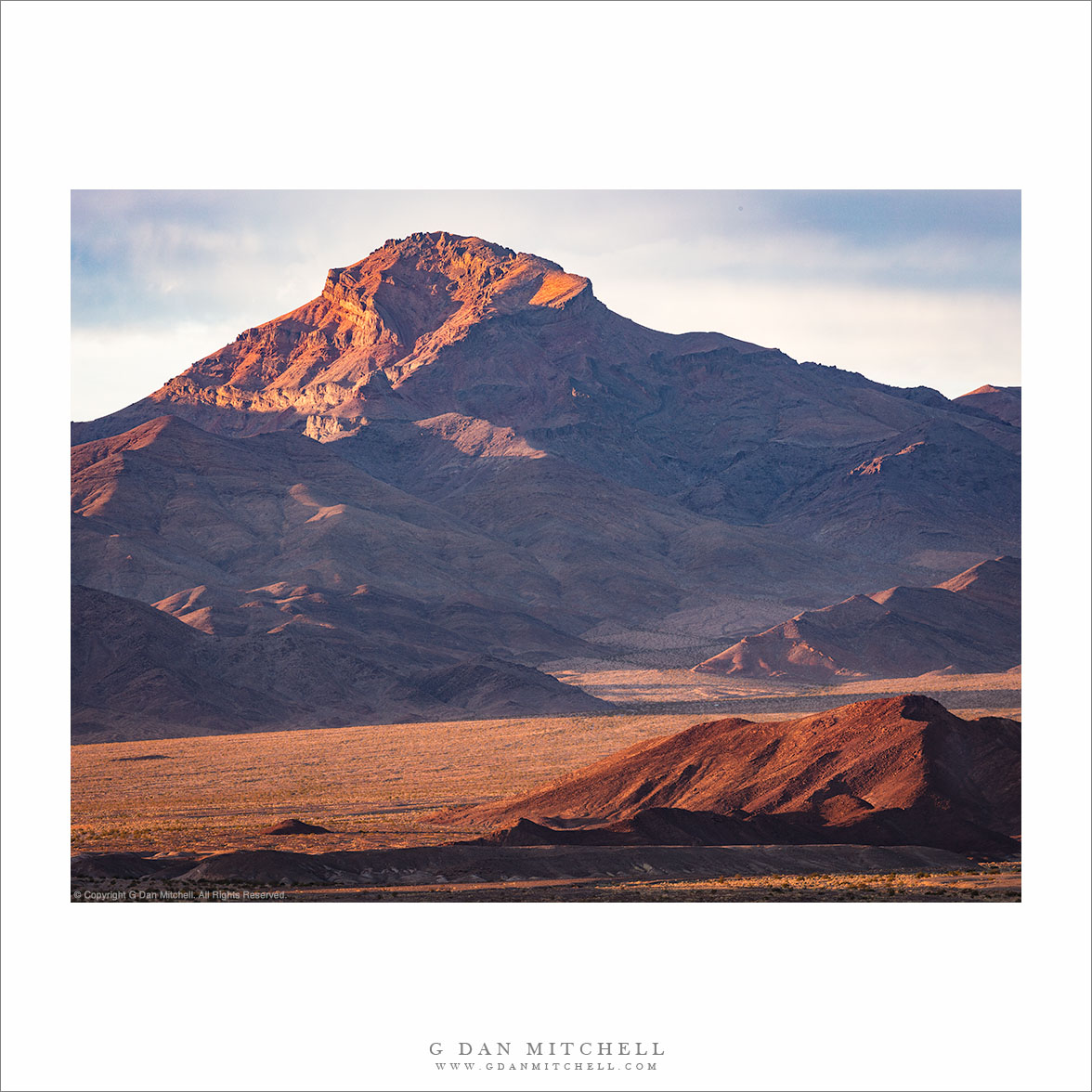
“Corkscrew Peak, Evening” — Evening light on the giant alluvial plain leading up towards Corkscrew Peak.
This peak has long intrigued me — along with the entire ridge that it lies on. Perhaps the name first caught my attention when I was trying to identify landmarks in photographs I took from out in the Valley. Hint: it does not really look much like a corkscrew, though I can see how the tilted rock layers that seem to run around it inspired the name.
I photographed this on my first evening in Death Valley back in February. After a very long drive from the Bay Area I set up camp, rested a bit, and then it was time to go find something to photograph. Since it was late in the day I wanted to keep it somewhat simple, so I headed to this spot along a road leading out of the Valley, arriving just in time to photograph the day’s last light.
Join the discussion — leave a comment or question. (Comments are moderated and may not appear immediately. Links in comments may be removed.) Cancel reply
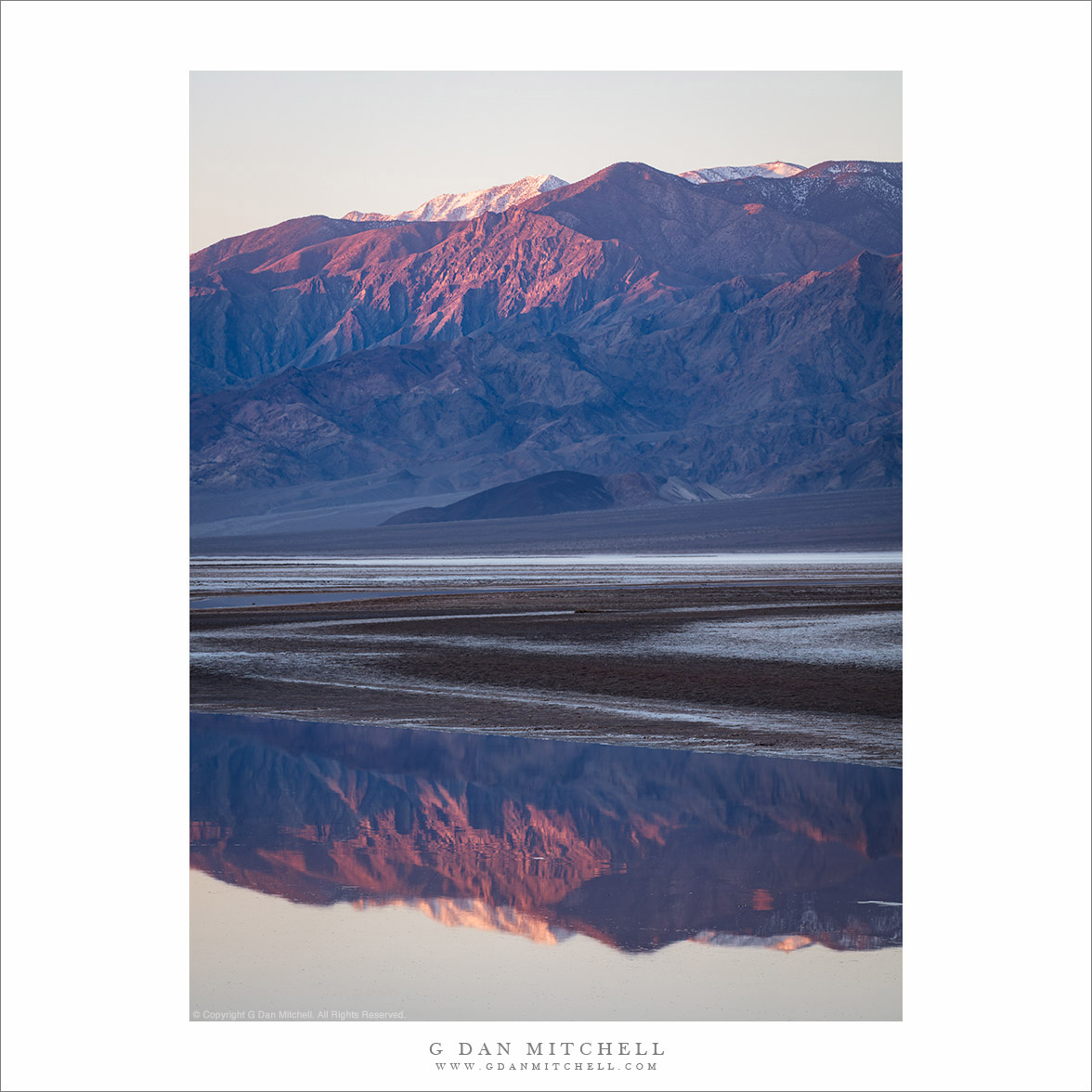
“Reflected First Light, Panamint Mountains” — Shallow salt flat water reflects the first light on the Panamint Mountains.
During my late-February visit to Death Valley National Park, I spent two early mornings photographing the Panamint Mountains in the first light, with the salt flats and shallow water in the foreground. The water is not the ephemeral “Lake Manly” phenomenon that we saw in 2024. This is a slow, shallow flow of water that seems to continue all year, regardless of conditions. It is just enough water to produce these reflections.
These days I photograph almost exclusively with a full frame digital system. (Sometimes I use a smaller APS-C system, often for my street and travel photography.) I usually use a pretty straightforward set of lenses that work well for my landscape photography, but occasionally I bring out an adapted medium format zoom lens and mount it using the Mirex tilt/shift adapter — yes, movements with a zoom lens! That was pretty useful for this photograph given the low light and the extreme distance between the foreground and the distant mountains.
Join the discussion — leave a comment or question. (Comments are moderated and may not appear immediately. Links in comments may be removed.) Cancel reply
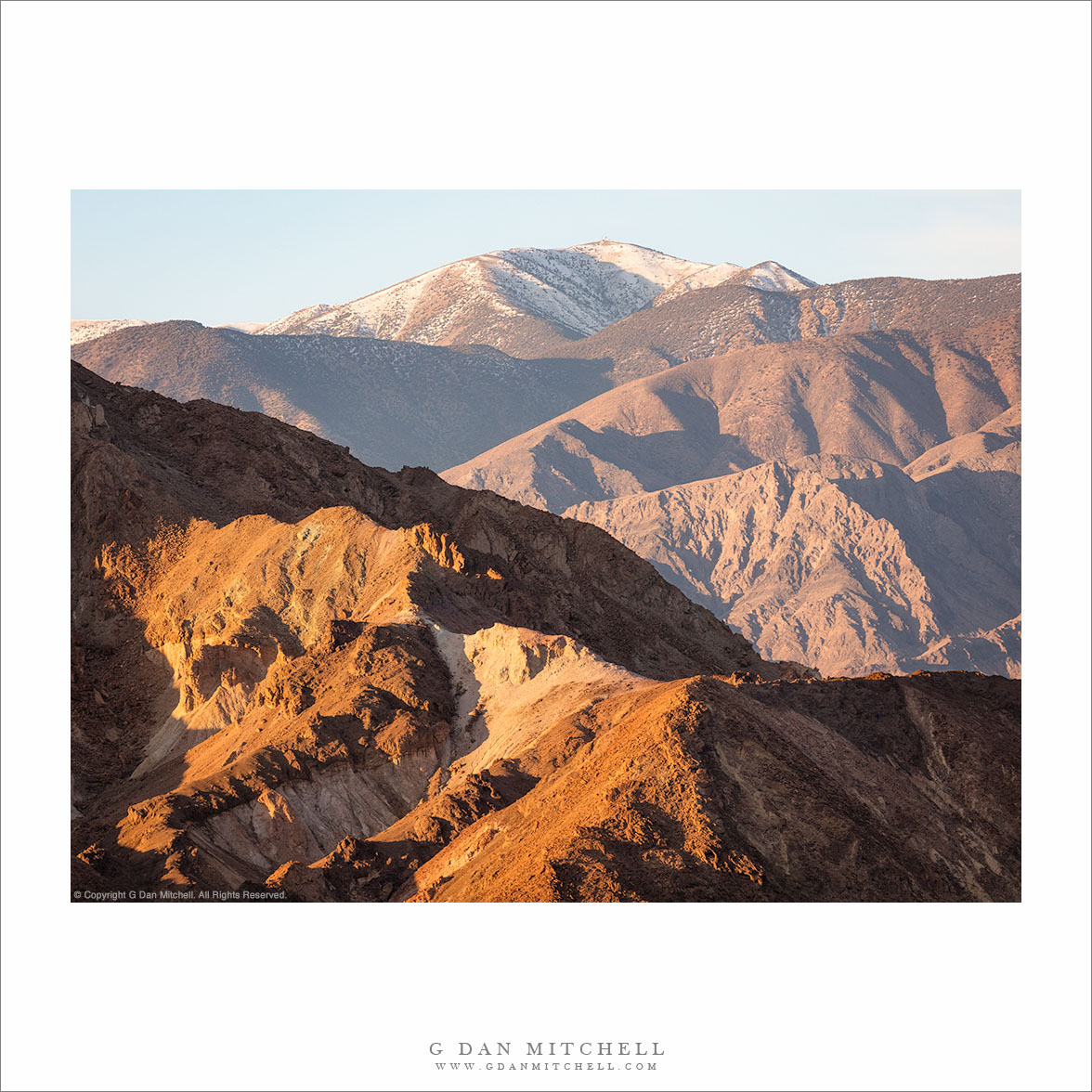
“Zabriskie to Rogers Peak” — Long morning view, from formations at Zabriskie Point to distant Rogers Peak in the Panamint Mountains.
Poor Rogers Peak doesn’t get a lot of respect. Despite being just under 10,000 feet tall, offering a rather impressive view from close up, and being snow-capped in the winter… it is eclipsed by its neighbor, Telescope Peak, the highest in the park. (You can see a bit of the shoulder of Telescope Peak at the far left.) It doesn’t help that a communications complex has been installed on its summit — which seems like a bit of an inappropriate insult in a national park!
The photograph encompasses a very long view, extending from rugged hills at Zabriskie Point all the way across Death Valley to the summit of the Panamint Mountains. I estimate that this is over 20 miles as the proverbial crow flies. Such distances are common in Death Valley National Park, a huge place with an expansive landscape.
Join the discussion — leave a comment or question. (Comments are moderated and may not appear immediately. Links in comments may be removed.) Cancel reply
Photographer and visual opportunist. Daily photos since 2005, plus articles, reviews, news, and ideas.
Manage Consent
To provide the best experiences, we use technologies like cookies to store and/or access device information. Consenting to these technologies will allow us to process data such as browsing behavior or unique IDs on this site. Not consenting or withdrawing consent, may adversely affect certain features and functions.
Functional
Always active
The technical storage or access is strictly necessary for the legitimate purpose of enabling the use of a specific service explicitly requested by the subscriber or user, or for the sole purpose of carrying out the transmission of a communication over an electronic communications network.
Preferences
The technical storage or access is necessary for the legitimate purpose of storing preferences that are not requested by the subscriber or user.
Statistics
The technical storage or access that is used exclusively for statistical purposes.The technical storage or access that is used exclusively for anonymous statistical purposes. Without a subpoena, voluntary compliance on the part of your Internet Service Provider, or additional records from a third party, information stored or retrieved for this purpose alone cannot usually be used to identify you.
Marketing
The technical storage or access is required to create user profiles to send advertising, or to track the user on a website or across several websites for similar marketing purposes.

Join the discussion — leave a comment or question. (Comments are moderated and may not appear immediately. Links in comments may be removed.)