
Tag Archives: pink

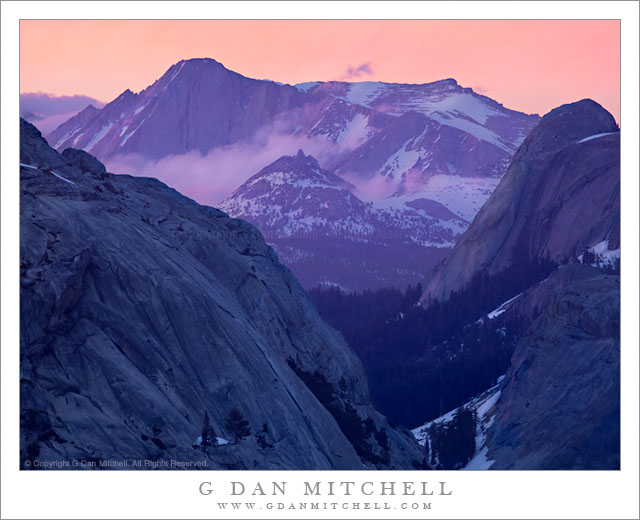
Alpenglow Clouds, Mount Conness

Alpenglow Clouds, Mount Conness

Alpenglow Clouds, Mount Conness. Yosemite National Park, California. June 18, 2011. © Copyright G Dan Mitchell – all rights reserved.

Clouds lit by alpenglow drift across the face of Mount Conness beyond the Tenaya Creek drainage, Yosemite National Park.

Earlier this week I posted another photograph of the same evening. This one was shot a bit earlier (believe it or not!) than the other photograph, as the intense and perhaps unexpected color display was just getting started. I’ll have more to write about the phenomenon in a future blog post that uses this evening as an example, but it almost seem like the sunset progressed backwards (oxymoron alert!) as it went on. It had begun with very boring and low contrast light, somewhat flattened by a haze that took on an increasingly ghastly blue-green hue as the light began to fade. Although the surroundings were spectacular on this opening day of Tioga Pass Road, the light and atmospheric conditions seemed to be conspiring to show them it their worst (literal and figurative) light.

But just at dusk a hint of pink appeared in some of the clouds ringing Mount Conness, the tall peak in the upper left. At first it was so faint that only those of us who were looking for it might have noticed, and we perhaps thought that we were simply trying to convince ourselves that something was going to happen. But the color increased, and as the more distant areas picked up better light, they shone through the foreground haze more clearly, and this haze faded in the same way that a scrim does in a theater when the front lights dim and the stage lights rise.

I find that this type of scene provides some of the most difficult technical and judgment challenges. So often the goal in an image, especially if it is going to be a print, is to try to get as much light into the scene as possible. A lot of the work in post-processing, at least for me, is done with the goal of trying to fill the image with light by means of various careful adjustments, often involving the use of masked curve layers. But here, the coloration depends upon not being overly bright – too much light either decreases the intensity of the pink and purple shadings or else sends them off into the land of the grotesque and gaudy. And the light in shadows – and there are a lot of shaded areas in this scene! – is very blue, much more so than the untrained eye would imagine when looking at the scene in person. This requires another set of tricky and subjective judgments – it would not look right to leave portions of the scene as blue “as they really were,” nor would it look right if the blue were diminished too much. But how much is right? There is no objective answer that I know of, so the goal (for example, on the large granite face of Polly Dome at the left) is to come up with a balance that seems blue enough but not too blue. A similar issue arises in these dark areas when it comes to deciding how bright is bright enough. Believe it or not, virtually nothing in this image is actually black, with the possible exception of a few very tiny areas in the lower left. The luminosity of the very dark areas had to be lifted a bit… but how much is just right? Again, a matter of personal judgment about which there is no objectively right answer.

All of that technical stuff aside, this evening provided one of the most glorious, albeit brief, displays of sublime light I have seen in the Sierra.

G Dan Mitchell Photography | Flickr | Twitter (follow me) | Facebook (“Like” my page) | LinkedIn | Email
Text, photographs, and other media are © Copyright G Dan Mitchell (or others when indicated) and are not in the public domain and may not be used on websites, blogs, or in other media without advance permission from G Dan Mitchell.
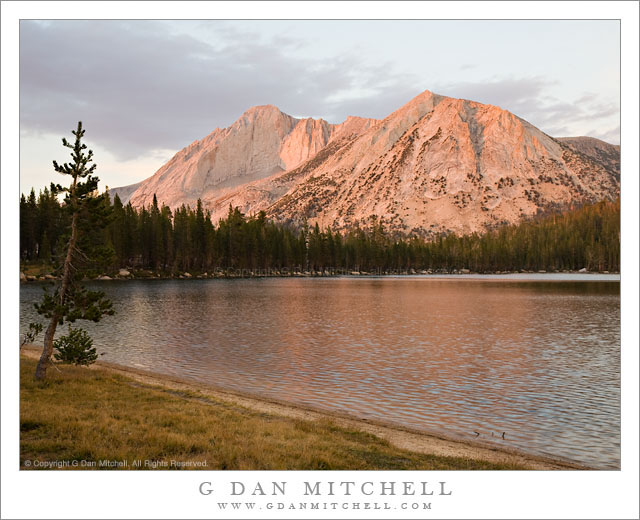
Mount Conness and Lower Young Lake, Sunset

Mount Conness and Lower Young Lake, Sunset

Mount Conness and Lower Young Lake, Sunset. Yosemite National Park, California. September 11, 2007. © Copyright G Dan Mitchell – all rights reserved.

Alpenglow lights Mount Conness above Lower Young Lake in the Yosemite National Park back-country.

I was recently going through a large portion of my archive in search of a variety of photographs of Mount Conness, a well-known peak along the northeast edge of Yosemite National Park on the crest of the Sierra. This is perhaps not the best known peak in Yosemite for most people – they are obviously going to be far more familiar with the cliffs and domes around Yosemite Valley or with Mount Lyell (the tallest peak in the park) or perhaps Mount Dana (second highest peak, and towering above the Tioga Pass entrance.) Mount Conness is found a bit further “north” along the crest, and while it may be less known, it is certainly no less visible once you know where to look. You can see it in the distance towering above Tenaya Lake if you stop at the iconic Olmsted Point overlook. It is visible from many places along the road to Tuolumne Meadows. Once you get away from roads and into the high country it can be seen from almost any high point with an open view in the direction of the peak, including places like Vogelsang High Sierra Camp.

This photograph was made on a quiet late-season evening at Lower Young Lake, a place that I return to frequently, most of the time in the off-season when fewer people are there and the fall colors of the high country are starting to appear. The peak (and many other features in this area) are beautifully illuminated late in the day as this high ridge is open without obstruction to the west. The light on the peak was magical on this evening, being colorful and contrasting with the higher and more drab clouds, but not being as gaudily bright as it can be on other evenings.

G Dan Mitchell Photography | Flickr | Twitter (follow me) | Facebook (“Like” my page) | LinkedIn | Email
Text, photographs, and other media are © Copyright G Dan Mitchell (or others when indicated) and are not in the public domain and may not be used on websites, blogs, or in other media without advance permission from G Dan Mitchell.
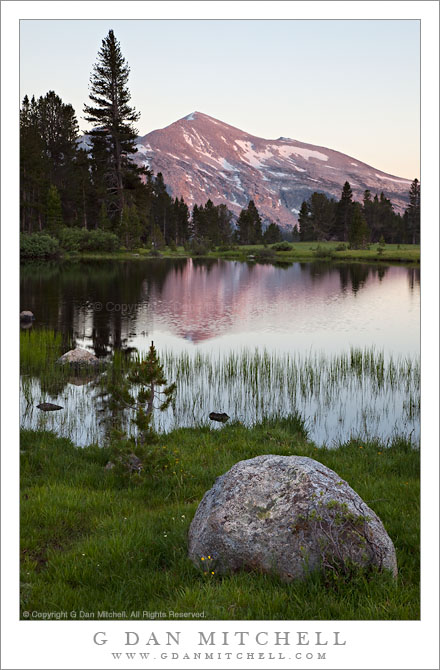
Alpenglow, Mammoth Peak

Alpenglow, Mammoth Peak

Alpenglow, Mammoth Peak. Yosemite National Park, California. July 22, 2010. © Copyright G Dan Mitchell – all rights reserved.

Alpenglow lights the face of Mammoth Peak beyond a small tarn near the summit of Tioga Pass, Yosemite National Park.

This was very close to the last exposure I made on this productive late-July day last year. After photographing for a few hours in the vicinity of Tioga Pass, I ended up right at the pass as the day came to an end. Braving hordes of mosquitos – comes with the territory! – I worked the area around the pass itself, building compositions out of juxtapositions of the water in the small meltwater ponds, shoreline meadow and boulders, grasses growing along the edge of the water, the surrounding pine forests, and the more distant peaks of Kuna Crest. In this photograph, what is very nearly the very last direct light of the day is bathing the slopes of Mammoth Peak, which still had a fair amount of snow on its flanks even in late July.

This scene posed a few technical challenges. First, there is obviously a great distance between the foreground granite boulder and the very distance mountain. I wanted the foreground to be in optimal sharpness, so I used a relatively small aperture to maintain sufficient sharpness on the far ridge. There was also a fairly large dynamic range in the scene, ranging from soft but direct light on the snow fields of the peak to the dark areas within the forest on the other side of the pond. I wasn’t certain that I’d be able to handle the full dynamic range in one exposure, so I made three – one longer exposure to get a bit more light from the shadows and another shorter one on the dark side to avoid blowing out the brighter areas of the sky. In post, I discovered that there was enough detail in the shadows that I could get everything I needed from a single exposure, though I had to do some work with curves to get create an image the conforms more closely to the way I saw the scene at the time.

G Dan Mitchell Photography | Flickr | Twitter (follow me) | Facebook (“Like” my page) | LinkedIn | Email
Text, photographs, and other media are © Copyright G Dan Mitchell (or others when indicated) and are not in the public domain and may not be used on websites, blogs, or in other media without advance permission from G Dan Mitchell.

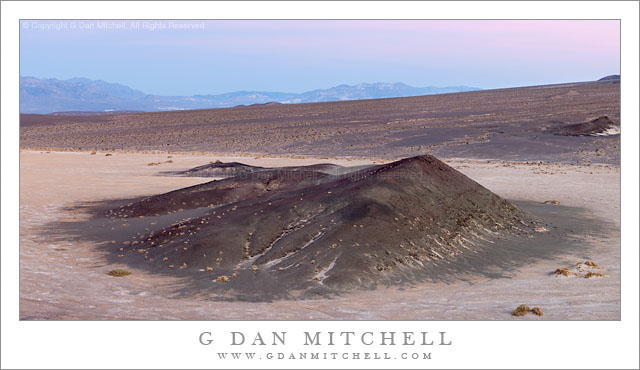
Hill Near Mesquite Flat, Dusk

Hill Near Mesquite Flat, Dusk

Hill Near Mesquite Flat, Dusk. Death Valley National Park, California. March 29, 2011. © Copyright G Dan Mitchell – all rights reserved.

Dusk light above a hill near Mesquite Flat in Death Valley, backed by a large alluvial fan from Tucki Mountain.

At the end of this day I was shooting from the top of a low hill in the Valley east of Stovepipe Wells, and there were interesting subjects throughout almost the entire 360 degree panorama around this elevated position. With this in mind, I had chosen to use the long 100-400mm zoom so that I could have some flexibility in composing elements of this huge scene.

I was mainly working with things that were in the large arc to my west (dunes and Cottonwood mountains and base of Tucki Mountain), north (the main Valley and transverse dunes), and east (the mountains running along that edge of the Valley) since the further subjects of the lower Valley were more or less out of sight beyond the alluvial fan that appears in the photograph. But I kept being intrigued by the low, dark hill on the flats below the similar hill on which I was standing. There is a row of them stretching from near the Devils Cornfield area up and across this alluvial fan. As the evening light transitioned towards post-sunset light I saw that the glow from clouds (a bit of which is visible in the distance above the Black Mountains) was lighting this hill and the surrounding flats in an interesting and colorful way.

But I had a little problem. I was still working a number of subjects and once and I really needed to keep shooting that 100-400. 100mm was still too long for this scene, but I didn’t have time to remove it and put on a shorter lens. I figured that I could simply change the camera to vertical orientation, very carefully level the tripod, and include the whole scene in four panning vertical frames that I could stitch together later. People often do this so that they can produce extremely high-resolution image, but that wasn’t my goal at all. In any case, it worked, and not only did I manage to get the shot that needed a wider lens, but as a bonus it is a very high-resolution shot.

G Dan Mitchell Photography | Flickr | Twitter (follow me) | Facebook (“Like” my page) | LinkedIn | Email
Text, photographs, and other media are © Copyright G Dan Mitchell (or others when indicated) and are not in the public domain and may not be used on websites, blogs, or in other media without advance permission from G Dan Mitchell.