
Tag Archives: print

Harbor Seals, Point Lobos

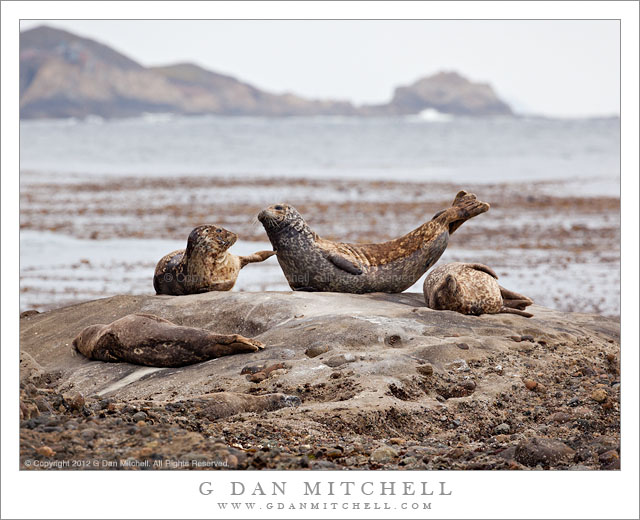
Harbor Seals, Point Lobos - California harbor seals interacting on a haul-out rock at the Point Lobos State Reserve.
California harbor seals interacting on a haul-out rock at the Point Lobos State Reserve.

Harbor Seals, Point Lobos. Point Lobos State Reserve, California. July 16, 2012. © Copyright 2012 G Dan Mitchell – all rights reserved.

California harbor seals interacting on a haul-out rock at the Point Lobos State Reserve.

The harbor seals are found in many areas of the California cost and elsewhere. These were lounging about on a haul-out rock at the Point Lobos State Reserve just south of Carmel and at the northern end of the Big Sur coastline. I have been going to Point Lobos for many years, and this particular rock is one I usually check out since it is quite close to the shoreline and there are often harbor seals about. Indeed, on this day there were perhaps a dozen of the critters on this rock, and more were hanging around nearby.

On one hand, it seems like a pretty lazy life they lead, especially on a calm summer day like this one. Haul out of the water and lounge about on rocks for hours. If they get hungry, the water is only a few feet away. But I suspect that the reality is much different. I have also gone to see them in the winter when the surf here can be astonishingly wild, and the ocean must be a very dangerous place. As I watched this group – which is sometimes an experience close to watching paint dry – eventually the middle seal decided to turn around and face the smaller one to the left. As it did so it arched its body to pivot around and the smaller one reached out with a flipper, suggesting a sort of friendly pat to the those with anthropomorphic tendencies.

G Dan Mitchell is a California photographer whose subjects include the Pacific coast, redwood forests, central California oak/grasslands, the Sierra Nevada, California deserts, urban landscapes, night photography, and more.
Blog | About | Flickr | Twitter | FacebookGoogle+ | 500px.com | LinkedIn | Email

Text, photographs, and other media are © Copyright G Dan Mitchell (or others when indicated) and are not in the public domain and may not be used on websites, blogs, or in other media without advance permission from G Dan Mitchell.
Tuolumne River, Alpenglow

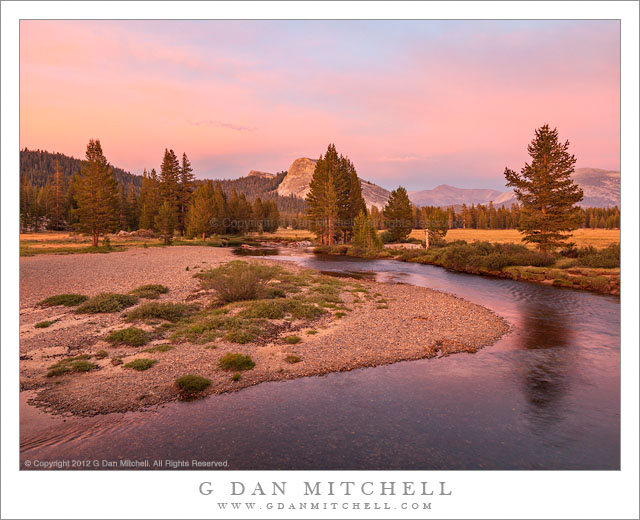
Tuolumne River, Alpenglow - The Tuolumne River curves through Tuolumne Meadows as alpenglow colors that landscape, Yosemite National Park.
The Tuolumne River curves through Tuolumne Meadows as alpenglow colors that landscape, Yosemite National Park.

Tuolumne River, Alpenglow. Yosemite National Park, California. July 7, 2012. © Copyright 2012 G Dan Mitchell – all rights reserved.

The Tuolumne River curves through Tuolumne Meadows as alpenglow colors the landscape, Yosemite National Park.

I have written previously about several topics that connect to this photograph. For one, I have described a certain type of atmospheric condition in the Sierra that may bring astonishingly intense evening colors when clouds above the mountains end to the west of the range, allowing the final sunset light to illuminate the clouds from beneath. On this evening it looked like all the pieces were in place for such a show, but I know that while these conditions make the light possible, they do not guarantee it – and on this evening there was a wonderful, subtle glow just after sunset… but not the imagined overwhelmingly brilliant light.

For another, I have written about scoping out a shot ahead of time, sometimes earlier the same day and sometimes weeks, months, or even years earlier. Earlier on this day I decided to take a walk in the meadow without my camera gear, with precisely the task of “scoping out” in mind. I wandered around somewhat aimlessly, following my nose this way and that to investigate lots of interesting things and places that I might have passed by on a more purposeful hike. Before heading back to camp for an early dinner I had selected three possible subjects that I thought might work well.

I have also written about how little control we have over our subjects when shooting landscape. We can anticipate and guess and be fortunate enough to be in the right place at the right time with the right gear and the skill to know how to use it, along with the ability to see what is happening – but in the end, in many ways, we take what we can find and work with it. When I arrived back in the evening an hour or so before the time of interesting light, I had a feeling that the first subject I had seen earlier might be the most promising. This was a scene that placed Lembert Dome between a couple of groups of trees and a bit of the river when viewed from the middle of a footbridge crossing the Tuolumne. I arrived and set up and began the planned wait for what I hoped would be very interesting light. However, as sunset approached, I could see that the shot I had planned was not going to work in the light that I found myself working with. So, on the spur of the moment and acting essentially intuitively, I picked up the tripod and camera and moved to a nearby spot and rather than making a tightly focused shot of the dome, I zoomed way out to include a gentle curve in the Tuolumne, a sandbar, and a line of foreground trees, and I made this photograph of the much subtler-than-expected post sunset light.

G Dan Mitchell is a California photographer whose subjects include the Pacific coast, redwood forests, central California oak/grasslands, the Sierra Nevada, California deserts, urban landscapes, night photography, and more.
Blog | About | Flickr | Twitter | FacebookGoogle+ | 500px.com | LinkedIn | Email

Text, photographs, and other media are © Copyright G Dan Mitchell (or others when indicated) and are not in the public domain and may not be used on websites, blogs, or in other media without advance permission from G Dan Mitchell.
Sand Tufa, Mono Lake

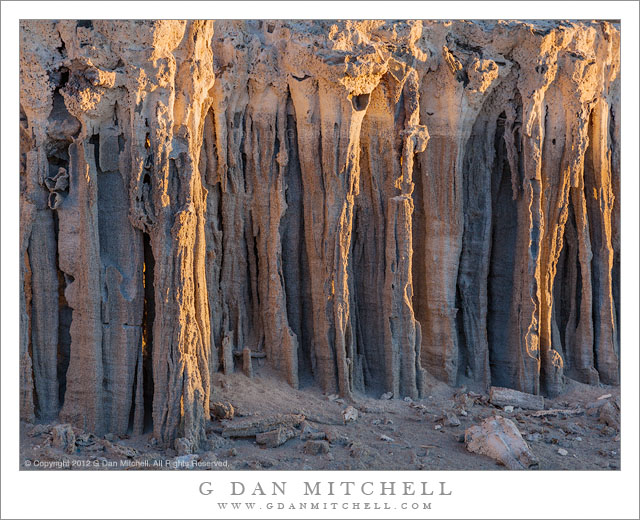
Sand Tufa, Mono Lake - Early morning light on details of sand tufa formations, Mono Lake
Early morning light on details of sand tufa formations.

Sand Tufa. Mono County, California. July 14, 2012. © Copyright 2012 G Dan Mitchell – all rights reserved.

Early morning light on details of sand tufa formations, Mono County.

I have wanted to photograph this subject for some time. The sand tufas are not found in the same location as the better-known “tufa towers” that are so often photographed, and they are smaller and somewhat subtler (if that is the right word) subjects. If you weren’t aware of what you were looking for, it would be very easy to pass right by them and barely notice their presence at all. They also appear to be very fragile, so great care should be taken if you ever happen to come across them. Walk around, not over or through them, and minimize your impact on them to the greatest extent possible. If you come across examples, it is probably best to not blast a lot of specific information to the world. I don’t know all of the details of their formation, but judging by their locations and by the recent history of lower lake levels, I suspect that they may have been underwater before the historically recent extraction of water from the eastern Sierra by Los Angeles.

If you are thinking of looking for an interesting and easy to shoot photographic subject, don’t bother with the sand tufa. You’ll probably have much better luck and more fun shooting the impressive and better known and larger “tower” features at other areas. These small structures do not tower above anything. Some are only inches tall, and the largest are just a few feet tall. Their natural color is a muted and, let’s be honest, boring gray color. Their location does not particularly allow them to be paired with more impressive and distant large-scale landscape features such as the expanse of the lake’s surface or the surrounding mountains and hills, with the possible exception of certain kinds of cloud formations. When I went there I had some pre-conceived ideas about I might photograph them, perhaps including the Sierra’s eastern escarpment in the images, but these ideas did not pan out. However, by shooting in the first few minutes of light and working with a long focal length to crop tightly I found some interesting fluted patterns to work with.

G Dan Mitchell is a California photographer whose subjects include the Pacific coast, redwood forests, central California oak/grasslands, the Sierra Nevada, California deserts, urban landscapes, night photography, and more.
Blog | About | Flickr | Twitter | FacebookGoogle+ | 500px.com | LinkedIn | Email

Text, photographs, and other media are © Copyright G Dan Mitchell (or others when indicated) and are not in the public domain and may not be used on websites, blogs, or in other media without advance permission from G Dan Mitchell.

One Front Street, San Francisco

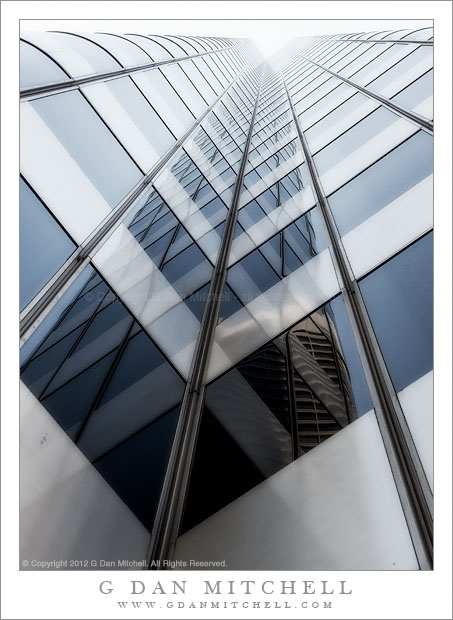
IOne Front Street, San Francisco - maginary (urban) landscape based on the facade of the One Front Street building, San Francisco
Imaginary (urban) landscape based on the facade of the One Front Street building, San Francisco

One Front Street, San Francisco. San Francisco, California. July 9, 2012. © Copyright 2012 G Dan Mitchell – all rights reserved.

Imaginary (urban) landscape based on the facade of the One Front Street building, San Francisco.

This is another in a short series of photographs I did earlier this month in which I focused on shooting very close to the base of some downtown San Francisco buildings, aiming the camera nearly straight up in order to see their shapes more abstractly, and then working fairly freely in post to modify the images in ways that I felt were interesting. This one, and some of the others, are subject to enough post-processing that they probably fit into the category that I describes as “imaginary landscapes.)

I imagine that architects who create such things understand these buildings in ways far different from this in which the rest of us see them. A few things, likely completely obvious to the building designers, occurred to me. One, obvious now that I see it, is that the visual character of the buildings themselves is formed as much by what they reflect of their surroundings as it is by their own shape, texture, and material. Most of what constitutes this photograph, for example, is not the building itself (which is largely defined by the narrow non-reflecting portions) but by what in the surrounding environment is reflected on its surface and how those reflections are shaped and modified by the reflecting surface of the building. In this case, the building reflects itself in the right angles such as the one in the center of this shot, along with the sky, and sometimes the surrounding buildings. (Though the latter is removed when you aim the camera up so sharply.)

G Dan Mitchell is a California photographer whose subjects include the Pacific coast, redwood forests, central California oak/grasslands, the Sierra Nevada, California deserts, urban landscapes, night photography, and more.
Blog | About | Flickr | Twitter | FacebookGoogle+ | 500px.com | LinkedIn | Email

Text, photographs, and other media are © Copyright G Dan Mitchell (or others when indicated) and are not in the public domain and may not be used on websites, blogs, or in other media without advance permission from G Dan Mitchell.