
Tag Archives: red

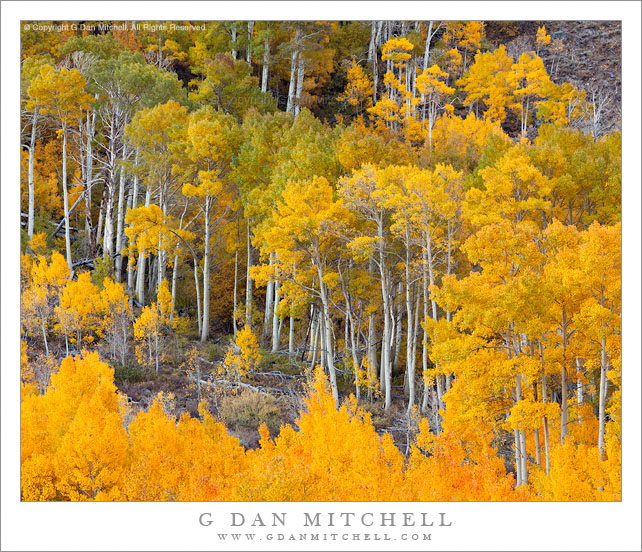
Aspen Trees, Conway Summit, Fall

Aspen Trees, Conway Summit, Fall

Aspen Trees, Conway Summit, Fall. Eastern Sierra Nevada, California. October 16, 2011. © Copyright 2011 G Dan Mitchell – all rights reserved.

Aspen trees in peak color at Conway Summit along highway 395 in the eastern Sierra Nevada.

I isolated this small bit of near-psychedelic color from the extensive aspen groves at Conway Summit, along highway 395 just north of Lee Vining and Mono Lake along the eastern edge of the Sierra Nevada range. When I visited the grove this past weekend the colors seemed to be essentially at their peak with alternating rows of red, orange, gold, and even a few lime green trees marching up the slopes toward the Dunderberg area high above.

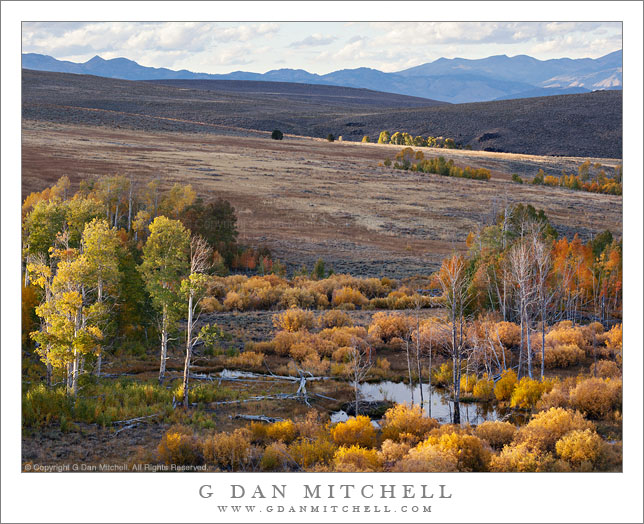
If you hit it at the right moment, the aspen color at this location is second to none, and a bonus for many is that it is so accessible, being right alongside the highway. Brilliant colors can occur on both sides of the summit, but those on the north side seem to me to be more varied, and it is a bit easier and safer to find a place to stop alongside the road.

The lighting during my visit was “interesting” – which often means good but with some challenges. From my point of view, the best light at Conway Summit, at least when it comes to photographing aspen color, occurs fairly late in the afternoon when the sun gets low in the sky and can backlight the groves of trees. However, because of the backdrop of Sierra Nevada peaks the interval of good light can be short – and it is distinctly before actual sunset. The “interesting” element during this visit was that clouds were building over the crest. This produces some spectacular sky conditions at times, but it also cast shadows across the trees that dulled the colors and lowered contrast. Now a bit of this can be a good thing, and too much backlight can be a bit difficult to handle. By scoping out perhaps three of four possible compositions from my position, I could wait until the “good light” hit one or another of them, swing the camera around in that direction, and work quickly while the light lasted. For this detail shot of a colorful section of the aspen groves just below my position I had what can perhaps be the very best light for such subjects – a bit of directional light from behind filtered through clouds.

G Dan Mitchell Photography
About | Flickr | Twitter | FacebookGoogle+ | 500px.com | LinkedIn | Email

Text, photographs, and other media are © Copyright G Dan Mitchell (or others when indicated) and are not in the public domain and may not be used on websites, blogs, or in other media without advance permission from G Dan Mitchell.
(Basic EXIF data may be available by “mousing over” large images in posts when this page is viewed on the web. Leave a comment if you want to know more.)

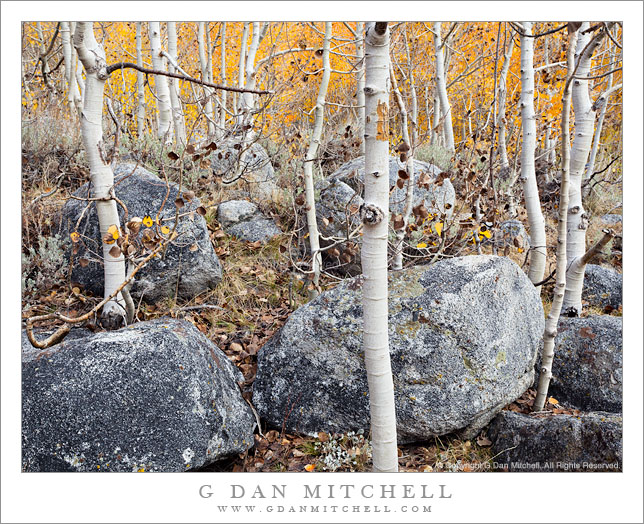
Fallen Aspen Branch, Snow

Fallen Aspen Branch, Snow
“Fallen Aspen Branch, Snow” — A small aspen tree branch blown down by an early fall storm rests on snow, North Lake, California.

Time to share aspen photos again! Each fall when the aspens change colors I head to the eastern Sierra to go aspen hunting! I made my first foray of the season this past weekend. I visited a number of the usual places – Bishop Creek, McGee Creek, Rock Creek, and Lee Vining Canyon. I’ve come to think that every aspen color season has a personality, defined by how and when and with what intensity the color appears, along with the related issues of the changing weather.

This year I think (from what I’ve heard) that the higher elevation trees were just changing colors about a week ago… before a strong early season storm came across the Sierra, dropping temperatures and quite a bit of snow. Over the weekend I saw up to about one foot of snow in places, which is an unusual amount for so early in the season. The aspen color was not exactly astonishing, and I think that the weather may be at least partially to blame. It seems that many of the mature colorful leaves were knocked down by the storm, and others that might now be colorful instead turned black and brown. While there was some interesting color, in many places I saw trees with leaves missing or trees that were almost fully still green.

The good news to take away from this is that since the lower elevation trees are still very green, there should be some fine aspen color very soon.

But I’ve often thought that a single leaf can be enough to make a photograph, and sometimes the single leaf can make a more effective image than a huge, colorful grove spanning many acres. So when I find that the color isn’t what I expected, one response is simply to look harder. As I walked along the road that passes North Lake, many of the subjects that I might have expected to photograph were nowhere to be seen. There were not large, spectacularly colorful trees. There was quite a bit of snow on the ground. So I looked harder… and one of the subjects I noticed was this single, small branch full of intensely colorful leaves lying on the snow.


Leave a comment or question using the form. (Click the title to see the full article and to comment if you are viewing it on the home page.)

G Dan Mitchell is a California photographer and visual opportunist. His book, “California’s Fall Color: A Photographer’s Guide to Autumn in the Sierra” (Heyday Books) is available directly from him. Blog | Bluesky | Mastodon | Substack Notes | Flickr | Email


All media © Copyright G Dan Mitchell and others.

Sunset, Lower McCabe Lake, Shepherds Crest, and Virginia Canyon

Sunset, Lower McCabe Lake, Shepherds Crest, and Virginia Canyon

Sunset, Lower McCabe Lake, Shepherds Crest, and Virginia Canyon. Yosemite National Park, California. September 19, 2011. © Copyright 2011 G Dan Mitchell – all rights reserved.

Afternoon storm clouds clear from the sunset sky above Lower McCabe Lake, Shepherds Crest, and Virginia Canyon, Yosemite National Park.

With this photograph I get to tell another of the “serendipitous photograph” stories that seem to keep coming up in my work. In this case, we had been camped near the lake in the lower area of the photograph for several days, getting to know the place and having time to carefully photograph various areas nearby. On a previous evening we had climbed to a second lake a few hundred feet higher than the “main” lake, from which one of our group decided to traverse a nearby slope. He ended up at another alpine lake that looked interesting, and the next morning others went with him to visit it. I didn’t, because I had some other things that I wanted to photograph in morning light and because I had a hunch that the light might turn out to be more interesting in the evening, mainly because the area of the lake was open to the west and, therefore, the evening light.

So in the evening, after our typical very early dinner, I departed on a walk to the upper lake that my friends had visited that morning, wandering around “our” lake and through the surrounding forest to pick up a rocky ramp that ascended toward the lake. However, I apparently missed a turn somewhere. I finished the main part of the climb and apparently should have turned left immediately – but I continued on straight ahead and soon found myself in a little meadowy area with a rather steep bunch of rocks between me and my goal. I finally found a circuitous route up a series of ramps, but now it was getting too close to sunset and my turn-around time, so I had to retrace my steps without getting to the lake.

I returned to the small meadow and made a few photographs there, then headed back toward the route by which I had ascended. Despite not making the lake, one of my main goals had been to get up high to photograph the surrounding terrain at sunset, especially since earlier in the day large thunderclouds had been building to the east and creating the possibility of some very special evening light. As I descended the upper part of the “ramp,” the pre-sunset colors started to light up and I quickly found a spot with a good vantage point to view this in several directions. Among the last photographs I made as the light started to fade was the series including this image. (It is actually a composite of two exposures – one for the very bright and saturated clouds and another for the darker shadows down near that lake.) Beyond the lake is the left end of rocky Shepherds Crest and even further in the distance is Virginia Canyon and then the Sierra crest.

G Dan Mitchell Photography
About | Flickr | Twitter | FacebookGoogle+ | 500px.com | LinkedIn | Email

Text, photographs, and other media are © Copyright G Dan Mitchell (or others when indicated) and are not in the public domain and may not be used on websites, blogs, or in other media without advance permission from G Dan Mitchell.
(Basic EXIF data may be available by “mousing over” large images in posts when this page is viewed on the web. Leave a comment if you want to know more.)

Tree, Granite Slabs, Evening Storm Clouds

Tree, Granite Slabs, Evening Storm Clouds

Tree, Granite Slabs, Evening Storm Clouds. Yosemite National Park, California. September 20, 2011. © Copyright 2011 G Dan Mitchell – all rights reserved.

A tree and granite slab are lit by brilliant sunset light from a dissipating evening thunderstorm, Yosemite National Park.

This was another of those sometimes-surprising bursts of evening Sierra color that results in effects so gaudy that they almost seem unreal – but this is real. I was camped down in a valley among trees so I wasn’t initially expecting much in the way of spectacular sunset photography. Instead, I planned to take advantage of the early shadows in the valley and get some evening photographs under soft light without any direct sun at all. I first worked some moving water where the nearby river flowed across granite slabs, and then I contemplated photographing some small plants in deeply cracked and patterned granite. As a worked my way across this granite, I remembered a small tree on the other side of the bowl that had looked like an interested photo subject a few days ago, so I walked over to that area where the tree stands in a shallow granite bowl.

Earlier in the afternoon I could see huge thunderheads building up to my east, but they did not move far enough west to affect me with anything more than a bit of gray sky. However, as the clouds built up to higher elevations, their tops began to take on the familiar “anvil” shape and the upper portions of the “anvils” began to spread to the west and out over my position. This is a classic setup for potentially spectacular evening sky color. Near sunset the clouds can pick up intense red/orange coloration from the sun setting in the west. At the same time, the storms begin to dissipate, creating semi-transparent “curtains” of virga (falling rain that doesn’t reach the ground), unusual shapes along the bottoms of the clouds, clouds emerging out of the gray murk as the sunset light picks them up.

As I arrived at my little tree, I quickly lost interest in that subject as the cloud light show began. First the bottom of the thunderhead began to turn brilliantly orange and red. Then the lower reaches of the small storm began to produce very unusual cloud shapes including mammatus clouds. Virga produced a brightly colored by semi-transparent scrim. It quickly became so bright that the red/orange colors began to wash the granite bowl, and I turned my camera from the little tree to the uphill granite surfaces and the clouds above.

In this vertical format image the tip of a small tree extends above the top of a dome-like area above me, and the brilliant light from the clouds washes the dome with color. The colors here have not been “amped up” in post – in fact, I’ve actually toned some of them down a bit!

G Dan Mitchell Photography
About | Flickr | Twitter | FacebookGoogle+ | 500px.com | LinkedIn | Email

Text, photographs, and other media are © Copyright G Dan Mitchell (or others when indicated) and are not in the public domain and may not be used on websites, blogs, or in other media without advance permission from G Dan Mitchell.

(Basic EXIF data may be available by “mousing over” large images in posts when this page is viewed on the web. Leave a comment if you want to know more.)