
Tag Archives: road

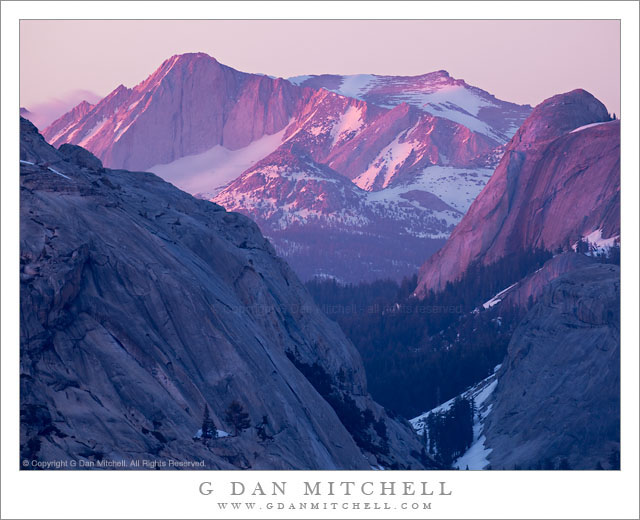
Alpenglow, Mount Conness

Alpenglow, Mount Conness

Alpenglow, Mount Conness. Yosemite National Park, California. June 18, 2011. © Copyright G Dan Mitchell – all rights reserved.

The last evening light illuminates domes near Tenaya Lake and the summit of Mount Conness with briilliantly colorful alpenglow, Yosemite National Park.

The tall peak at upper left is the summit of Mount Conness, one of the highest peaks in Yosemite National Park. The peak is located on the park boundary and the Sierra Nevada crest a bit north of Tioga Pass, and is visible from many places in the Tuolumne/Tioga high country. It is also a popular destination for peak baggers. The left foreground granite dome is the lower face of Polly Dome, which drops to the shoreline of Tenaya Lake. The left slope of Pywiak dome is visible in the shadows at lower right and beyond is the more brightly illuminated Medlicott dome.

I forgive you if you don’t believe the colors that you see in this photograph. I barely believe them myself, and I was (obviously!) there for the show. What happened on this evening was a near perfect example of a light phenomenon that Sierra photographers watch for and are occasionally lucky enough to experience. I have learned to see the signs that indicate that this light is possible, but also to understand that even when the conditions offer this potential that they rarely deliver.

On certain cloudy evenings in the Sierra it appears that there will be no sunset color – everything is hazy and drab and washed out. But if things play out just right, this very set of drab conditions (that induce some photographers to put away their gear too soon!) can produce some of the most striking and intense color possible if a few things fall into place just right. On this evening I had stopped for a moment at Olmsted Point, thinking to photograph ice-covered Tenaya Lake with a long lens and including the mass of Mount Conness in the distance. When I arrived there, things were about as unpromising as they could possibly be. A dull, greenish-blue haze hung in the air, overcast washed out the light, and Conness was obscured by clouds. I had actually put my gear back in the car when I looked back up and noticed that the summit of Conness had briefly poked through the clouds, accentuating its bulk and the sense that it towered over the foreground mountains. The light was still awful (I have the photos to prove it! ;-) but I thought I’d see if I could get something with the peak emerging from its shroud.

But still nothing much happened. I turned the camera to photograph some nearby trees and a blackbird that was looking for snacks. Then I noticed that there was some brighter light to the southwest and I began to consider the possibility that the cloud cover might end a bit to the west – and that is requirement #1 for the light conditions I’m describing. If the cloud deck ends to the west, as the sun reaches the horizon it may briefly break under the clouds and send brilliantly colorful light up into the clouds in the Sierra from below, creating a miles-wide light panel of the most astonishing colors. But still, it was hazy and the peaks were shrouded in clouds. But then I noticed that the clouds around Conness were beginning to drift off to the east and thin a bit. I mentioned (knock on wood!) to one of the other photographers that there was a possibility of “miracle light,” but that I wasn’t making any promises!

Then the thinning clouds began to pick up a slight pink tinge and the left side of Conness began to get some light directly from the west. Then, within a minute or so, the colors went absolutely crazy. People around me were audibly gasping as the color changed. At one point several of us spontaneously looked up to the west when we noticed the light suddenly increase out of the corners of our eyes. At the same time, the clouds almost completely dissipated from the area around the peak and because the whole sky was filled with brilliantly colorful clouds, this light began to suffuse even the depths of the canyon and slopes facing away from the sunset with this amazing light.

Never put your camera away until the last light is gone. :-)

G Dan Mitchell Photography | Flickr | Twitter (follow me) | Facebook (“Like” my page) | LinkedIn | Email
Text, photographs, and other media are © Copyright G Dan Mitchell (or others when indicated) and are not in the public domain and may not be used on websites, blogs, or in other media without advance permission from G Dan Mitchell.
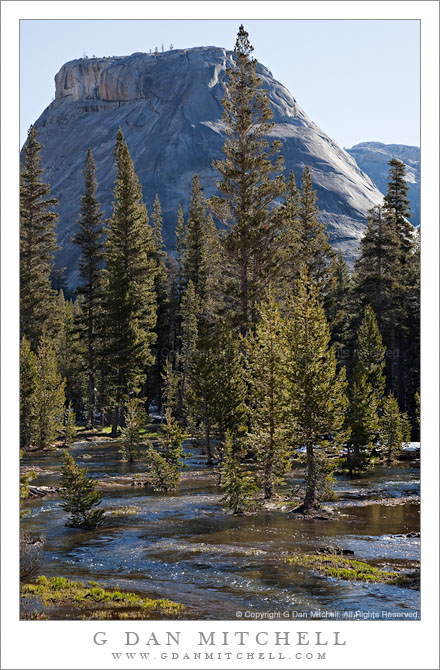
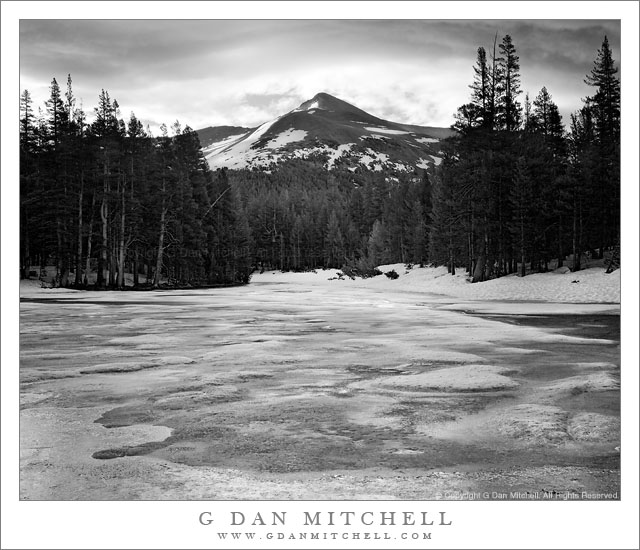
Cascade Creek Spring Torrent

Cascade Creek Spring Torrent

Cascade Creek Spring Torrent. Yosemite National Park, California. May 7, 2011. © Copyright G Dan Mitchell – all rights reserved.

A small tree stands in the raging spring torrent of Cascade Creek, Yosemite National Park.

This may be the final photograph in this series I shot in early May when I visited this seasonal cascade on the way into Yosemite Valley. Compared to some of the others this one takes in a larger portion of the scene, mainly so that I could include the little leafless tree or bush at the lower left, as it stands against the tremendous force of the rushing water descending steeply among the rocks.

This creek is fed by seasonal snow melt fairly early in the season because the ares that feed its flow are at a relatively lower elevation. For a while each year, but especially in a wet year like this one, this little creek rages as it drops precipitously down this narrow canyon towards a point below where it flows into the Merced River. A bridge provides an interesting vantage point from which to shoot almost directly down into the torrent.

G Dan Mitchell Photography | Flickr | Twitter (follow me) | Facebook (“Like” my page) | LinkedIn | Email
Text, photographs, and other media are © Copyright G Dan Mitchell (or others when indicated) and are not in the public domain and may not be used on websites, blogs, or in other media without advance permission from G Dan Mitchell.
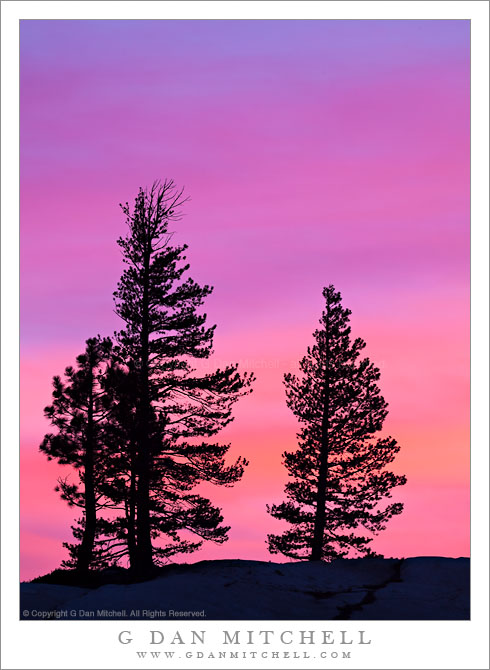
‘Rim of the World’ Overlook, Morning

'Rim of the World' Overlook, Morning

‘Rim of the World’ Overlook, Morning. Sierra Nevada, California. May 7, 2011. © Copyright G Dan Mitchell – all rights reserved.

The view toward Yosemite and the High Sierra from the ‘Rim of the World’ overlook above the Tuolumne River canyon along highway 120.

‘Rim of the World’ is the name given to a scenic overlook above the deep valley of the Tuolumne River along route 120, the northern route into Yosemite National Park. It is something of an odd place. It is a fairly pedestrian traffic pullout, though it overlooks the immense and impressively deep canyon of the Tuolumne. But the view is at least partially obstructed by things like power lines. However, it is a view that on clear days can extend great distances to very high Sierra peaks.

I most often simply blow past the spot on my way to or from the park. However, on this morning as I passed I thought the low morning light looked interesting so I found a spot to turn around and drove back. There was a bit of high cloudiness, and the light was coming across the folds of these foreground hills from the right, lighting up various bits of ridge and trees and illuminating the morning haze enough to amplify the effect of distance. If I’m not mistaken, the further ridge with its faintly seen snow fields is in the area of Mount Hoffman.

G Dan Mitchell Photography | Flickr | Twitter (follow me) | Facebook (“Like” my page) | LinkedIn | Email
Text, photographs, and other media are © Copyright G Dan Mitchell (or others when indicated) and are not in the public domain and may not be used on websites, blogs, or in other media without advance permission from G Dan Mitchell.

Boulders and Spring Torrent, Cascade Creek

Boulders and Spring Torrent, Cascade Creek
“Boulders and Spring Torrent, Cascade Creek” — Runoff from spring snow melt rushes over boulders of Cascade Creek, Yosemite National Park.

I recently posted the black and white version of this photograph of Cascade Creek in full spring flow.

The color version of this photograph posed a series of post-processing questions and problems that others who have worked with a scene like this one can probably imagine. The creek descends through a narrow, rocky gorge at this point and I photographed it early in the morning before any direct sunlight was able to reach the water. Benefits of shooting at this time included the softer light, which tends to both throw some light into the shadows and to soften the brightest highlights. This also permits a longer exposure which allows the water to blur a bit and express the wild motion of the creek. However, since the primary source of light was the open sky, the camera “sees” a very blue scene. (Our visual system compensates for this, so it doesn’t look as blue as it really is when you are on the scene.)

There are several ways to deal with the color balance issues that this situation creates. You could just “go with the blue,” and I’ve seen photographs done that way. I’ve even seen some in which the photograph amped up the saturation and ended up with something very blue. In general, that’s not my thing! I’m most often looking for something that seems “believable” – it may not be objectively accurate, but I intend it to be “subjectively accurate.” With this in mind, my first instinct was simply to warm the color balance in order to move away from the blue cast and toward a warmer one.

My immediate impression was that this was an improvement, and I worked with this interpretation for several days – but something about it didn’t sit quite right with me. (This is perhaps one reason that I also worked with the black and white rendition in the meantime.) Eventually I did some comparisons between the “warmed up” version and the original… and neither seemed like what I was after. The overly blue original looked garish but the overly warm version seemed artificial. I tried some other approaches and finally discovered that because the blue was so intense that I could simply desaturate it – more than you might think – and keep the “colder” coloration without letting it overwhelm the image.

G Dan Mitchell Photography | Flickr | Twitter (follow me) | Facebook (“Like” my page) | LinkedIn | Email
Text, photographs, and other media are © Copyright G Dan Mitchell (or others when indicated) and are not in the public domain and may not be used on websites, blogs, or in other media without advance permission from G Dan Mitchell.

Canon EOS 5D Mark II (at B&H)
Canon EF 70-200mm f/4 L USM at 126mm (at B&H)
ISO 100, f/16, 1/8 second