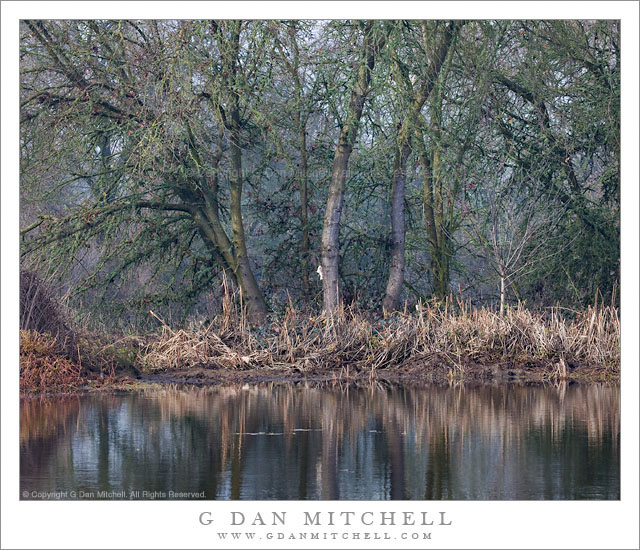
Weak sunlight breaks through Central Valley tule fog to illuminate trees and brush growing on a levee near the Cosumnes River.
This morning started out with extremely dense Central Valley tule fog – at first so thick that I more or less gave up photographing. But eventually, as usually happens, the upper layers of the fog began to thin, and some light began to filter down through the fog. By late in the morning the fog was thinning enough that very pale sunlight began to show through and softly light the dense vegetation on this levee along the edges of the Cosumnes River. This is an incredibly rich environment in the winter, especially with all of the water from winter rains and the nearby river, and the vegetation grows very thick here.
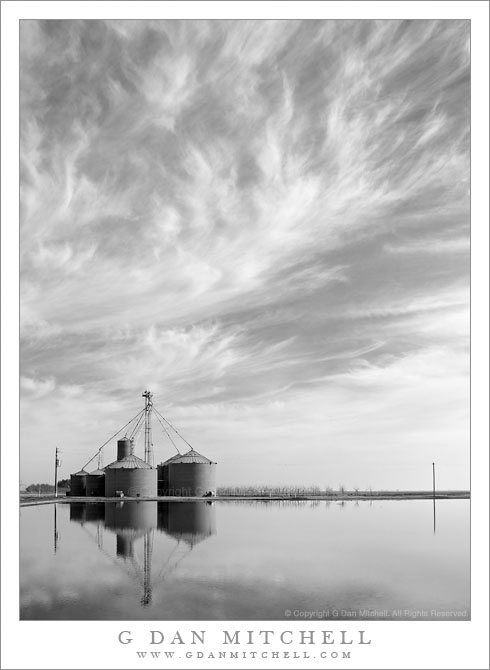
Thin winter clouds drift above farmland, Central Valley, California.
Photographing these beautiful winter clouds above the California Central Valley near the Cosumnes River between Stockton and Sacramento involved a certain amount of luck. For the most part it had been an extremely foggy morning – so foggy that at a few points early in the day I simply couldn’t find anything to shoot. Eventually the light began to filter down through the tule fog and I had some good luck shooting further up the valley at the Cosumnes River Wildlife Preserve.
At a certain point as the fog begins to thin it goes through a phase that is not so photographically compelling. The very thick fog can be quite interesting, and the light can be very special just as the sun starts to force its way through the fog as it starts to clear. But they there is a period when it is sort of sunny and sort of foggy, and but perhaps lacks the best aspects of each of the two conditions. That is how it was at about the time I left the Preserve and started back down the valley on my drive home.
Much earlier in the morning I had visited this side road near a bend in the Cosumnes River, so I decided to try it again since it was only slightly out of my way on the return drive. I drove slowly all the way to the end of the side road – to where it runs into the levee at the river – and then turned around to start back. I saw lots and lots of waterfowl, including impressive sandhill cranes and beautiful white egrets, but they were all too far from the road or in areas that didn’t provide the right kind of background. Near these flooded fields I stopped to consider trying to photograph some of the birds, changed my mind, and instead decided to see what I could do with these buildings, the flooded fields, and the sky. It was my luck that this final stop coincided with the near clearing of the fog and the appearance overhead of these wonderful clouds.
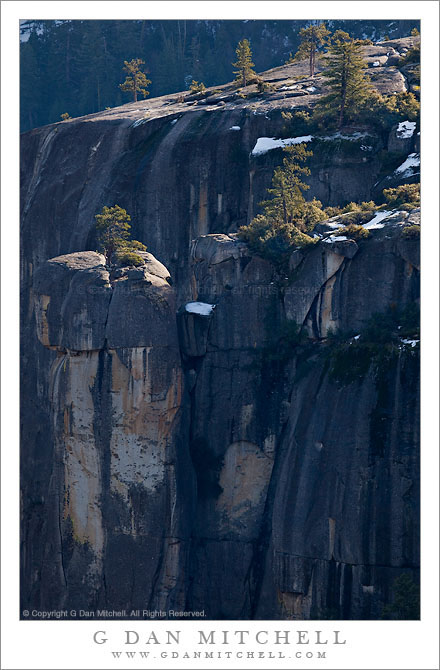
Sparse trees grow in granite slabs above steep granite cliffs in Lower Yosemite Valley.
(Note: After receiving some advice from a helpful reader – which was much appreciated! – I now know that this feature has a name. It is called “the Rostrum,” and I have retitled the photograph accordingly.)
I’ve seen these tree-topped columns and the granite slabs beyond many times when I’ve taken Crane Flat Road into the Valley. On my recent visit to Yosemite, photographing these trees in both early and late light was on my agenda, and I got myself into position to shoot them on two or three occasions.
At the right times of day – and there are at least two when this can work – the light slants across the top of the granite slabs and ledges at the top of these cliffs and catches the trees with side or back light. Below these upper slopes the vertical fluted forms of the cliffs drop nearly vertically to the Merced River canyon below. The cliffs themselves are in what I might describe as lower Yosemite Valley – think of Crane Flat Road above Cascade Creek or the area well beyond the upper end of Wawona Tunnel. There is a lot of very interesting and imposing rock in this part of the Valley, though I think it may get overlooked a bit by comparison to the truly astonishing faces and domes and peaks of the Valley proper.
Since the light changes throughout the year, and especially because the point at which the sun sets moves north as the years moves from winter to summer, I want to come back and photograph this area again a bit later in the year when I think the potential for light later in the day might improve. From my point of view, the ideal conditions might combine “golden hour” side light with shadows that reduce the detail on the forest covered slopes beyond – and without the bright snow patches that appear here. Of course, a fresh snowfall here might also be interesting…
I got a bit of a laugh out of one thing that happened when I made this photograph, though it is similar to similar situations I’ve had in the past. It is not at all unusual for lots of tourists to stop when they see a photographer with a big tripod and large lens at a pull-out along the road. I assume they think that if the photographer with the Fancy Equipment is stopping that there must be something there worth photographing. But sometime the photographer is pointing the camera in direction that must only confuse them. On this occasion I was in a spot with a classic and stunning view of distant Bridalveil Fall, and I’ll bet that many of those stopping thought they might try to duplicate my “shot of the falls.” But as they stopped and looked they may have wondered about me if they noticed that my lens was aimed at some seemingly nondescript spot perhaps 30% to the right of the fall…
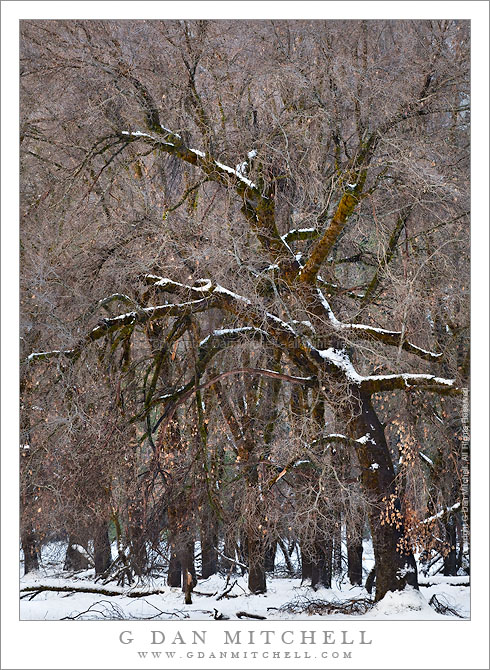
Snow dusts winter oak trees in El Capitan Meadow, Yosemite Valley.
A thick-trunk mature black oak fringed with snow stands in front of a grove of smaller oaks in El Capitan Meadow, Yosemite Valley. The small branches in the upper part of the tree are so thick that they almost create a cloud-like effect in this light, as the low angle winter sun leaves the Valley floor in shadow. A few leaves still remain on the lower branches of the tree.
Photographer and visual opportunist. Daily photos since 2005, plus articles, reviews, news, and ideas.
Manage Consent
To provide the best experiences, we use technologies like cookies to store and/or access device information. Consenting to these technologies will allow us to process data such as browsing behavior or unique IDs on this site. Not consenting or withdrawing consent, may adversely affect certain features and functions.
Functional
Always active
The technical storage or access is strictly necessary for the legitimate purpose of enabling the use of a specific service explicitly requested by the subscriber or user, or for the sole purpose of carrying out the transmission of a communication over an electronic communications network.
Preferences
The technical storage or access is necessary for the legitimate purpose of storing preferences that are not requested by the subscriber or user.
Statistics
The technical storage or access that is used exclusively for statistical purposes.The technical storage or access that is used exclusively for anonymous statistical purposes. Without a subpoena, voluntary compliance on the part of your Internet Service Provider, or additional records from a third party, information stored or retrieved for this purpose alone cannot usually be used to identify you.
Marketing
The technical storage or access is required to create user profiles to send advertising, or to track the user on a website or across several websites for similar marketing purposes.