Tag Archives: season

Three Elk, Point Reyes

Three Elk, Point Reyes

Three Elk, Point Reyes. Point Reyes National Seashore, California. May 30, 2011. © Copyright G Dan Mitchell – all rights reserved.

Three tule elk grazing on hills above Drakes Beach at Point Reyes National Seashore, California.

This is one more – and possibly the last – in the series of tule elk photographs that I made at the Point Reyes National Seashore on Memorial Day. A group of perhaps eight or ten bull elk were grazing along the top of the hills above Drakes Bay when we encountered them in beautiful late afternoon light. As soon as I got out with my camera they moved just a bit further away, but still well within photography range.

There is a typical sequence in how I usually photograph creatures such as these. Because I never know how long they will stick around, I begin my just shooting them in any way that seems even somewhat interesting, perhaps muttering to myself, “At least I have tule elk shots in my portfolio now!” But after getting a few “insurance” shots right off the bat, I start to be more selective and more observant. Initially, I’m looking for a variety of interesting individual shots. These might include a single animal separate from the group, perhaps the full group, and perhaps sub-groups of two or three. I also pay a lot of attention to their positions, watching to make sure that faces are visible. (In this shot, the leftmost elk is partially obscured, but because his eyes are still visible and because of the way his antlers align with those of the front animal, on balance I don’t think this is a big problem.) I also watch for distracting elements, and may stop shooting if they are present. For example, the rear end of an elk is bright white and, uh, not the most photogenic part of the beast – so I wait until an animal presenting its backside to the camera either moves out of the frame or rotates into a better position.

I also try to think the same way I think when photographing a group of people. Their faces and eyes are the most important things, with the relationships their positions create among them being a very close second. Here two of the elk are looking almost at me, but slightly past my left shoulder. The third animal seems to be looking more toward the other two, creating a different sort of relationship among the animals. These things are so fleeting that I sometimes don’t see them until they have happened, so I have learned to not be conservative about exposing a lot of frames!

To the extent that I have control over such things, I also like to think about the angle of the light on the subjects. Sometimes you have no choice – you simply have to shoot from where you are. However, with these elk I did have some range of options. They were along a road, and I chose to stop a bit before their position because the light coming from the left would light them in a more dramatic and interesting fashion than if I had gotten closer and shot them with the light right behind me. In addition, I try to look beyond the animals themselves and be aware of how they position themselves against background subjects. This particular shot isn’t a great example, but in others I might wait for the moving animals to position themselves in a place where the background elements relate to them in some interesting way.

With all of this detail, you might get the idea that I’m standing there making a series of careful and logical calculations about how to shoot these guys. That’s not really what happens at all. Much of it turns out to happen in a quick and intuitive and almost subconscious manner “in the moment.” I’ve probably written here before about my belief in the important of “practice” (something I learned from my musical background) when it comes to being able to work and see quickly and effectively.

G Dan Mitchell Photography | Flickr | Twitter (follow me) | Facebook (“Like” my page) | LinkedIn | Email
Text, photographs, and other media are © Copyright G Dan Mitchell (or others when indicated) and are not in the public domain and may not be used on websites, blogs, or in other media without advance permission from G Dan Mitchell.

Boulders and Spring Torrent, Cascade Creek

Boulders and Spring Torrent, Cascade Creek
“Boulders and Spring Torrent, Cascade Creek” — Runoff from spring snow melt rushes over boulders of Cascade Creek, Yosemite National Park.

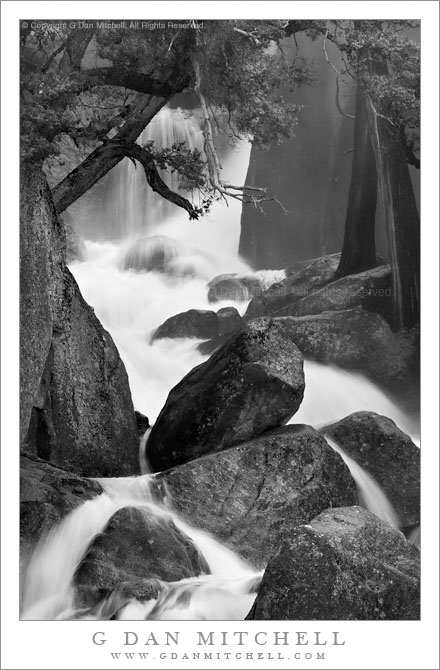
I recently posted the black and white version of this photograph of Cascade Creek in full spring flow.

The color version of this photograph posed a series of post-processing questions and problems that others who have worked with a scene like this one can probably imagine. The creek descends through a narrow, rocky gorge at this point and I photographed it early in the morning before any direct sunlight was able to reach the water. Benefits of shooting at this time included the softer light, which tends to both throw some light into the shadows and to soften the brightest highlights. This also permits a longer exposure which allows the water to blur a bit and express the wild motion of the creek. However, since the primary source of light was the open sky, the camera “sees” a very blue scene. (Our visual system compensates for this, so it doesn’t look as blue as it really is when you are on the scene.)

There are several ways to deal with the color balance issues that this situation creates. You could just “go with the blue,” and I’ve seen photographs done that way. I’ve even seen some in which the photograph amped up the saturation and ended up with something very blue. In general, that’s not my thing! I’m most often looking for something that seems “believable” – it may not be objectively accurate, but I intend it to be “subjectively accurate.” With this in mind, my first instinct was simply to warm the color balance in order to move away from the blue cast and toward a warmer one.

My immediate impression was that this was an improvement, and I worked with this interpretation for several days – but something about it didn’t sit quite right with me. (This is perhaps one reason that I also worked with the black and white rendition in the meantime.) Eventually I did some comparisons between the “warmed up” version and the original… and neither seemed like what I was after. The overly blue original looked garish but the overly warm version seemed artificial. I tried some other approaches and finally discovered that because the blue was so intense that I could simply desaturate it – more than you might think – and keep the “colder” coloration without letting it overwhelm the image.

G Dan Mitchell Photography | Flickr | Twitter (follow me) | Facebook (“Like” my page) | LinkedIn | Email
Text, photographs, and other media are © Copyright G Dan Mitchell (or others when indicated) and are not in the public domain and may not be used on websites, blogs, or in other media without advance permission from G Dan Mitchell.

Canon EOS 5D Mark II (at B&H)
Canon EF 70-200mm f/4 L USM at 126mm (at B&H)
ISO 100, f/16, 1/8 second


Boulders and Spring Torrent, Cascade Creek

Boulders and Spring Torrent, Cascade Creek

Boulders and Spring Torrent, Cascade Creek. Yosemite National Park, California. May 7, 2011. © Copyright G Dan Mitchell – all rights reserved.

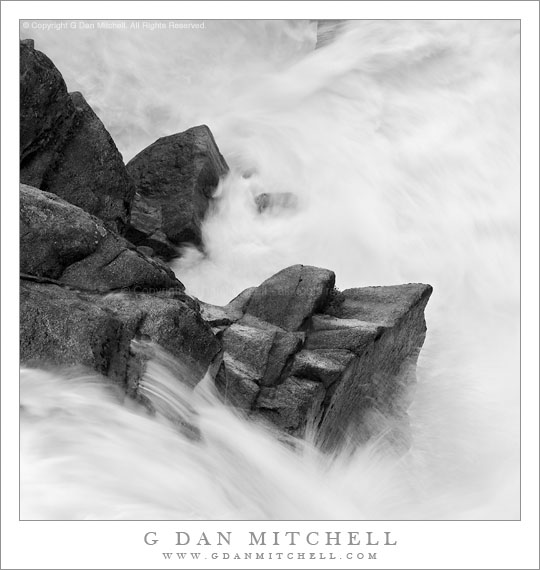
Runoff from spring snow melt rushes over boulders of Cascade Creek, Yosemite National Park.

This is a subject that I return to several times each year – a particular section of creek that can be viewed from overhead and which can vary from nearly dry to a wild torrent depending upon the time of year and the character of each new year. During the past year I was inspired by Charles Cramer’s stunning photograph of this subject to look at it more closely and from some different perspectives. (A small bit of “Charlie’s scene” appears in this photograph. I wonder if you can find it? :-)

In some ways, the view of this scene is limited in that you can only see it from a particular range of positions – unless you have the skill of levitation! In another way it is hardly limiting at all since the larger view contains many possible smaller views of rocks and plants and water and light. I still have in mind a horizontal composition in this general area, but so far it hasn’t quite worked. Guess I’ll have to keep trying.

I made this photograph in the morning before any direct light had worked its way around the mountains and down into the stream bed. Beyond the stream, which drops precipitously into the Merced River far below, there was open sky and that is the light that reflects on some of the wet rocks. By playing around to find an appropriate combination of ISO values, aperture, and shutter speed, I tried to get the water to hold some detail but to also be blurred enough to reflect its wild motion as it tumbles down this rocky canyon.

As is sometimes the case, I still cannot decide for sure between this monochrome version and a color version that will appear here before long.

G Dan Mitchell Photography | Flickr | Twitter (follow me) | Facebook (“Like” my page) | LinkedIn | Email
Text, photographs, and other media are © Copyright G Dan Mitchell (or others when indicated) and are not in the public domain and may not be used on websites, blogs, or in other media without advance permission from G Dan Mitchell.

Dogwood Blossoms, Forest

Dogwood Blossoms, Forest

Dogwood Blossoms, Forest. Yosemite Valley, California. May 7, 2011. © Copyright G Dan Mitchell – all rights reserved.

A dogwood tree blooms in the forest of Yosemite Valley.

I have a feeling that I need to try a largish print of this one – there is so much detail in the scene that it is almost hard to make sense out of it in a small jpg. In the late afternoon I had wandered along the north edge of the Valley until I reached a point a bit east of the Ahwahnee Hotel. Having finished in this area, I headed around the hotel grounds and toward the Merced River and the former campground areas that were closed after the epic floods of a decade or so ago. This area is in some spots largely overgrown by thick, low plants and in some places I know that there are some good specimens of dogwood.

Although it was early in this year’s dogwood bloom cycle, I found a couple of very good trees in this area, and these two were almost completely in bloom. The forest here is quite dark and thick, and especially during the early evening time when I arrived this made the density of the vegetation seem even more impressive. The idea here was to fill the frame with flower-laden branches with the strong vertical lines of the forest trees behind, but also with detail everywhere in the frame.

G Dan Mitchell Photography | Flickr | Twitter (follow me) | Facebook (“Like” my page) | LinkedIn | Email
Text, photographs, and other media are © Copyright G Dan Mitchell (or others when indicated) and are not in the public domain and may not be used on websites, blogs, or in other media without advance permission from G Dan Mitchell.