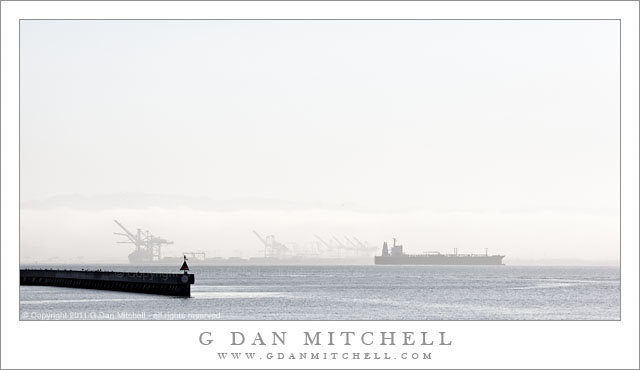
Anchored ship and ship yard cranes of the port of Oakland beyond a breakwater, San Francisco Bay.
I made this photograph on one of my summertime San Francisco visits on which I head up there on the train very early in the morning, and then I walk wherever my nose leads me, making photographs. On this visit I left the train station and ended up crossing a bridge to the inlet behind AT&T park, sometimes called “McCovey Cove.” From along the far side of this inlet I could see across the San Francisco Bay to the towering cranes at the port of Oakland. They were backed by a fog bank that completely obscured the city of Oakland and all but the very tops of the East Bay Hills.
This morning light coming across the Bay can be very special. As it often shines through the moisture laden air over the water and sometimes through clearing fog, it can take on a luminous glow and can even be almost too bright to look at. This was that sort of morning, so I let the sky exposure go as close to white as I could and still retain some sense of the thick air. The dark object at the left is a concrete breakwater outside the entrance to South Beach Harbor.
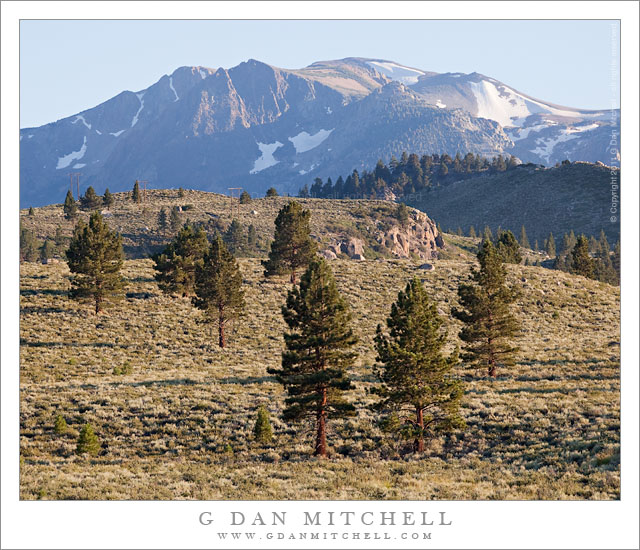
Trees ascend sage-covered hills toward the Sierra Nevada crest near June Lake, California.
Near highway 395 in Mono County, the main north-south route east of the Sierra crest, these open stands of large conifers ascend from the high desert sagebrush country towards the peaks of the Sierra crest, which rise much more abruptly on this side of the range than on the gentle west side. The tall ridge is above the June Lakes resort area between Mammoth Lakes and Lee Vining.
While my primary goal on this trip was to photograph in the Yosemite high country along Tioga Pass Road, smoke from a wildfire near Glacier Point in the park was drifting over the Tuolumne area and creating a lot of very non-photogenic haze. I had a hunch that by dropped over to the east side of the range I might be able to get away from the smoke or at least find areas where it wasn’t so thick. The smoke was still affecting the light near Lee Vining, but I didn’t have to drive too far south to get out of its path, though even here there is a bit of haze increasing the effect of atmospheric recession.
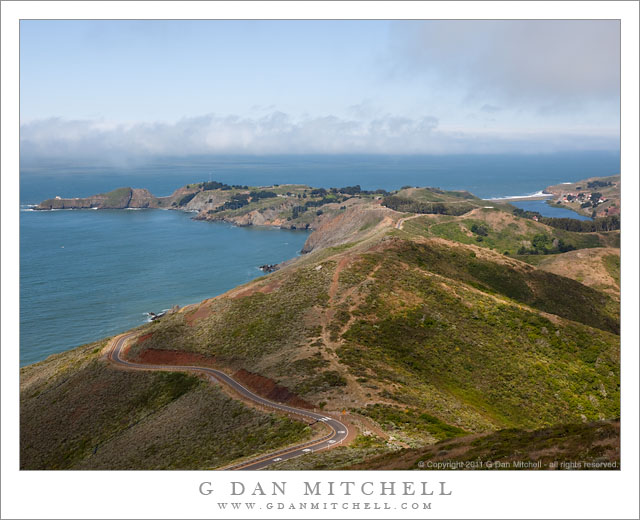
Offshore fog lies beyond Point Bonita and Rodeo Beach and the Marin Headlands of the Golden Gate National Recreation Area.
I was surprised to find a clear view like this during my mid-July visit to the Marin Headlands of the Golden Gate National Recreation Area (GGNRA) across the Bay from San Francisco. I had almost decided to stay home or go elsewhere based on weather reports that had the coast completely socked in my dense fog for most of the day. Indeed, it was foggy as I passed through San Francisco and drove across the Golden Gate Bridge. The fog was high, and I could see some distance beneath it, but it was still a rather gray day.
Since the lower section of Conzelman Road, the normal quick and scenic route up into the headlands, was closed for construction, I took that alternate route that passes through a tunnel to come out near Rodeo Beach. I turned left up the hill to reach the upper section of the road. After photographing near Battery 129 for a while, the sun began to break through the fog, and I was surprised to find a fairly clear patch just outside the Golden Gate.
The photograph shows the last section of the headlands as the hills drop towards the historic fort and batteries near the Point Bonito light house, which is barely visible at the end of the peninsula on the left. The line of surf at the upper right is Rodeo Beach, a popular spot with Bay Area folks.
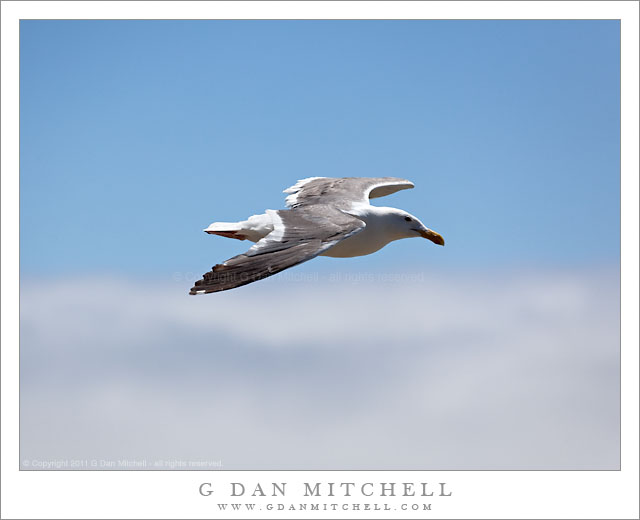
A solitary gull flies above California’s Pacific Ocean coastline with a fog bank and blue sky beyond.
With some free time earlier this week, and the excuse of driving my son to a summer-session class at UC-Santa Cruz, I headed north from Santa Cruz looking for things to photograph. Because there was a lot of fog, even in the middle of the day, fog was one of my general subject ideas. And I almost always make at least a quick stop at a couple of bluff-top locations that I know of where shore birds often glide by very close as they ride the updrafts from the ocean winds. It turned out that my first stop was precisely one of these locations. With nothing else specific in mind at this midday hour, I figured I would at least spend a bit of time honing my skills and tracking and photographing birds in flight.
Although sea gulls are not necessarily my favorite subjects, there sure were plenty of them to practice on! At the spot I picked, they first become visible perhaps 10-15 seconds away as they come around the edge of a bluff to the south. As they approach they tend to vary their altitudes, with some dropping low enough that they disappear behind the cliff and others going so high that only their shaded undersides are visible. But a few come very close at almost eye level.
I almost always learn something new when I photograph birds in flight and this session was no exception. While in retrospect it seems like one of those “Well, duh!” realizations, I figured out that really strong winds tend to upset the birds ability to remain level, and for this reason they are constantly adjusting to remain level. From moment to moment the wings move into interesting positions or they find themselves tilting wildly to get back on course. This is much more interesting than what they do in benign conditions, where they often seem to just… coast.
So, add one more thing to watch for as they fly past. This isn’t an easy thing, and I have the greatest admiration for those who are really great at photographing birds in flight – or “BIF,” as some call them. The first challenge is simply to keep the moving birds in the viewfinder when using a long focal length lens. (I advise practicing the process of simply following the birds without even firing the shutter at first.) But that’s not enough. You must also attempt to keep the bird(s) in a position within the frame that is aesthetically interesting and which will position the target under the active AF points on the camera. Easier said than done! Then there is the matter of trying also be aware of what the bird is doing – watching wing and head position and so forth. On top of that, you ideally also want to be aware of the what else is in the frame – sky, clouds, water, other birds – and factor that into the decision about when to press the shutter. There are exposure challenges, too, especially with birds like this gull that have white on their backs… and this portion of the bird is in direct sun.
Let’s just say that – for me at least – it takes a lot of exposures to get a few shots that I like.