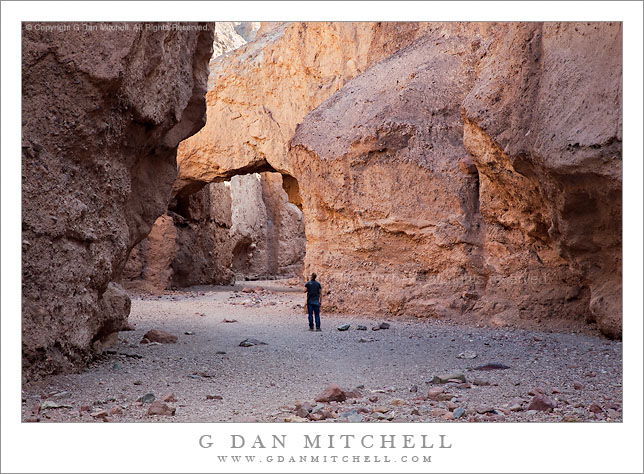
A hiker pauses below the bridge in Natural Bridge Canyon, Death Valley National Park, California.
I visited this canyon and its natural bridge on my late-March visit to Death Valley. The Nature Bridge canyon is located just a bit north of Badwater, and after a short drive up the alluvial fan to the trailhead it is an easy hike up an impressively narrow and deep canyon to the large, blocky bridge. I like to save the canyons for mid-morning or late-afternoon shooting, since the light here can actually improve a bit further away from the sunrise/sunset edges of the day – the direct light is block by the tall canyon walls.
This canyon is narrow, but not as narrow as some of the other popular canyons with trails such as Mosaic Canyon, in which there a spots where two people cannot pass. Compared to that this canyon is much wider in most spots, perhaps 20 feet or more in places. Nonetheless the vertical and tall walls of the lower section of the canyon block out most of the sky and give a feeling of being somewhat closed in.
G Dan Mitchell is a California photographer and visual opportunist. His book, “California’s Fall Color: A Photographer’s Guide to Autumn in the Sierra” (Heyday Books) is available directly from him.
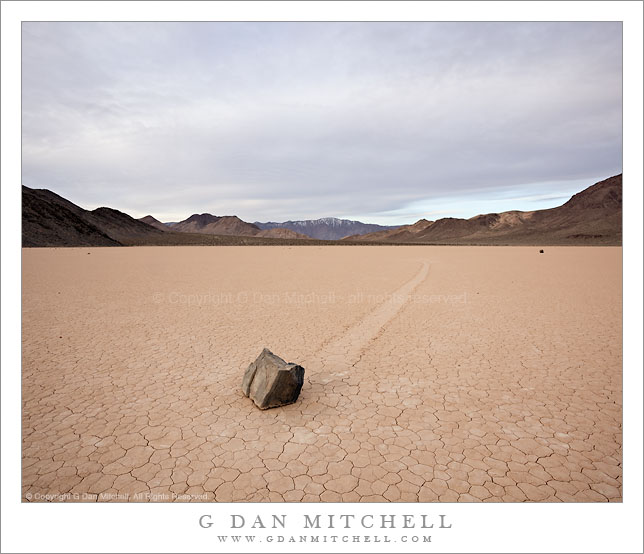
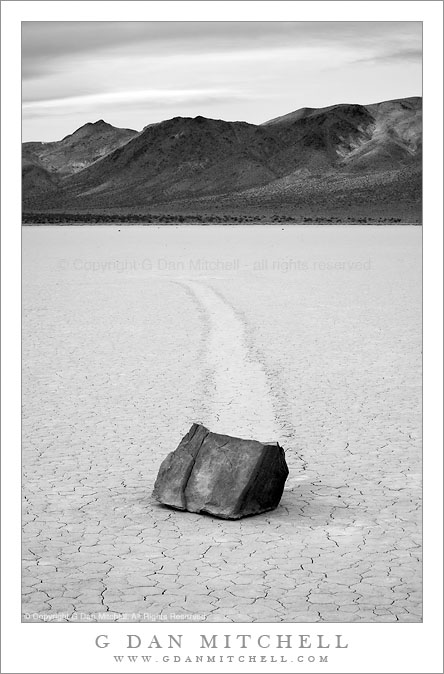
A “moving rock” beneath overcast morning skies at the Racetrack Playa, Death Valley.
First a bit of background about “the Racetrack,” the location of the famous “moving rocks” in Death Valley National Park. About 25 miles out in the desert back-country of the park on a very bad gravel road there is an isolated and desolate playa known as “the Racetrack.” (For those considering a visit, getting to the Racetrack is no trivial matter. The drive takes nearly two hours one-way and the road is awful, with some of the worst wash-board surface I’ve ever encountered. There are absolutely no services along the road or at the Racetrack – no water is available and your cell phone won’t work.) The name of the place comes, in some circuitous way, from the mysterious rocks that have clearly traveled across the playa, sometimes many hundreds of yards, and left tracks gouged into the playa surface. The most likely explanation for the phenomenon involves a combination of a periodically flooded playa, extremely high winds, and rare occasions when it is cold enough to freeze the surface of collected water, locking the rocks in place and allowing the wind to move them. I’ve never heard anything concrete about the frequency of this alignment of conditions, but as far as I know no one has ever observed the rocks actually moving, nor is there any indication that they have moved recently.
I’ve been out there three times in the past, and had great conditions for doing photography. On this visit I had plans to photograph in sunset and sunrise light and to attempt night photography of the rocks under the full moon. (I did the latter once before, but was less familiar than I am now with how to best do this with a DSLR.) Since I’ve had such good luck with weather and lighting conditions in the past, I suppose I was due for less than optimum conditions… and that is what I encountered. Shortly after arriving at the playa the sky was covered by high, thin clouds. Except for a brief moment close to sunset this made late day photography difficult. The overcast stuck around until I left then next morning, making the planned full moon night photography an impossibility, and the morning light was also challenging.
That said, I’m still glad I went. Standing in the middle of this empty playa completely alone as the day ends or begins is an amazing experience that few people get to have. And I did manage to bring back a few photographs that I think will “work.” This one was shot fairly early in the morning at what might have been around sunrise, if a sunrise had actually occurred.
This photograph is not in the public domain and may not be used on websites, blogs, or in other media without advance permission from G Dan Mitchell.
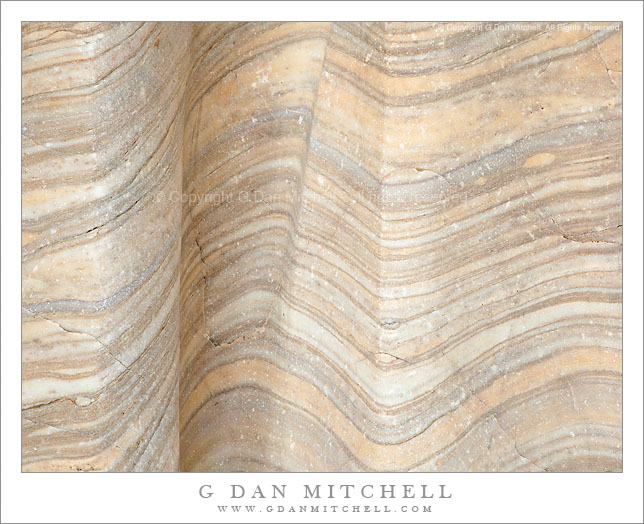
Folded and twisted rock forms in Mosaic Canyon, Death Valley National Park, California.
Although this formation is found very near the entrance to the canyon, on this visit I also managed to wander further up the canyon than I have in the past, discovering very different and far more open terrain that what I had seen before. Mosaic Canyon, a short drive up the hill from Stovepipe Wells, is known for its very narrow and twisty lower section, its access to higher regions of the Mount Tucki area, and the striking and unusual rock formations laid bare by erosion from water traveling down the canyon in past floods.
In the lower canyon there is a section where this beautifully banded rock runs alongside the trail. Sometimes that patterns are a bit hard to see, but this time it appeared that recent rains and the soft afternoon shaded light brought them out a bit more. This section featured ribbon-like folds in the surface of the rock that must have been created by water erosion.
This photograph is not in the public domain and may not be used on websites, blogs, or in other media without advance permission from G Dan Mitchell.
Night panoramic photograph of the powerplant building and other structures along Railroad Avenue at the historic Mare Island Naval Shipyard, Vallejo, California.
This is a bit of a first for me – a night photography stitched panorama. This image is composed of two separate exposures which were aligned and “stitched” into a single image in post. (As such, it could be a very large print!) Shooting from an elevated position, I shot almost directly north (as you can tell from the star trails in the larger version). The view looks up Railroad Avenue past the iconic power plant building with its smokestack that is visible from all over Mare Island.
I’m usually a bit casual about exposure time with long exposure night photographs. It isn’t that I don’t care – it is just that one has a ton of leeway when it comes to the very long exposures I typically use. For example, on a 3 minute exposure you would have to be off by three minutes to overexpose by one stop! So rather than use a stopwatch or an automatic timer I just count to myself. I’m usually will within a 10% error, and that is good enough. However, when stitching “good enough” often isn’t. The separate component frames really need to be quite similar, so in this case I resorted to using my watch to get relatively accurate 90 second exposures.
Another interesting factor in night photography is illustrated in this photo, namely the wildly varied colors of the light sources we deal with. There are three dominant sources in this image. The overall illumination comes from the full moon, which is quite similar to day light in terms of white balance. On the near wall of the brick power plant there is very “hot” and saturated yellow/red tinted light, probably from sodium vapor lamps. Near the left end of the image is an old wooden building that is illuminated by very green light, which I believe comes from mercury vapor lamps. I often chuckle a bit when people speak of “white balancing” the color in a scene like this. If you pick one source for your white balance you’ll throw the others even more out of line. My philosophy is usually to just go with what looks right!
Finally, the idea of making the stitched panorama came from the recently started Panocturnists web site, begun by people connected with The Nocturnes, the San Francisco Bay Area night photography group. I was intrigued by the idea of creating panoramic night photography, and I’ve done a few images along these lines on my two most recent visits to Mare Island.