
Tag Archives: travel

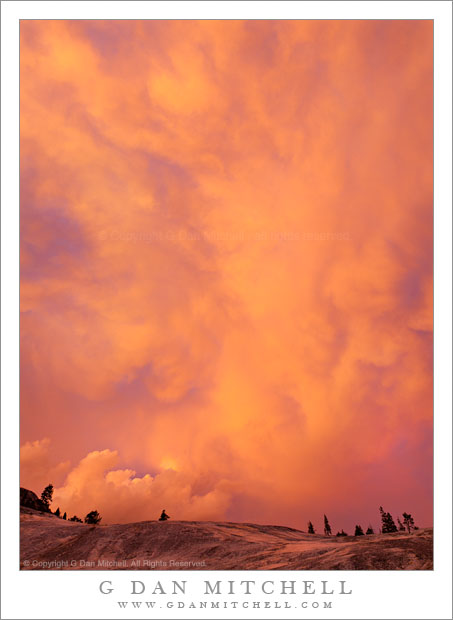
Dissipating Storm Clouds, Sunset

Dissipating Storm Clouds, Sunset

Dissipating Storm Clouds, Sunset. Yosemite National Park, California. September 20, 2011. © Copyright 2011 G Dan Mitchell – all rights reserved.

Sunset light on dissipating thunderstom clouds above granite slabs, Yosemite National Park.

Late on this September afternoon in the Yosemite back-country I had a good idea that something might happen around sunset, but I could not have known in advance just how intense the cloud color would turn out to be. The set-up was classic. Thunder storms had built up throughout the afternoon, and by late in the day I would see and hear large storms to my north and east – though I remained right on the edge of the storm potential as I was a bit further west. As evening approached the cloud-building forces began to diminish, leaving the tops of the larger cells unsupported, and they began to thin and stretch westward, curving up and over my location along the Tuolumne River.

Knowing that interesting light of one sort or another was probable, I walked to an area of granite slabs and bowls that I had photographed when visiting this area at the start of my trip nearly a week earlier. As I considered a few photographs of the granite and trees in that area, my attention kept being drawn to the sky. At first it remained a relatively low contrast mass of gray, though the thinning clouds started to allow views through falling virga towards more distant clouds that rose into the sunlight. Then, as the sun dropped and the foreground lost the direct light, the clouds began to light up and take on wildly saturated colors. (A technical note: in many of the photographs, though not in this one, the dynamic range between cloud highlights and foreground was so large that it required multiple exposures separated by up to five stops to capture it all!)

I moved to the base of the granite bowl in which I had photographed rocks and small trees a week before when I saw these spectacular clouds building to the north west. The color was simply unbelievable – and you can see that the intense saturated light was not just in the sky, but that it also colored the granite near the bottom of the image. For this photograph I used a short focal length to try to take in a large section of the flowing and wildly shaped and colored clouds.

G Dan Mitchell is a California photographer whose subjects include the Pacific coast, redwood forests, central California oak/grasslands, the Sierra Nevada, California deserts, urban landscapes, night photography, and more.
Blog | About | Flickr | Twitter | FacebookGoogle+ | 500px.com | LinkedIn | Email

Text, photographs, and other media are © Copyright G Dan Mitchell (or others when indicated) and are not in the public domain and may not be used on websites, blogs, or in other media without advance permission from G Dan Mitchell.
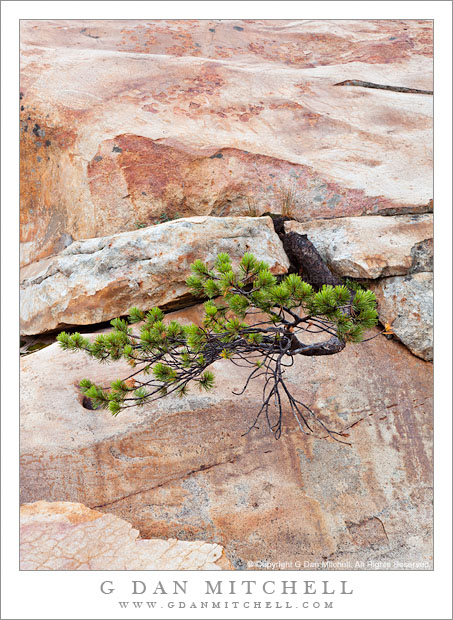
Tree and Stained Granite

Tree and Stained Granite

Tree and Stained Granite. Yosemite National Park, California. September 15, 2011. © Copyright 2011 G Dan Mitchell – all rights reserved.

A small tree grows from a crack in red-stained granite slabs, Yosemite National Park.

Back in mid-September of this year I joined a group of five other photographers for a bit more than a week of photography in the High Sierra back-country of Yosemite National Park, going out along the Tuolumne River and spending some significant time in two locations and having several days to photograph at each of them. The first few days were spent along the Tuolumne in a place where a short hike led to a beautiful bowl of smooth granite slabs interrupted by some trees and stained by seepage from a band of reddish rocks above. In some ways this might have seemed like a tricky spot to photograph since it is in the bottom of a canyon and the light is blocked to the east and somewhat blocked to the west. But I like the indirect light found in shaded areas after dawn and before sunset, so I went back to this area on at least three days to photograph in this diffused, soft light.

The rocks are part of a large area of granite slabs that this non-geologist assumes were carved and smoothed by glaciers traveling down from the peaks above the Tuolumne area. In this spot the formations include large areas of smooth and curved granite surfaces, areas that have been pock-marked by erosion and water, cracks of various sizes ranging from incipient to gigantic, and trees and other plants growing anywhere they can find footing: tiny cracks, larger cracks like this one, collections of sand and debris in low spots, and so on. I came back to this tree and some of its neighbors several times and came to think of it as the “bonsai tree.”

G Dan Mitchell is a California photographer whose subjects include the Pacific coast, redwood forests, central California oak/grasslands, the Sierra Nevada, California deserts, urban landscapes, night photography, and more.
Blog | About | Flickr | Twitter | FacebookGoogle+ | 500px.com | LinkedIn | Email

Text, photographs, and other media are © Copyright G Dan Mitchell (or others when indicated) and are not in the public domain and may not be used on websites, blogs, or in other media without advance permission from G Dan Mitchell.
Detail, Red Cathedral

Detail, Red Cathedral
“Detail, Red Cathedral” — The eroded and fluted face of the Red Cathedral, Zabriski Point, Death Valley National Park.

I have recently posted other photographs made in the area of Zabriskie Point in Death Valley, including one other of this feature sometimes known as the Red Cathedral. It stands to the right of the more famous and recognizable parts of the Zabriskie Point Landscape where, for example, Manley Beacon is one of the most well-known visual icons in the park.

This detail photograph was made using a long lens very shortly after the first morning light had arrived on this feature. In my experience, getting good light on Red Cathedral can be a tricky thing. Parts of it face away from the sun and towards Death Valley and because its face is deeply fluted it can be tricky avoiding blocked shadows. But increasing exposure too much creates problems with saturated colors on the brightest strata that cut through its face. If you shoot it in the morning, light somewhat softened by some high clouds can be helpful, and that is what I had on this morning – the sun light is direct, but it is also filtered a bit by passing through broken clouds to the east.


Leave a comment or question using the form. (If you are reading this on the home page, click the article title to see the full article and the comment form.

G Dan Mitchell is a California photographer and visual opportunist. His book, “California’s Fall Color: A Photographer’s Guide to Autumn in the Sierra” (Heyday Books) is available directly from him. Blog | Bluesky | Mastodon | Substack Notes | Flickr | Email

All media © Copyright G Dan Mitchell and others.

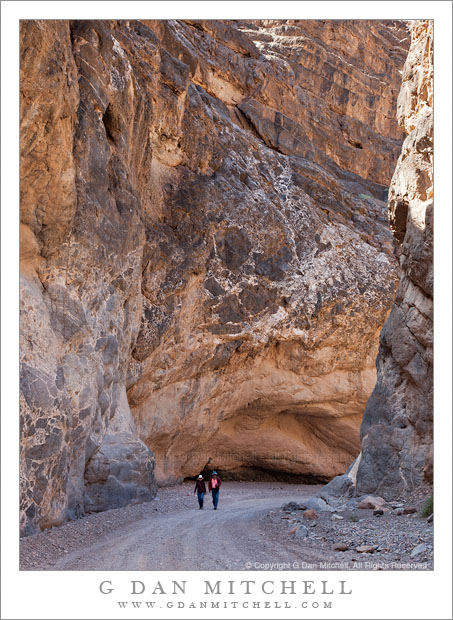
Hikers, Titus Canyon

Hikers, Titus Canyon

Hikers, Titus Canyon. Death Valley, National Park. March 28, 2010. © Copyright 2011 G Dan Mitchell – all rights reserved.

Hikers in Titus Canyon, Death Valley National Park.

There are essentially two ways to get to this portion of Titus Canyon in Death Valley National Park – you can either do a very long drive from near Beatty on gravel roads or you can walk a short distance up from the base of the canyon along the eastern side of Death Valley itself. I’ve done both. The road is quite an experience – in any other park it would probably be regarded as a very special thing, especially the last portion above Death Valley where it twists and turns down a slot canyon that is in places barely wide enough to a vehicle yet so tall that it can be hard to see the tops of the canyon walls. (It is not exactly a bad road, but it isn’t trivial either. There are some very exposed sections where it crosses the mountain ridge and descends past Leadville. Although there are reports of people using lesser vehicles, take seriously the recommendations for reasonably high ground clearance and some from of all-wheel drive.)

However, on this visit I simply parked my car at the base of the canyon, shouldered my camera equipment, and walked up the canyon a ways. There is, of course, much that you probably won’t see if you enter the canyon this way, largely because the road is so long that you won’t likely cover much of it on foot. However, I think that you can more clearly sense the scale of the lower slot canyon when traveling of foot. I included two hikers who happened by to give a sense of that scale to the landscape.

G Dan Mitchell is a California photographer whose subjects include the Pacific coast, redwood forests, central California oak/grasslands, the Sierra Nevada, California deserts, urban landscapes, night photography, and more.
Blog | About | Flickr | Twitter | Facebook | Google+ | 500px.com | LinkedIn | Email

Text, photographs, and other media are © Copyright G Dan Mitchell (or others when indicated) and are not in the public domain and may not be used on websites, blogs, or in other media without advance permission from G Dan Mitchell.