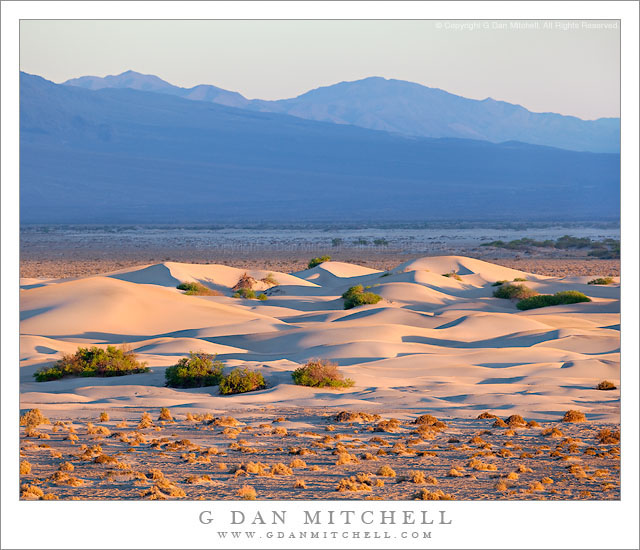
Early morning light striking minor dunes on Mesquite Flat with Cottonwood Mountains wash and the Last Chance Range in the distance, Death Valley National Park.
These dunes are not too far from the main Mesquite Dunes near Stovepipe Wells – they are a bit further east from the better known tallest section of the dunes. The areas of lower dunes provide some very interesting shapes and textures on a smaller scale in some ways that those of the larger dunes. I photographed these with a long lens, shooting from a rise, at a point in time very shortly after the first morning light had struck the sand. The background hills, part of a very large alluvial fan at the base of the Cottonwood Mountains, were in the shadow of a cloud.
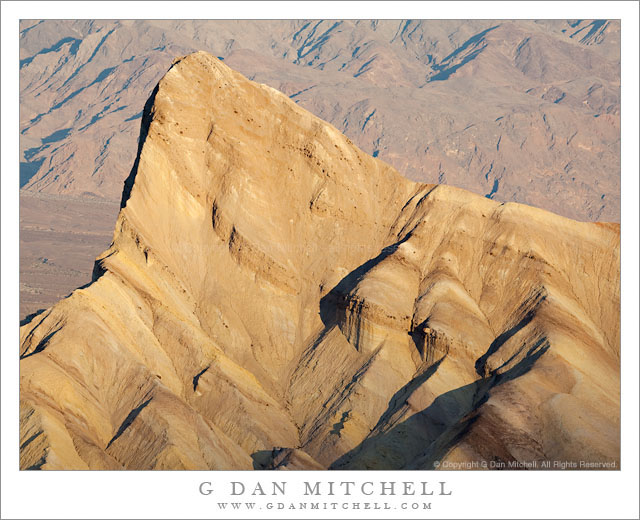
The first morning light strikes Manly Beacon at Zabriskie Point, Death Valley National Park.
Icon alert!
I had more or less promised myself that I would not photograph at Zabriskie Point on this trip – been there, done that – unless the conditions were really special. But I miscalculated my morning start on this day and discovered that I wasn’t going to make it to my intended destination in time. As I passed Zabriskie on my way to the “other place,” telling myself that I still had a half hour before I needed to be in place for the early light… I noticed that clouds above this area were already starting to pick up the pink color of dawn light. I hesitated for a moment – I really wanted to photograph that other subject – but quickly realized that it would make a lot more sense to the shoot the subject that was here in the light that was developing than to drive further and miss out entirely on the first light.
So I turned into that familiar parking lot with its familiar fleet of photographers’ cars and quickly loaded up my gear. I was a bit surprised that I saw so few people up above at the official overlook, but it was quite windy and I figured that perhaps they had just dropped down on the other side of the wall below this spot. In any case, I had a different spot in mind, one further to the right, so I headed over that way and quickly discovered that the wind was blowing almost too strongly to make photographs. I made a couple of shots from a small gap there and then headed up toward the overlook. At the top of the little trail from the parking lot I dropped onto the small use trail to the side of the wall and was again surprised to see almost no other photographers. I walked a few feet farther and discovered that the “usual crowd” was huddled in a small area in the lee of the wall, trying desperately to find protection from the wind.
These days, my main project when I stop at Zabriskie is to find and photograph small, isolated elements of the landscape with a long lens. For the most part – unless truly magical conditions are present, and they weren’t on this morning – I don’t really spend much time on the classic views of Gower Gulch, the Valley, and the Panamint Range. However, since I’m there and know the progression of the light fairly well at this point, I’m not about to pass up the opportunity to get a better image of one of these iconic subjects. So as the first light was about to hit the summit of Manly Beacon I turned my rig that direction and spent a couple of minutes photographing it as the line between shadow and morning light traveled down its face.
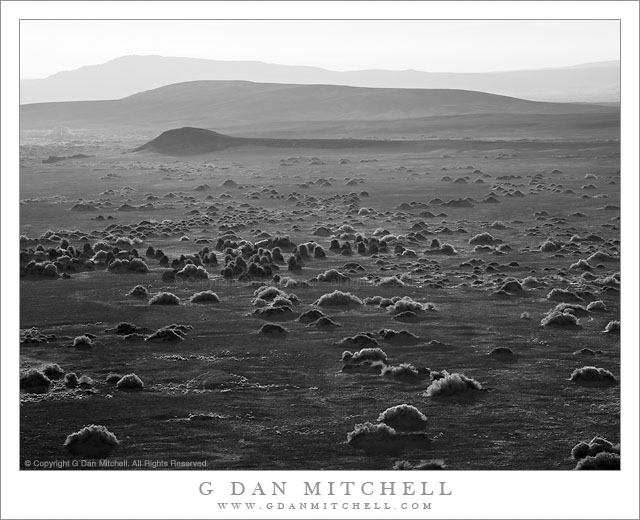
Low angle morning light silhouettes receding hills and plants near Devils Cornfield, Death Valley National Park.
Taking advantage of the low angle light from the sun as it rose above the Funeral Mountains, I shot almost directly into the light with a long lens to photograph these backlit plants (“arrowweed” I believe) growing along the fringes of the Devils Cornfield area not far from Stovepipe Wells. Although the compressed perspective from the relatively long focal length disguises the fact, I was shooting from a hill that gave me some elevation above the flat surface of the Valley here, and provided a bit better view of the tops of the hills receding into the haze.
I made a variation on this photograph at the same time that I posted earlier – it is in color and used an even longer focal length to get a bit more detail of the mesquite tree that is barely visible in the upper right area of this shot. The color image has a much less start appearance than the black and white rendition with its contrast between the light on the tops of the plants and the surrounding dark soil.
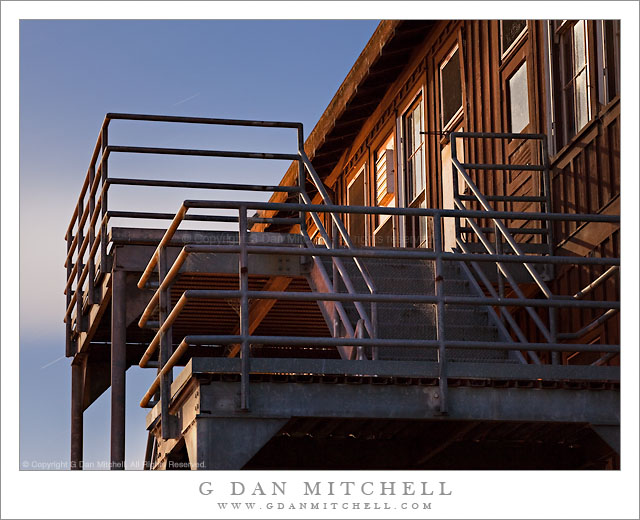
The light of the full moon illuminates the facade of a wooden building, and outside stairway, and passing overhead fog clouds at Mare Island Naval Ship Yard.
Since I was out doing night photography this weekend, I’m going to use this as an excuse to insert a night image into the recent stream of Death Valley photographs. (There are more of those, but a bit of variety can’t hurt.) I got an email from Tim Baskerville, the guiding light (guiding dark?) of The Nocturnes, the San Francisco Bay Area night photography group. Tim has introduced and guided many new night photographers over the past few decades, and The Nocturnes group is a sort of loose collective linking together lots of night photographers and providing instruction, online resources, and shows of night photography work. As this is the 20th year for the group, lots of special activities are taking place and this little spontaneous get-together at Mare Island was one of them.
A small story from this weekend’s shoot may illustrate the widespread effect of Tim’s work with night photography in general and with the Mare Island location specifically. Those of us who were to meet Tim at Mare Island arrived to find other photographers already assembled at the indicated meeting place – but we didn’t really recognize most of the group. It turns out that another night photography group (loosely organized, as I understand it, by Thomas Hawk and Ivan Makarov) was going to be there as well. We spoke with them a bit and then they departed for the far end of the island. (They returned later and we worked side by side.) But then, a few minutes later, more vehicles began to show up and we thought that they might be the rest of our group, especially when someone asked “Are you the Nocturnes?” But no, this was a third night photography group, this one out of Sacramento!
In any case, as the light diminished and night came on we started shooting. We had a nearly full moon, which can be a wonderful asset, not so much as a subject (it is very difficult to include the full moon in night shots) but for the beautiful light is sheds on other subjects that might otherwise be very dark. On top of that, we had a combination of some high clouds (which are relatively stationary) and low fog (which creates a nice luminous glow as it quickly passes). I decided to begin the evening’s work by photographing this wooden-sided building and its outside staircase, illuminated by the moonlight, and with a bit of the cloudy sky and faint star trails.