
Tag Archives: alpine

A Reprise: “Fractured Granite, Reflections”

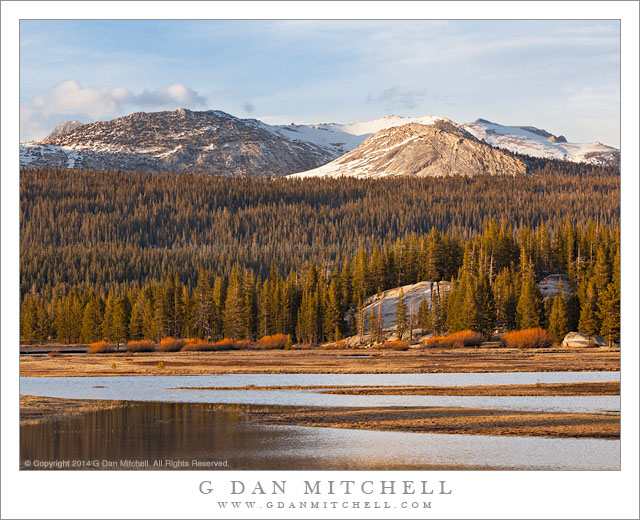
Fractured Granite, Reflection, Sequoia-Kings Canyon National Parks
“Fractured Granite, Reflection” — The base of a rugged granite wall reflected in the still surface of a sub-alpine Sierra Nevada lake

Today I am reprising a photograph that I shared previously since it is part of the Yosemite Renaissance XXIX exhibit opening this weekend in the Yosemite Museum Gallery in The Valley. 

An exhibition of contemporary art of Yosemite and the Sierra
Saturday, March 1 to Sunday, May 11, 2014
Yosemite Museum Gallery, Yosemite National Park

The first event of the show is tonight

The public is invited to the
Awards Reception, Friday, February 28 from 5:30 to 7:30 PM

Perhaps I’ll see you there!

Now, to the text of the original post, plus a more recent addition…

Fractured Granite, Reflections. Kings Canyon National Park, California. September 15, 2013. © Copyright 2013 G Dan Mitchell – all rights reserved.

The base of a rugged granite wall reflected in the still surface of a sub-alpine Sierra Nevada lake

A few days ago I returned from a 9-day trip into the back-country of Kings Canyon National Park. I was one of a group of four photographers who traveled to a remote location at about 11,000′, where we remained for more than five days, photographing the surrounding terrain morning and evening. We followed the common routine of such work – up before dawn and off to investigate and photograph some valley or lake, back by mid or late morning for breakfast, generally hanging out and doing camp chores during the midday period when the light is often less exciting, then back out in the late afternoon for a few more hours of exploration and photography before returning to camp for a post-sunset dinner. Unlike a typical backpack trip, where one rarely stays in the same place for long, we remained in the same camp for six nights, allowing us to really get to know the surrounding area very well.

With so much time, we were frequently able to return to places that we had already visited – perhaps coming back in the evening after a morning visit, returning to try again to catch a subject that didn’t have the right light the first time, or shooting the subject in various conditions ranging from clear skies to rain. This bit of interesting rock was next to a lake that I walked to on a number of occasions, and on this morning I arrived when the lake was still in shadow but illuminated by light reflected from nearby rock faces. Because it was so early the air was very still, allowing me to photograph this very sharp reflection of the fractured granite cliff where it entered the water. A bit of vegetation just above the waterline has taken on early fall colors.

Addendum: It occurred to me last week that there is a (perhaps tenuous?) connection between this photograph – with its theme of a vertical rock face above placid water – and this one by Ansel Adams that I had an early connection to: http://www.christies.com/lotfinder/photographs/ansel-adams-lake-precipice-frozen-lake-and-5056399-details.aspx – I have a personal connection to the place, which I wrote about here: https://gdanmitchell.com/2010/01/14/a-photograph-exposed-submerged-boulders-precipice-lake


G Dan Mitchell is a California photographer and visual opportunist. His book, “California’s Fall Color: A Photographer’s Guide to Autumn in the Sierra” (Heyday Books) is available directly from him.

G Dan Mitchell: Blog | Bluesky | Mastodon | Substack Notes | Flickr | Email


All media © Copyright G Dan Mitchell and others as indicated. Any use requires advance permission from G Dan Mitchell.

Snag and Talus Field

Snag and Talus Field

Snag and Talus Field. Kings Canyon National Park, California. September 16, 2013. © Copyright 2014 G Dan Mitchell – all rights reserved.

An old snag stands atop a rocky outcropping and in front of a huge talus field, Kings Canyon National Park

During our mid-September 9-day expedition into the Sierra Nevada high country of Kings Canyon National Park we spent the better part of a week camped in this 11,000′ basin full of lakes and trees and rocks. We camped near the outlet stream of a lake located in a narrow section of the valley, with many more lakes beyond our location and a string of them ascending the valley to our south. Each day, from early morning until after dark, was largely spent exploring this landscape and making photographs.

The valley of lakes to our south, of which our lake was the lowest, was plainly visible to us from our camp site, which was situated on a rise above this lowest lake. From here we could look up the canyon across “our lake” and see a string of several other lakes along this creek. A few were easy to see while others further up the valley revealed themselves primarily by surrounding rock and by breaks in the vegetation. Every day, no matter what else we were doing and where else we photographed, we did at least some work around these closest lakes, and I developed a sort of “daily rounds” taking me up one side of the valley to the upper lake and then back down the other, with occasional detours across the middle of the valley. Is I recall, I was making one of those detours when I photographed this tree, located on top of a small rocky knoll in the middle of the upper valley and backed by the tremendous talus field descending from the surrounding ridges high above.

G Dan Mitchell is a California photographer and visual opportunist whose subjects include the Pacific coast, redwood forests, central California oak/grasslands, the Sierra Nevada, California deserts, urban landscapes, night photography, and more.
Blog | About | Flickr | Twitter | FacebookGoogle+ | 500px.com | LinkedIn | Email

Text, photographs, and other media are © Copyright G Dan Mitchell (or others when indicated) and are not in the public domain and may not be used on websites, blogs, or in other media without advance permission from G Dan Mitchell.

Decaying Tree

Decaying Tree
Decaying Tree

Decaying Tree. Kings Canyon National Park, California. September 13, 2013. © Copyright 2013 G Dan Mitchell – all rights reserved.

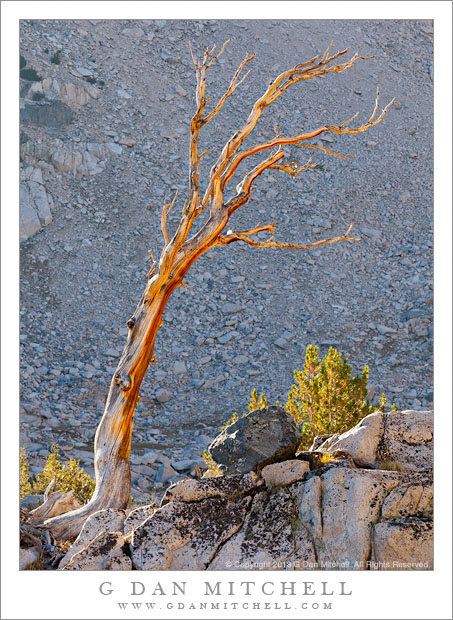
The decaying stump of an ancient sub-alpine Sierra Nevada tree

I came upon this jumble of the remains of a very old and large tree while walking about on our first full morning camped at the spot where we would remain for six nights in the Kings Canyon National Park high-country. From our camp at about the 11,000′ level I walked uphill, intending to investigate a dome on the ridge behind us and to see if I could find anything to photograph around a small lake that I could see on our maps.

As I walked up the hill I passed through small meadows and by dried-up tarns with their barren rocks and the branches of various fallen trees. As I approached the location of the lake I had to find a route between rocks and various small but thick groves of trees. As I passed one of these spots I noticed this old tree in the (long) process of disintegrating. The boundary between these ancient and rugged living thing and rock has sometimes seemed fuzzy to me. While I understand that the rocks are far, far older than any tree, these trees grow so slowly, are often so twisted and gnarled, wind so intimately among the rocks and boulders, and are of a color that looks more like rock than wood.

G Dan Mitchell is a California photographer and visual opportunist whose subjects include the Pacific coast, redwood forests, central California oak/grasslands, the Sierra Nevada, California deserts, urban landscapes, night photography, and more.
Blog | About | Flickr | Twitter | FacebookGoogle+ | 500px.com | LinkedIn | Email

Text, photographs, and other media are © Copyright G Dan Mitchell (or others when indicated) and are not in the public domain and may not be used on websites, blogs, or in other media without advance permission from G Dan Mitchell.
Fallen Snag, Dry Tarn

Fallen Snag, Dry Tarn
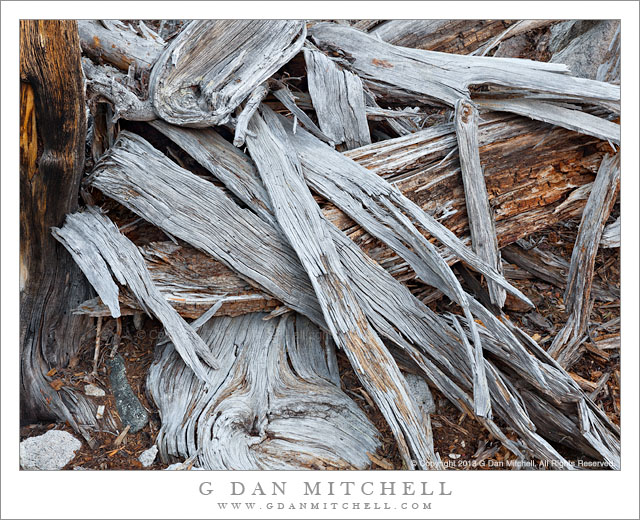
“Fallen Snag, Dry Tarn” — The bleached remains of an old dead tree lie on the rocks of a dry subalpine tarn, Kings Canyon National Park

This year was the second of two very dry years in the Sierra Nevada and much of the west. The snowfall this past winter (2012-13) was far below normal and set records in some places. Last October and November it seemed like we might be starting a very wet season, which would have been welcome after the previous winter’s low levels of precipitation, but then the tap was shut off near the end of the year and there was hardly any more precipitation at all during the rest of the season, the portion when the majority of the Sierra’s precipitation falls. Consequently, this has been a strange summer in the Sierra. Although there may have been more monsoonal rain the usual, the effects of the depleted snow pack are obvious. The spring run-off occurred early and was anemic. By July much of the Sierra looked more like August, and I was already seeing signs of fall by early August.

With all of this in mind, it was no surprise to use to find some unusually dry conditions in the Kings Canyon back-country when we visited for more than a week in mid-September. (Though, in some ways, things were less horrendous than I might have expected. Perhaps this was a combination of going at a time when things tend to be dry anyway and, as a local pointed out to me, some recent summer rains.) On our first day at the location where we stayed to photograph for nearly a week I wandered up some nearby meadows towards a lake that I though I might want to photograph. Very close to my campsite I found several completely dry tarns. (A “tarn” is a seasonal pond fed by snowmelt, and many of them dry up each season.) This very old, sun bleached snag lay across the exposed rocks of this one, creating a stark images.

G Dan Mitchell is a California photographer and visual opportunist. His book, “California’s Fall Color: A Photographer’s Guide to Autumn in the Sierra” from Heyday Books, is available directly from G Dan Mitchell.

Blog | Bluesky | Mastodon | Substack Notes | Flickr | Email
Articles | Sales | Sierra Nevada Fall Color | Contact Info

All media © Copyright G Dan Mitchell and others as indicated. Any use requires advance permission from G Dan Mitchell.