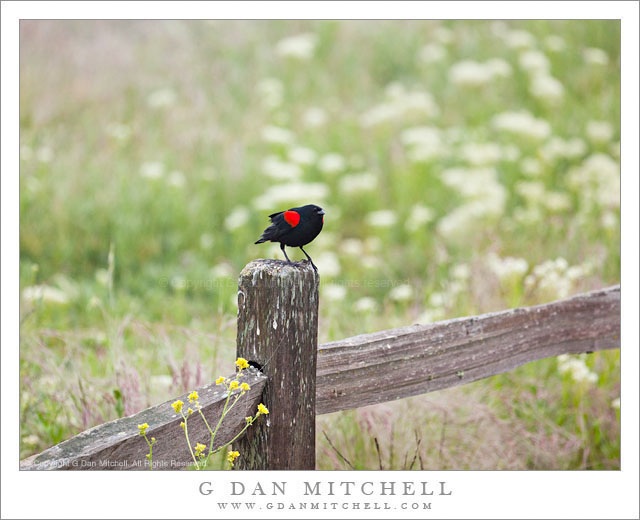
A redwing blackbird pauses atop a fence post in front of central California oak/grassland, Calero County Park.
Photographed on the same morning as another recent shot of this same type of bird, the bright red upper wings of this redwind blackbird provide a striking contrast to its jet black body. This bird was on a fence surrounding an old manmade pond at the Calero County Park south of San Jose, California – a place that I can drive to in little more than 15 minutes, and where I have hiked extensively for a number of years. These birds often flock around this small lake on winter and early spring mornings. Here it was still overcast, though the low fog from earlier in the morning was now dispersing.
G Dan Mitchell is a California photographer whose subjects include the Pacific coast, redwood forests, central California oak/grasslands, the Sierra Nevada, California deserts, urban landscapes, night photography, and more. Blog | About | Flickr | Twitter | Facebook | Google+ | 500px.com | LinkedIn | Email
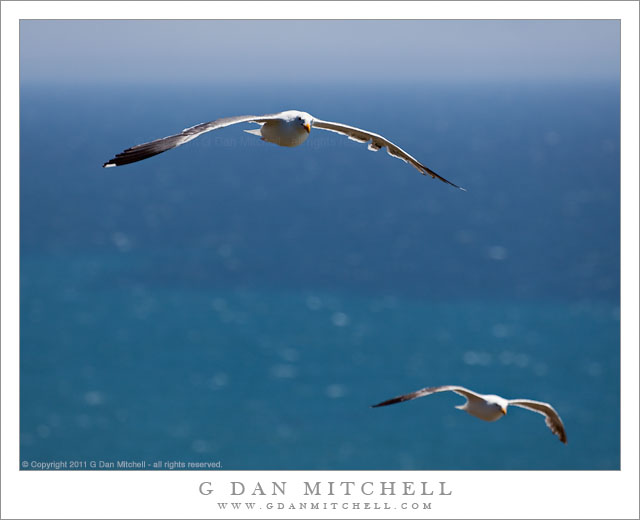
Two sea gulls glide along the top of coastal bluffs above the Pacific Ocean north of Santa Cruz, California.
Since I’ve related the basic story previously – more than once – I’ll keep it short this time. Since I live within an hour or less of the California coast, I head over that way frequently to photograph. Among my favorite subjects are the pelicans that travel up and down (but mostly, for some inexplicable reason up) the coast, riding the updrafts along the tops of coastal bluffs. I had some free time on this day, so I headed over with photographing the birds as one of my possible goals.
When I got to this familiar spot, there were no pelicans. (Eventually a few did fly past, but this was not a good day for pelicans.) Before moving on to other subjects I thought I’d at least stay here a while and practice the skills involved in photographing these birds in flight since even though there were no pelicans, there were plenty of other obliging birds. Most of the time it is difficult to get two gulls in the frame once they get close and start to fly past, but these two hung close enough together to be in the same frame, and their low trajectory placed them right in front of the deep blue water, with the fog-softened horizon near the top of the frame.
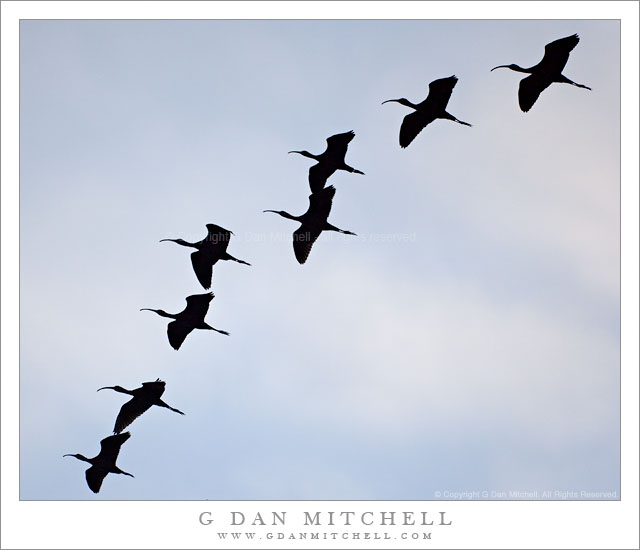
A flock of white-faced ibises is silhouetted against evening blue sky and clouds above the Merced National Wildlife Refuge.
On this winter evening I visited, for the first time, the Merced National Wildlife Reserve on a detour I took while returning home from a few days photographing in Death Valley. This winter I have (finally!) started to become aware of the amazing annual influx of migratory birds in California’s Central Valley and I managed to get out there a couple of times to view and photograph the magnificent flocks of birds. Being new at this, I have been working at figuring out just how to photograph this subject, and I’ve come up with a few approaches that seem to work, though I have a lot to learn. In this case, I had figured out that if I just picked a spot and waited that eventually flocks would fly over my position, and that I would have a chance of photographing them against the evening sky and clouds. Being almost completely ignorant when it comes to identifying these birds – but no less impressed with them because of this – I had virtually no idea what I was photographing in the moment when I tracked the birds and made the exposures. In fact, it wasn’t until later that I noticed the wonderful curved bills of these birds and then found out from my friend Tom Clifton (who does know how to identify these critters) what they were.
As the birds approach I work to synchronize my camera motion with the speed and direction of their flight. I try to keep them in the frame, and preferably in the frame in a way that might create an interesting composition. And while I do that I try to keep some attention on the background against which they fly and some small remaining bit of my attention on the technical matter of keeping at least one of them under an autofocus point in the camera’s viewfinder. As a flock approaches, things seem to start out fairly slowly and it may seem like the birds are taking a long time to arrive. But as they get closer – especially when shooting with a 400mm focal length and double-especially when they are as close as this flock – the action speeds up, and as they pass overhead it is all I can do to keep them centered in the viewfinder as I let the camera’s burst mode do its job at the right moment.
There are things about the experience that the camera cannot capture. The cold and damp of a Central Valley winter evening might be evoked by the right sort of landscape photograph, but not by a photograph like this one – yet this is an integral part of the experience. Even more than that, the sound of these birds, alone or in huge groups, sticks in my mind as much or more than the visual image. If you have been there and heard it, perhaps a photograph may cause you to recall it.
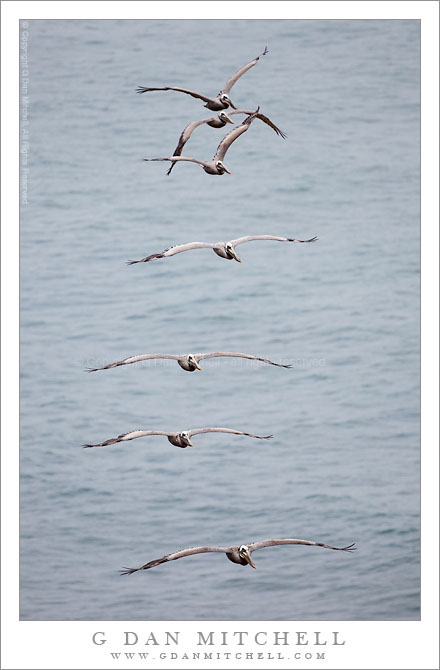
A vertical column of pelicans stacked one above the other along the Pacific Ocean coastline of California.
On a slow night this week – while waiting for a new hard drive to get backed up – I want back through some more raw files from the first half of 2010. Almost invariably, when I go back through older collections of images I find at least a few things that seem interesting to me know even though they didn’t really register at the time I shot them
I have previously shared some other photographs of these magnificent Pacific Coast birds that I made on this mid-May evening along the Pacific Coast Highway north of Santa Cruz, shooting from a bluff locations that I often return to. At this particular spot, when the conditions are just right, birds coming north up the coast and coasting on updrafts along the cliffs often climb toward the top of the bluff and frequently turn inland a bit right here as they come around an outcropping. That is what happened with these pelicans, who were coming almost towards me and were flying below my position on top of the bluff, creating what looks like a vertical stack of birds. How thoughtful of them to line up so that they fit perfectly within a 3:2 ratio portrait orientation frame! :-)
Photographer and visual opportunist. Daily photos since 2005, plus articles, reviews, news, and ideas.
Manage Consent
To provide the best experiences, we use technologies like cookies to store and/or access device information. Consenting to these technologies will allow us to process data such as browsing behavior or unique IDs on this site. Not consenting or withdrawing consent, may adversely affect certain features and functions.
Functional
Always active
The technical storage or access is strictly necessary for the legitimate purpose of enabling the use of a specific service explicitly requested by the subscriber or user, or for the sole purpose of carrying out the transmission of a communication over an electronic communications network.
Preferences
The technical storage or access is necessary for the legitimate purpose of storing preferences that are not requested by the subscriber or user.
Statistics
The technical storage or access that is used exclusively for statistical purposes.The technical storage or access that is used exclusively for anonymous statistical purposes. Without a subpoena, voluntary compliance on the part of your Internet Service Provider, or additional records from a third party, information stored or retrieved for this purpose alone cannot usually be used to identify you.
Marketing
The technical storage or access is required to create user profiles to send advertising, or to track the user on a website or across several websites for similar marketing purposes.