
Tag Archives: beams

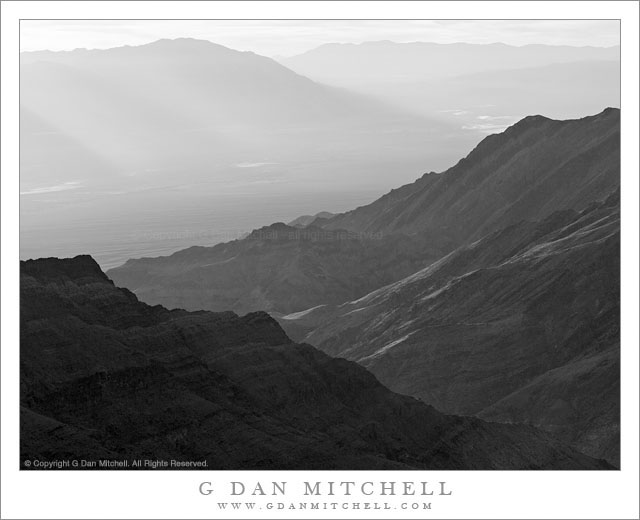
Death Valley and Trail Canyon, Morning

Death Valley and Trail Canyon, Morning -Dawn light comes over the Black Mountains to illuminate Death Valley and Trail Canyon at the base of the Panamint Range, Death Valley National Park.
Dawn light comes over the Black Mountains to illuminate Death Valley and Trail Canyon at the base of the Panamint Range, Death Valley National Park.

Death Valley and Trail Canyon, Morning. Death Valley National Park, California. January 5, 2012. © Copyright 2012 G Dan Mitchell – all rights reserved.

Dawn light comes over the Black Mountains to illuminate Death Valley and Trail Canyon at the base of the Panamint Range, Death Valley National Park.

Sometimes I don’t know at the time of exposure whether or not a photograph might end up as a color or a black and white image. However, I saw this scene as being black white as I made the photograph. It was made just a bit later than a photograph of a similar scene that I posted recently, and by this time the intense dawn color was gone and replaces by more subdued tones and far less saturated color. However, by now the early sun light was beginning to directly strike the lower slopes of the foreground canyon.

The large canyon in the foreground at the base of the two dark ridges is part of a complex sometimes called Trail Canyon. At one time there was a road up the canyon to the area near where I made the photograph – from what I hear it provided access to a mine down in the canyon. Some years ago the road washed out in several places, and the park’s policy now is to mostly let these old tracks simply slide into oblivion, thus allowing the terrain to revert to wilderness. This canyon, like many along the lower reaches of the major mountain ranges of the park, intrigues me with its huge gravel fan and in the way that it breaches the incredibly rugged mountains of the Panamint Range.

G Dan Mitchell is a California photographer whose subjects include the Pacific coast, redwood forests, central California oak/grasslands, the Sierra Nevada, California deserts, urban landscapes, night photography, and more.
Blog | About | Flickr | Twitter | FacebookGoogle+ | 500px.com | LinkedIn | Email

Text, photographs, and other media are © Copyright G Dan Mitchell (or others when indicated) and are not in the public domain and may not be used on websites, blogs, or in other media without advance permission from G Dan Mitchell.
Schoolhouse Ruins, Rhyolite

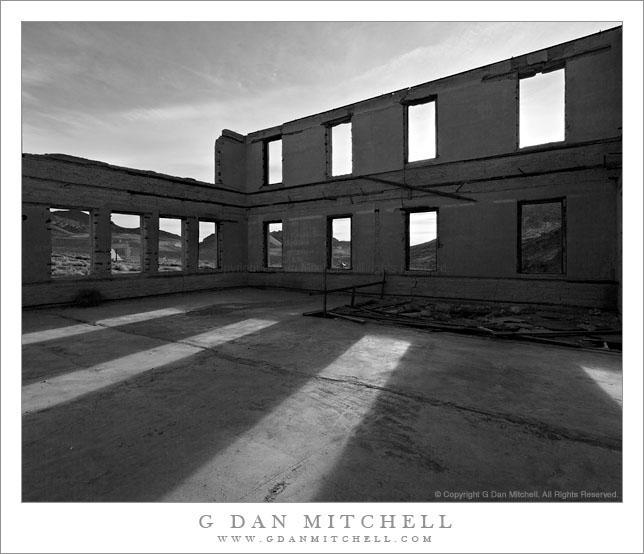
Schoolhouse Ruins, Rhyolite

Schoolhouse Ruins, Rhyolite. Rhyolite, Nevada. April 1, 2009 © Copyright 2009 G Dan Mitchell – all rights reserved.

Morning sunlight shine through the window frames of the ruins of the abandoned schoolhouse in the ghost town of Rhyolite Nevada, near Death Valley National Park.

The ghost town of Rhyolite, Nevada is located just east of the boundary of Death Valley National Park, along the edge of the Amargosa Valley, and not far from Beatty, Nevada, which itself is close to the Nevada Test Site. Put all of that together and you have the potential for a bit of a spooky place!

Rhyolite was a short-lived mining town in the early 1900s, when it apparently was home to thousands of people who streamed to this forsaken landscape to find silver. The town was eventually abandoned – although some mining still takes place in the area – but a good number of the larger buildings are still there, in various states of decay. An old train station that looks pretty fancy is fenced off to keep us out, but you can walk (respectfully and carefully!) among many other old structures including the old school house that is the subject of this photograph.

I’ve been out here a number of times and dawn is my favorite time to photograph here. The light makes it to many of the old ruins very shortly after actual sunrise, and there is a moment of often beautiful light at this time. From Rhyolite the hills inside Death Valley National Park are visible to the west and above the nearer hills you can see Telescope Peak, the highest point in the park at over 11,000′ elevation.

The school (like a few of the other ruins) looks like it must have been a very large and robust structure. Even though the roof and the second floor are gone, almost all of the exterior walls still stand and don’t show any immediate signs of incipient collapse. On this morning I made a series of photographs from just inside one of the “doorways” of the school with a wide-angle lens. I selected and shared a few of them back in 2009, but I recently went back to my original raw files and decided to try this one in black and white.

G Dan Mitchell Photography
About | Flickr | Twitter | FacebookGoogle+ | 500px.com | LinkedIn | Email

Text, photographs, and other media are © Copyright G Dan Mitchell (or others when indicated) and are not in the public domain and may not be used on websites, blogs, or in other media without advance permission from G Dan Mitchell.
(Basic EXIF data may be available by “mousing over” large images in posts when this page is viewed on the web. Leave a comment if you want to know more.)

Alcatraz and Yerba Buena Islands, San Francisco Bay, Foggy Morning Light

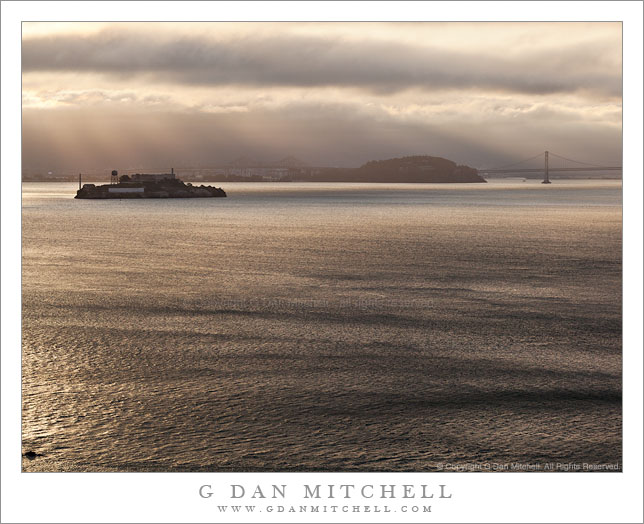
Alcatraz and Yerba Buena Islands, San Francisco Bay, Foggy Morning Light

Alcatraz and Yerba Buena Islands, San Francisco Bay, Foggy Morning Light. San Francisco, California. March 21, 2009 © Copyright 2009 G Dan Mitchell – all rights reserved.

San Francisco Bay morning fog over begins to break up over Alcatraz and Yerba Buena Islands and the San Francisco Oakland Bay Bridge.

I made this photograph back around the start of spring in 2009. I recall shooting from the Marin Headlands back toward the Bay as the fog began to break up, still obscuring the view but allowing beams of light to begin to come through the gloom and light up portions of the Bay. Alcatraz Island is at upper left and beyond that is the Treasure Island and Yerba Buena Island complex.

Many things intrigued me about this scene. Although it is in shadow still, Alcatraz stands out as the clearest object in the scene. The patterns on the water were amazing, created by a combination of the normal surface waves, the wakes of ships that had passed, and the mottled and mixed lighting of areas of fog and sun. Beyond the main subjects and over the East Bay shoreline around Oakland, light beams come down from the clearing fog.

This photograph is also an example of why I save and later review all of my raw files. Either because I don’t understand the image when I first make it or perhaps I move on to the next project too quickly sometimes it is not unusual when a photograph “slips through the cracks” and I end up overlooking it. This was one of those photographs… which I now find hard to understand.

G Dan Mitchell Photography
About | Flickr | Twitter | FacebookGoogle+ | 500px.com | LinkedIn | Email

Text, photographs, and other media are © Copyright G Dan Mitchell (or others when indicated) and are not in the public domain and may not be used on websites, blogs, or in other media without advance permission from G Dan Mitchell.

(Basic EXIF data may be available by “mousing over” large images in posts when this page is viewed on the web. Leave a comment if you want to know more.)

Two Oaks, Morning Sun

Two Oaks, Morning Sun

Two Oaks, Morning Sun. Calero Hills, California. April 30, 2011. © Copyright G Dan Mitchell – all rights reserved.

The springtime morning sun shines through a pair of oak trees in the Calero Hills south of San Jose, California.

On the final day of April and for the first time this season, I found to go for a hike at my favorite local park, a place where I have walked just about every available trail (and invented a few routes of my own) and photographed for a number of years. The park would not seem like anything all that special by comparison to some of the other places I visit, but it is close and I’ve gotten to know it in a way that makes it more special. The place is called the Calero County Park, part of the Santa Clara County Parks system.

The entrance to the park is in a broad valley that is largely occupied by stables. (Or, used to be – it looks like the stables must have closed since last season.) Rising from this valley are the typical grass-covered hills of central and northern California, with oaks and other trees scattered around and, in places, thicker trees and brush. At this time of year, the hills turn what I call “impossibly green” – and if you have seen them on a late-winter or early spring morning you know what I mean.

I started this hike a bit after dawn, so the golden hour light was more or less gone. I had a general idea of photographing some wildflowers (which didn’t happen – it was too windy) and some oak trees that grow alone or in small groups on the grass-covered hills. I passed a small lake – where a single egret often hangs out, but not on this morning – and topped a rise and descended into a small valley from which I have made quite a few photographs of oaks. It didn’t look too promising at first, but at the far end of this area I noticed that a pair of trees were still obscuring the sun and that I might be able to shoot straight into the sun with the trees blocking its disk, and get a photograph including the tree shadows on the hillside grasses.

This turned out to be another of those all-too-common ephemeral photographs in that the sun was starting to rise above the top branches of the tree and would soon be “out in the open,” making it much too bright for what I had in mind. So I worked quickly to set up tripod and camera and select a lens, then frame a composition, focus, and make a series of exposures that might be needed to deal with the huge dynamic range between direct sun and backlit tree trunks. By the time I had everything set up and was ready to shoot the sun had already risen above the upper branches, so I ended up looking for a slightly better shadow and putting the tripod down very low – and this gave me must enough time to make the series of exposures I figured I would need.

In the end, I got lucky. One single shot somehow managed to not blow the sun out too badly yet hold enough detail in the grass that a bit of work in post could bring it back. With all of the potential for lens flare – which I had to some extent in every shot – this one only had two small bits of it, and they were easily dealt with.

G Dan Mitchell Photography | Flickr | Twitter (follow me) | Facebook (“Like” my page) | LinkedIn | Email
Text, photographs, and other media are © Copyright G Dan Mitchell (or others when indicated) and are not in the public domain and may not be used on websites, blogs, or in other media without advance permission from G Dan Mitchell.