
Tag Archives: geology

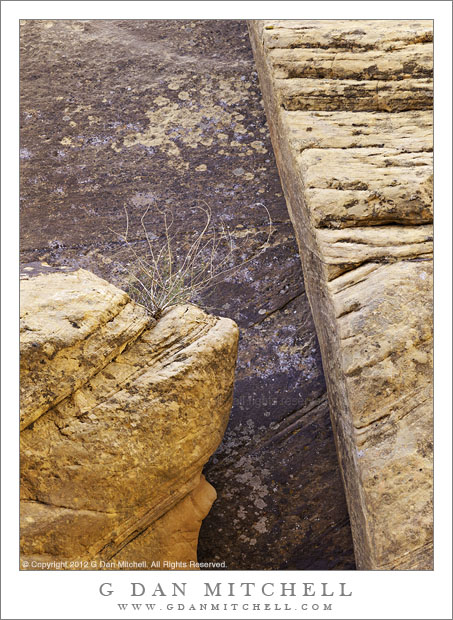
Sandstone Patterns, Dried Plant

Sandstone Patterns, Dried Plant - A dried plant and sandstone patterns in a southwest desert canyon, Utah
A dried plant and sandstone patterns in a southwest desert canyon, Utah

Sandstone Patterns, Dried Plant. Grand Staircase-Escalante National Monument, Utah. October 23, 2012. © Copyright 2012 G Dan Mitchell – all rights reserved.

A dried plant and sandstone patterns in a southwest desert canyon, Utah

I was in Utah twice this fall, most recently with my friends Charlie and Karl to photograph a range of desert canyons and similar terrain. I’ve written before that I’m very new to photographing Utah, having seriously shot there for the first time only this past spring. But I’m trying to make up for lost time! Overall, I have spent something like a total of more than five weeks there this year! Yes, I like shooting in Utah. :-)

On the previous visits, I went to quite a few of the well-known locations – largely the national parks – and began the process of getting to know and understand that place a bit. On the most recent visit I was fortunate to be traveling with people who have shot there for decades, and I benefited from their long experience. Getting a bit more off the beaten track, we barely touched national parks – passing through Zion and visiting some remote areas of Capitol Reef. Instead we poked into a range of little canyons and valleys and so forth that don’t have the prominence of the parks. The specific locations are perhaps not that important since the state seems to be filled with similar places. This was my first real experience with the intimate desert canyons and river/creek courses that carve deeply into the landscape, where midday light bounces and reflects into the deep landscape in ways that are utterly unlike the California locations where I most often photograph.

This photograph was made in such a place, the first narrow canyon that we visited. Parking in an inauspicious spot along a gravel desert road, we dropped into a wash and wandered upstream, soon entering a narrow canyon as the sandstone walls rose beside us. Before long the canyon was narrow enough that we had to continually cross back and forth across the creek or simply wade straight up its course. As the canyon narrowed, direct sunlight no longer made it down to the creek – instead the light reflected from the higher cliff faces and bounced down into the canyon, toning the light red from the sandstone surface. In this photograph the cliff and two large pieces of sandstone contain angled strata and reflect the light in various ways as a small and seemingly dead plant sits in a crack in the rock.

G Dan Mitchell is a California photographer whose subjects include the Pacific coast, redwood forests, central California oak/grasslands, the Sierra Nevada, California deserts, urban landscapes, night photography, and more.
Blog | About | Flickr | Twitter | FacebookGoogle+ | 500px.com | LinkedIn | Email

Text, photographs, and other media are © Copyright G Dan Mitchell (or others when indicated) and are not in the public domain and may not be used on websites, blogs, or in other media without advance permission from G Dan Mitchell.
Glacial Erratics, Near Olmsted Point

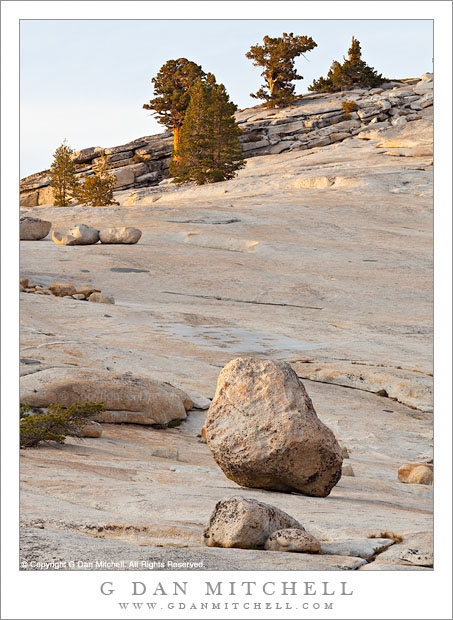
Glacial Erratics, Near Olmsted Point - Glacial erratic boulders rest on a tree-topped granite slab at sunset near Olmsted Point, Yosemite National Park
Glacial erratic boulders rest on a tree-topped granite slab at sunset near Olmsted Point, Yosemite National Park

Glacial Erratics, Near Olmsted Point. Yosemite National Park, California. September 16, 2012. © Copyright 2012 G Dan Mitchell – all rights reserved.

Glacial erratic boulders rest on a tree-topped granite slab at sunset near Olmsted Point, Yosemite National Park

Among the various landscapes of the high Sierra, this sort of scene most clearly says “Yosemite” to me: the glaciated granite slabs, mostly solid but broken but exfoliating and broken by cracks; the scattered glacial erratic boulders left behind by retreating ice; and the sparse trees somehow managing to not only survive but seemingly prosper while growing on almost solid rock. Although you don’t see precisely these things in the better known Valley, once you get up into the high country of the park you’ll see these features almost everywhere, and especially in the zone from, say, 8000′ of elevation or so and on up.

This photograph was made close to Olmsted Point. While Olmsted is probably better known for its “backside” view of Half Dome and its huge views up toward Tenaya Lake and on to the Sierra crest at Mount Conness, the immediate surroundings are full of this typical Sierra terrain that I described above. Most of the terrain above, below, and around the Point shows evidence of this glacial action, and by taking a few steps away from the parking lot in almost any direction (but do avoid cliffs!) you can find enough examples of this landscape to keep yourself occupied for a long time.

G Dan Mitchell is a California photographer whose subjects include the Pacific coast, redwood forests, central California oak/grasslands, the Sierra Nevada, California deserts, urban landscapes, night photography, and more.
Blog | About | Flickr | Twitter | FacebookGoogle+ | 500px.com | LinkedIn | Email

Text, photographs, and other media are © Copyright G Dan Mitchell (or others when indicated) and are not in the public domain and may not be used on websites, blogs, or in other media without advance permission from G Dan Mitchell.
Ledge With Fallen Rocks

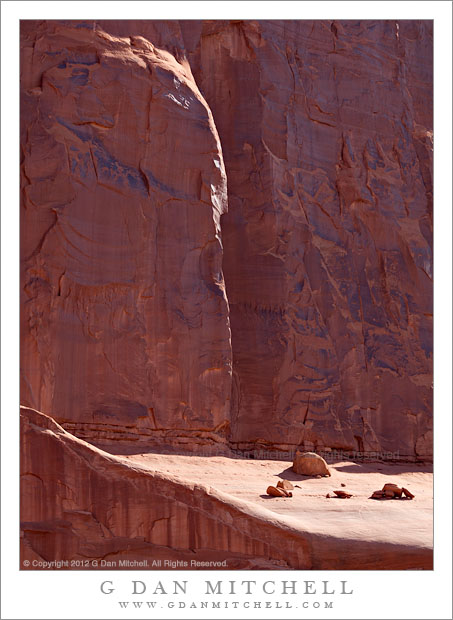
Ledge With Fallen Rocks - Red cliffs and rocks on a ledge at Park Avenue, Arches National Park
Red cliffs and rocks on a ledge at Park Avenue, Arches National Park

Ledge With Fallen Rocks. Arches National Monument, Utah. April 6, 2012. © Copyright 2012 G Dan Mitchell – all rights reserved.

Red cliffs and rocks on a ledge at Park Avenue, Arches National Park.

I made this photograph fairly early in the morning at the Park Avenue area of Arches National Park. While morning might was hitting the walls behind my camera position, the walls in front of me were still in fairly deep shade. However, as the sun rose, its light began to come over the tops of these tall sandstone walls and spill down into the canyon. As the morning wore on, the light/shadow line began to move back closer to this wall, first illuminating the ledge and the fallen rocks in holds and then beginning to highlight edges of some of the cracks in the wall itself.

The Park Avenue area seems like one of the most accessible areas of this park being only a short distance inside the park boundaries and being very close to the roadway. The area is essentially a canyon between two nearly parallel walls of sandstone, often topped with remarkable towers and other features as the canyon descends toward where it opens up into sage brush country below. At this particular hour of this particular morning, as wonderful as that scene was, the light shooting down the canyon was only so-so, so I looked around, put on a long lens, and photographed smaller vignettes of the landscape such as this one.

G Dan Mitchell is a California photographer whose subjects include the Pacific coast, redwood forests, central California oak/grasslands, the Sierra Nevada, California deserts, urban landscapes, night photography, and more.
Blog | About | Flickr | Twitter | FacebookGoogle+ | 500px.com | LinkedIn | Email

Text, photographs, and other media are © Copyright G Dan Mitchell (or others when indicated) and are not in the public domain and may not be used on websites, blogs, or in other media without advance permission from G Dan Mitchell.

Sand Tufa, Mono Lake

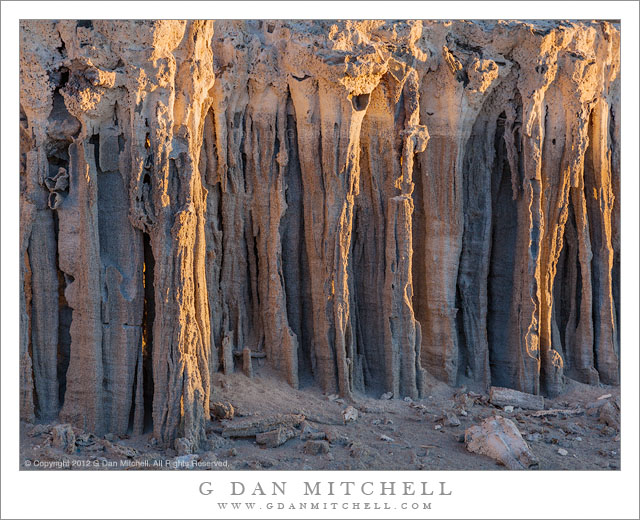
Sand Tufa, Mono Lake - Early morning light on details of sand tufa formations, Mono Lake
Early morning light on details of sand tufa formations.

Sand Tufa. Mono County, California. July 14, 2012. © Copyright 2012 G Dan Mitchell – all rights reserved.

Early morning light on details of sand tufa formations, Mono County.

I have wanted to photograph this subject for some time. The sand tufas are not found in the same location as the better-known “tufa towers” that are so often photographed, and they are smaller and somewhat subtler (if that is the right word) subjects. If you weren’t aware of what you were looking for, it would be very easy to pass right by them and barely notice their presence at all. They also appear to be very fragile, so great care should be taken if you ever happen to come across them. Walk around, not over or through them, and minimize your impact on them to the greatest extent possible. If you come across examples, it is probably best to not blast a lot of specific information to the world. I don’t know all of the details of their formation, but judging by their locations and by the recent history of lower lake levels, I suspect that they may have been underwater before the historically recent extraction of water from the eastern Sierra by Los Angeles.

If you are thinking of looking for an interesting and easy to shoot photographic subject, don’t bother with the sand tufa. You’ll probably have much better luck and more fun shooting the impressive and better known and larger “tower” features at other areas. These small structures do not tower above anything. Some are only inches tall, and the largest are just a few feet tall. Their natural color is a muted and, let’s be honest, boring gray color. Their location does not particularly allow them to be paired with more impressive and distant large-scale landscape features such as the expanse of the lake’s surface or the surrounding mountains and hills, with the possible exception of certain kinds of cloud formations. When I went there I had some pre-conceived ideas about I might photograph them, perhaps including the Sierra’s eastern escarpment in the images, but these ideas did not pan out. However, by shooting in the first few minutes of light and working with a long focal length to crop tightly I found some interesting fluted patterns to work with.

G Dan Mitchell is a California photographer whose subjects include the Pacific coast, redwood forests, central California oak/grasslands, the Sierra Nevada, California deserts, urban landscapes, night photography, and more.
Blog | About | Flickr | Twitter | FacebookGoogle+ | 500px.com | LinkedIn | Email

Text, photographs, and other media are © Copyright G Dan Mitchell (or others when indicated) and are not in the public domain and may not be used on websites, blogs, or in other media without advance permission from G Dan Mitchell.