
Tag Archives: hill

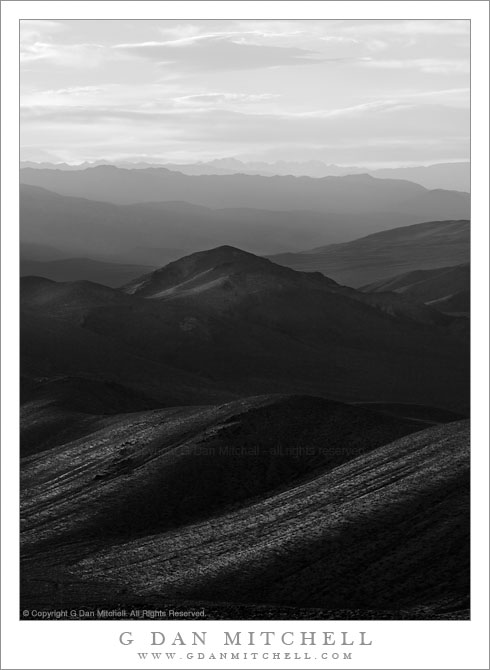
From the Panamints to the Sierra, Evening

From the Panamints to the Sierra, Evening

From the Panamints to the Sierra, Evening. Death Valley National Park, California. March 30, 2011. © Copyright G Dan Mitchell – all rights reserved.

The Sierra Nevada in evening light as seen from Aguereberry Point in Death Valley National Park’s Panamint Range.

I made this photograph from Aguereberry Point shortly before sunset. Aguereberry Point is a lonely prominence over 6000′ above Death Valley, high in the Panamint Mountain range, a place of astonishing panoramic views – and often some significant winds. As I drove the gravel road to the point late in the afternoon I saw three or four other vehicles heading the other direction, but when I arrived at the point a bit more than an hour before sunset no one else was there.

Having photographed here a few times previously, I am becoming more familiar with the challenges and the opportunities of shooting here. One of the challenges – as is the case in many spots in Death Valley – is that certain subjects seem to be “photographable” at very specific times and only for short intervals. One of the most interesting views from Aguereberry is southeast down into Trail Canyon and on to the lower slopes of Wildrose Peak beyond. This is wild, rugged, austere terrain. However, because it lies on the east side of this range the light changes quickly from a washed out blast of daytime sun to sudden deep shadows as the sun drops behind the higher ridges of the Panamints. (Trail Canyon is not seen in this photograph.)

Another challenge is that, impressive and overwhelming as the scale of this grand scene is, it can be difficult to pull interesting compositions out of it. I tend to work with longer lenses here, both to isolate smaller areas out of the huge landscape and to compress distance. In this photograph, the silhouetted crest of the highest part of the Sierra Nevada range is on the horizon, with the intervening ridges of the Panamint Range and others probably including the Inyo Mountains and the ridge just west of Panamint Valley.

And, since I tend towards those large and long lenses… wind is an issue! And on top of Aguereberry Point there is nothing to stop the often strong winds of Death Valley. On this evening the winds were howling, so I found a spot below some rocks where it was a bit less windy and then spent a lot time waiting for momentary lulls in the wind when I could make photographs.

G Dan Mitchell Photography | Flickr | Twitter | Facebook | Email
Text, photographs, and other media are © Copyright G Dan Mitchell (or others when indicated) and are not in the public domain and may not be used on websites, blogs, or in other media without advance permission from G Dan Mitchell.
Melting Ice, Gaylor Lake and the Cathedral Range

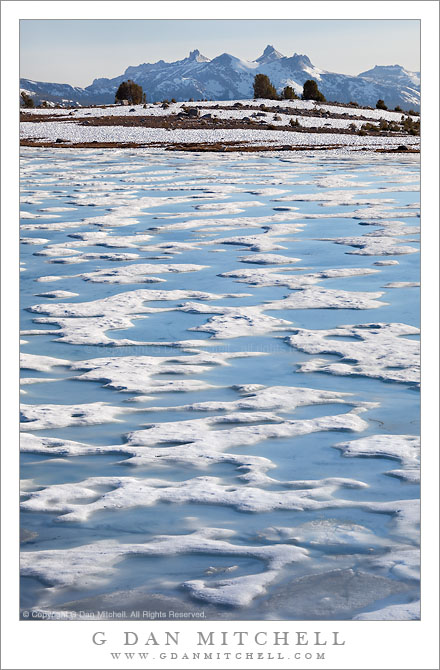
Melting Ice, Gaylor Lake and the Cathedral Range

Melting Ice, Gaylor Lake and the Cathedral Range. Yosemite National Park, California. June 29, 2010. © Copyright G Dan Mitchell – all rights reserved.

The distant Cathedral Range rises above the melting ice of Gaylor Lake, Yosemite National Park.

Near the end of June last summer I hiked up here late in the day with my friends Mike and Karl. This was a somewhat unusual season in the Yosemite Sierra, in that there had been a lot of snow during the winter season and it had continued right on into spring. Consequently, the high passes opened up later than usual, and on a very late June day when things would typically be a bit more summer-ish, it looked more like late winter up here when we arrived.

I’ve visited this place quite a few times, but had never seen quite this scene before. More typically, the snow and ice are completely gone by the time I manage to get up there, and a typical visit usually entails arriving late on a warm afternoon and then hanging out in the sun while waiting for the evening light to come on. This time we were in snow before we crossed the ridge before the lake, and we had to think a bit about just how to head down toward the lake since the usual path was covered in snow. The lake itself was (obviously, judging from the photo!) still covered in ice, though melting was underway and the surface was a jigsaw puzzle of alternating blue pools and white ice.

We found a location near clumps of trees on rocky talus slopes above the lake to do our photography. In this photograph I shot down the length of the lake to mostly fill the frame with the melting ice. Beyond a small rocky rise at the end of the lake, the terrain drops off towards the meadows of the Tuolumne region, and beyond rise the peaks of the Cathedral range in early evening light.

G Dan Mitchell Photography | Flickr | Twitter | Facebook | Email
Text, photographs, and other media are © Copyright G Dan Mitchell (or others when indicated) and are not in the public domain and may not be used on websites, blogs, or in other media without advance permission from G Dan Mitchell.
Winter Evening Sky, Panamint Range, Death Valley

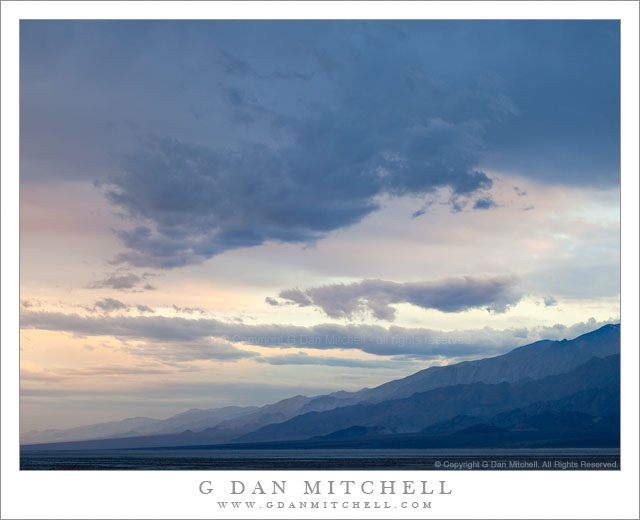
Winter Evening Sky, Panamint Range, Death Valley

Winter Evening Sky, Panamint Range, Death Valley. Death Valley National Park, California. February 18, 2011. © Copyright G Dan Mitchell – all rights reserved.

Winter clouds fill the evening sky above the eastern slopes of the Panamint Range in Death Valley National Park.

After the long drive from the San Francisco Bay Area I arrived at Stovepipe Wells in Death Valley and set up my camp in the mid afternoon and hung out a bit, thinking about the prospects of late afternoon and evening shooting. Because a weather front was coming in (the forecast called for a chance of rain in the Valley and pretty much certain light snow over the passes) the clouds were increasing, in many directions heading past the point of “picturesque” and more towards “socked in.” I was hoping for some evening light – or early rain? – but it seemed less promising as evening approached. In circumstances like these I may come up with a few possible shooting alternatives ahead of time, watch as conditions develop, and make a last-minute decision about where to go based on observations and hunches.

So, late in the afternoon I stopped near Death Valley Dunes and worked to line up some long shots that filled the background of the dunes with the rugged shapes of the Grapevine Mountains, and then headed towards the junction with the road to Scotty’s Castle to try to figure out if the light held more promise to the north or the south. It didn’t look totally promising in either direction, but I thought that I might be able to make something out of the haze to the south as the ridges on both sides of the Valley receded, especially if a bit of glow in the sky turned up right at sunset. So, south it was.

I drove just a little ways in that direction to a point where the road curves a bit towards the east to travel around the northernmost area of salt flats in what I think of as the lower valley – this is the area a bit south of the Salt Creek cutoff. From here there is a fairly open view all the way down to the end of the Valley, and it looked like the clouds were going to evolve in some interesting ways. It didn’t look like I would see a gaudy, brilliantly colorful sunset, but something more subtle and quiet looked like it might happen. As the light began to fade I made a series of photographs whose subject was largely the sky and the atmospheric recession along the Panamint Range (shown here) on the west side of the Valley and the mountains just beyond Furnace Creek.

G Dan Mitchell Photography | Flickr | Twitter | Facebook | Email
Text, photographs, and other media are © Copyright G Dan Mitchell (or others when indicated) and are not in the public domain and may not be used on websites, blogs, or in other media without advance permission from G Dan Mitchell.

Monterey Cypress Forest, Point Lobos

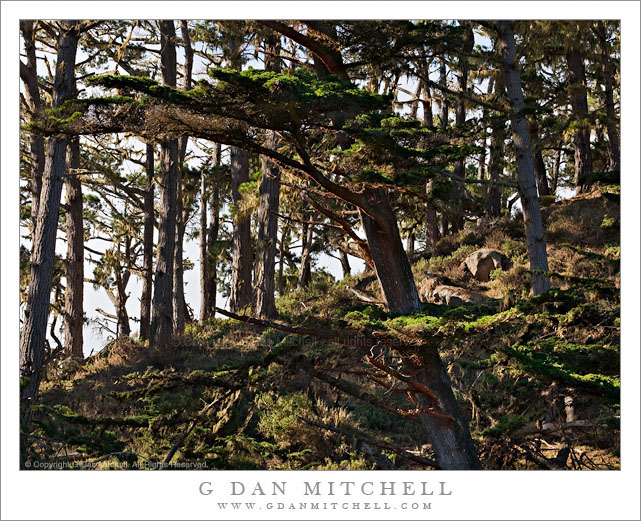
Monterey Cypress Forest, Point Lobos

Monterey Cypress Forest, Point Lobos. Point Lobos State Reserve, California. January 8, 2011. © Copyright G Dan Mitchell – all rights reserved.

Winter light on the Monterey Pine forest growing on a hillside at Point Lobos State Reserve.

The photograph is the color version of the same scene that I recently posted in a black and white rendition. My initial reaction to the image, and the idea I had in the back of my mind when I photographed it, was that it would be black and white. I wanted to “abstract” the dense shapes and textures of the trees and ground plants and rocks, and I sometimes think that the intrinsically unreal quality of black and white can work for that. However, when I worked up the photograph in color I started to like it, too, though in a different way. At least in the small versions that I looked at on the screen, the color version creates a bit more separation among objects in the scene and seems to have a bit more depth. I guess I won’t know until I make prints!

I have often looked at the straight and upright trees on this rocky prominence as I walked past on a trail that passes by just beyond the left side of the frame. This formation sits between two coves at Point Lobos and rises to a high point (to the right of the photograph) before dropping abruptly to steep rocks and then the sea. From the trail you look up the slope toward the high point and through these trees. But I could never quite see a composition. On this winter day the light was a bit unusual. There was a bit of haze and mist in the air, though not a lot – if I stood with the sun at my back I could not really see it, but if I faced into the sun it was apparent. In any case, even though this was photographed during the harsh light midday time period, the light was softened at least a bit, but still a bit stark from side lighting, the shadows among the trees, and the bright and cloudy sky beyond. It is difficult to find a clear line of sight to this grove that isn’t either very, very far away or else right inside of it. I looked around for a bit and finally found a place not far away along the trail from which I could shoot between tree branches.

This photograph is not in the public domain and may not be used on websites, blogs, or in other media without advance permission from G Dan Mitchell.

G Dan Mitchell Photography
FlickrTwitter (follow me) | Facebook (“Like” my page) | LinkedInEmail

Text, photographs, and other media are © Copyright G Dan Mitchell (or others when indicated) and are not in the public domain and may not be used on websites, blogs, or in other media without advance permission from G Dan Mitchell.