A line of geese fly in front of the first clouds of an approaching winter storm front above California’s Central Valley.
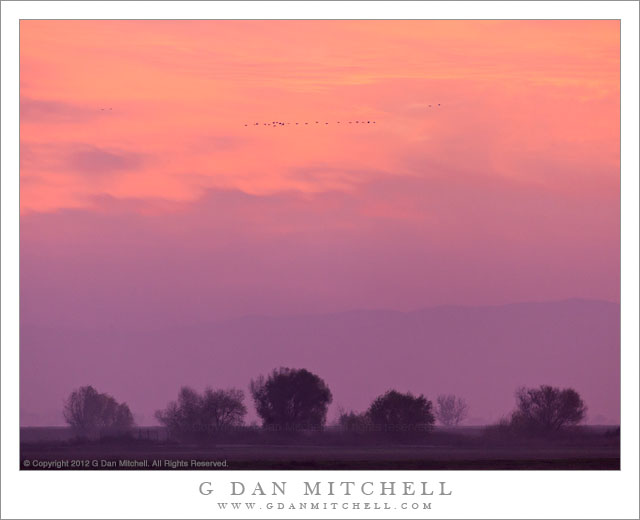
This photograph was made at a late enough time in the evening that it was becoming hard to see in the same detail that the camera has. The sun had gone down and the light reflected up into the clouds was beginning to fade, and Central Valley haze filled the air, partially obscuring the details on anything more than a few hundred feet away.
We were surprised and pleased to have a spectacular sunset as the clouds of an incoming weather system that had early blocked the light were now lit up from below as the sun dropped to the horizon. The intense colors of the red clouds were almost too bright to photograph. Here I used a long lens to isolate a small section of the terrain to the west that held a group of silhouetted trees, with the Coast Range mountains beyond, and the sky turning all shades of purple, orange, and red. Although it may be difficult to see in this small jpg, a long line of geese is traveling from right to left high in the sky.
G Dan Mitchell is a California photographer and visual opportunist whose subjects include the Pacific coast, redwood forests, central California oak/grasslands, the Sierra Nevada, California deserts, urban landscapes, night photography, and more. Blog | About | Flickr | Twitter | Facebook | Google+ | 500px.com | LinkedIn | Email
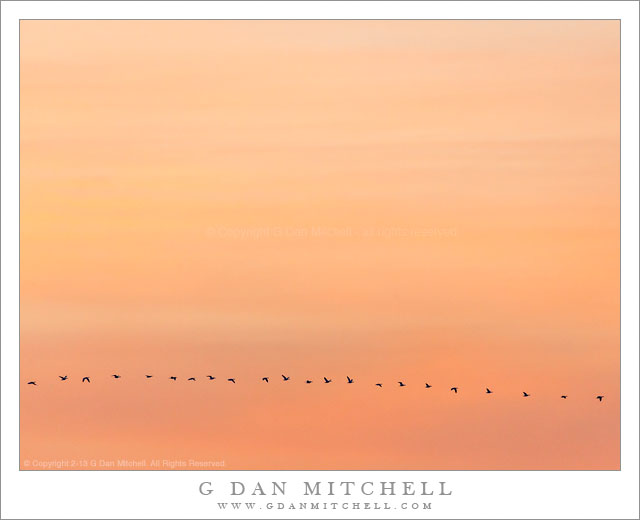
A row of Ross’s geese stretches into a line as they fly in front of dusk sky on a winter evening above California’s San Joaquin Valley.
The post-sunset twilight period is one of the most special of the day in these Central Valley wildlife refuges. There is a transformation at this point that fascinates me, even after seeing it a number of times. During the day, it often seems that not much is going on. The larger flocks of birds are mostly settled in somewhere, with only small numbers flying from place to place, albeit with an occasional momentary eruption of geese. As sunset approaches, the geese become more active, taking flight and moving from location to location. On this evening, the process was mostly one of leaving rather than arriving, as the flock nearest to us gradually left the pond where they had been settled and then flew off to more distant points. As the sun sets the wildlife seems like it is going to settle down. But then, as darkness comes on, special things happen. In this particular location, just as things quiet, the cranes return. Unlike the geese, who flap and squawk, the cranes have a distinctive and less raucous cry and then float in with much less flapping of wings. And at close to this same time, I often begin to notice that geese are flying in smaller groups all throughout the sky. At this San Joaquin Valley location, it can seem that they stretch all the way to the Diablo Range to the west. Simultaneous with this, if there are clouds in the sky, they take on the rich post-sunset colors that can perhaps be seen better by the camera than the eye.
The idea of this photograph was simple. I wanted to find and photograph a line of geese in front of a colorful section of the dusk sky. To make this work, I have to become aware of cloud patterns and where the most colorful portions of the sky are, and both clouds and colors are in a constant state of change. As groups of birds fly into view I try to guess which of them might follow a path across these areas of the sky, at which point I pick up a group in the viewfinder and follow it as it crosses into the scene. I am probably less attentive to the birds than to the non-bird portions of the scene that slide across my viewfinder, and I wait until the birds appear against a particular pattern or color of sky and clouds to make exposures. Obviously, little of this is in my control beyond the timing of my attempts to take advantage of whatever the sky and the birds happen to provide to me! In some ways, it still amazes me that it is possible to capture a simple scene like this one. Both technique and equipment play an important role here. In order to work with birds that may be a good distance away and in order to constrain my field of view to small sections of the sky, I work with a 400mm focal length. I must hand hold the camera rather than using the tripod, adding an additional challenge. By this time the light is so low that I find myself shooting at ISO 3200, something that would have been darned near impossible even a few years ago. And somehow, in light that is rapidly fading toward darkness, it is possible to photograph a moving flock of birds against a dusk sky.
G Dan Mitchell is a California photographer and visual opportunist. His book, “California’s Fall Color: A Photographer’s Guide to Autumn in the Sierra” (Heyday Books) is available directly from him.
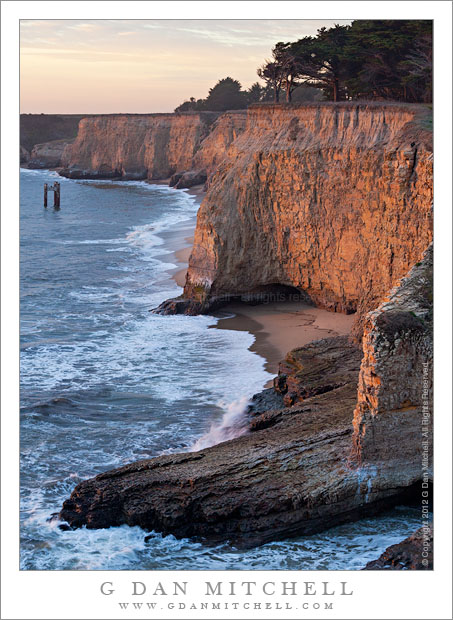
The last light shines on coastal bluffs and Davenport, California
On this early December day I had gone off to try to join a G+ “photowalk” that was purportedly taking place that day. I was looking forward to going to a few favorite local photography locations and to meeting some people who I’ve only known online. But it was not to be! I ended up being delayed at home and couldn’t leave in time to meet the group at their first location, Henry Cowell Park. I went with Plan B and figured I would try to join up with them at lunch in Davenport. I got there and didn’t see anyone, so I figured that I was early and I drove up the coast a bit. I came back to Davenport and thought they might be in one of the two restaurants, so I picked one and went in for lunch… by myself. (I found out later that, yes, they were in the other restaurant a hundred yards south.) After lunch I went across the road to the parking area when I thought folks might meet up, but still no luck – though I did see a few photographers out on the nearby bluff. I headed out there and finally ran into a couple of people from the group… which had gone down to a nearby beach area to shoot.
Finding interesting stuff up here on the bluff, I decide to work the location I found myself in rather than heading off and looking for something else. While the location was interesting, the light was initially unpromising. However, I thought there was a chance that things might improve later so I walked around and began doing some shooting. At one point, I talked to some other photographers about the somewhat bland lighting conditions and pointed out that it seemed to me that there was at least a chance that we might get a bit of interesting light as the sun dropped to the horizon, when the light can sometimes shine in below the clouds and produce some brief but beautiful conditions. This prediction turned out to be right, and I made this photograph just as the show was beginning, and warm-tone light was starting to hit the bluffs, beaches, and water.
G Dan Mitchell is a California photographer and visual opportunist whose subjects include the Pacific coast, redwood forests, central California oak/grasslands, the Sierra Nevada, California deserts, urban landscapes, night photography, and more. Blog | About | Flickr | Twitter | Facebook | Google+ | 500px.com | LinkedIn | Email
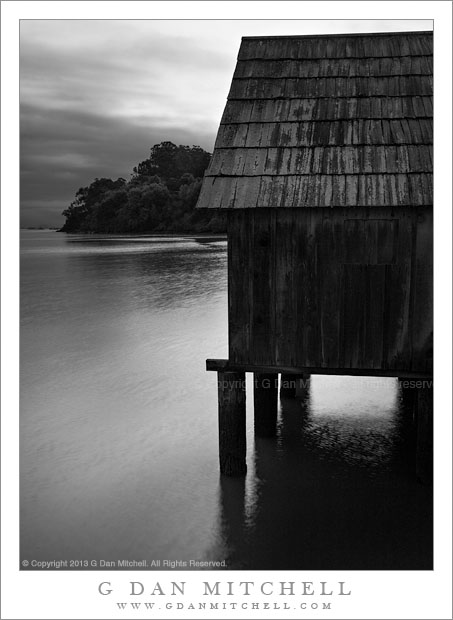
A shoreline building extends over the edge of San Francisco Bay at China Camp
I had been watching the reflections on the calm water of this lagoon since I first arrived here in the morning. Earlier I had been on a high bluff behind the camera position for this photograph, looking down at this village and the curve of the beach of its small lagoon. The clouds thinning behind a departing Pacific weather front were starting to allow sun light to pass, yet still filtering and softening it. This light was falling on the smooth surface of this water in this relatively quiet area of the San Francisco Bay, and creating all sorts of interesting reflections.
Eventually I walked down to the village and among its old buildings, gravitating toward the shoreline. I first photographed an old pier and then investigated a building from which it extends. From here I was able to look out across the lagoon toward a further peninsula and the light of the sun on the clouds. This was technically a bit of a tricky photograph since it includes brightly sun-lit clouds right above and to the left of the building, but also includes deep shadows below and on the near side of the building. To be honest, I was unsure of what exposure would work best and provide the best balance between avoidance of blown out sky and enough shadow detail to pull it back in past without problems with image noise – so I bracketed. I bracketed like nobody’s business – making something like five exposures in the series. Ironically, in the end I was able to extract all of the detail I needed from a single exposure!
G Dan Mitchell is a California photographer and visual opportunist whose subjects include the Pacific coast, redwood forests, central California oak/grasslands, the Sierra Nevada, California deserts, urban landscapes, night photography, and more. Blog | About | Flickr | Twitter | Facebook | Google+ | 500px.com | LinkedIn | Email
Photographer and visual opportunist. Daily photos since 2005, plus articles, reviews, news, and ideas.
Manage Consent
To provide the best experiences, we use technologies like cookies to store and/or access device information. Consenting to these technologies will allow us to process data such as browsing behavior or unique IDs on this site. Not consenting or withdrawing consent, may adversely affect certain features and functions.
Functional
Always active
The technical storage or access is strictly necessary for the legitimate purpose of enabling the use of a specific service explicitly requested by the subscriber or user, or for the sole purpose of carrying out the transmission of a communication over an electronic communications network.
Preferences
The technical storage or access is necessary for the legitimate purpose of storing preferences that are not requested by the subscriber or user.
Statistics
The technical storage or access that is used exclusively for statistical purposes.The technical storage or access that is used exclusively for anonymous statistical purposes. Without a subpoena, voluntary compliance on the part of your Internet Service Provider, or additional records from a third party, information stored or retrieved for this purpose alone cannot usually be used to identify you.
Marketing
The technical storage or access is required to create user profiles to send advertising, or to track the user on a website or across several websites for similar marketing purposes.

 G Dan Mitchell is a California photographer and visual opportunist whose subjects include the Pacific coast, redwood forests, central California oak/grasslands, the Sierra Nevada, California deserts, urban landscapes, night photography, and more.