Tag Archives: line

Sand Waves

Sand Waves
Rising waves of sand in soft light, Death Valley National Park

Sand Waves. © Copyright 2012 G Dan Mitchell – all rights reserved.

Rising waves of sand in soft light, Death Valley National Park.

This photograph comes from a memorable visit to a remote location in Death Valley National Park about eight years ago. I was in the park during the first few days of January. I saw far fewer other visitors than I usually encounter there these days, and I experienced some very cold temperatures! A few days earlier the thermometer in my vehicle registered at freezing as I drove below sea level very early one morning. On the morning after I made this photograph I finally got around to checking the temperature at around 9:00AM after the sun had come up, only to discover that it was still in the low twenties!

When I arrived at this location in the late afternoon there was only one other small group of visitors. (They were gone when I came back from photographing, and I had the place completely to myself that night.) I figured out where I would camp that night, and then I grabbed my photography gear and headed out into the nearby landscape of sand with distant vistas of playa and mountains. It was late enough the I soon found myself photographing the dunes in soft, post-sunset light.


G Dan Mitchell is a California photographer and visual opportunist. His book, “California’s Fall Color: A Photographer’s Guide to Autumn in the Sierra” is available from Heyday Books and Amazon.

Blog | About | Flickr | FacebookEmail

Links to Articles, Sales and Licensing, my Sierra Nevada Fall Color book, Contact Information.

Scroll down to leave a comment or question.


All media © Copyright G Dan Mitchell and others as indicated. Any use requires advance permission from G Dan Mitchell.

Winter Landscape

Winter Landscape
A California winter landscape photograph reduced to its compositional fundamentals.

Winter Landscape . © Copyright 2019 G Dan Mitchell – all rights reserved.

A California winter landscape photograph reduced to its compositional fundamentals.

This photograph fits into a category I describe as “imaginary landscapes,” a type defined loosely by where it sits along the continuum between supposed representational reality and abstraction of landscape-derived materials. That might seem an overly-wordy way to describe it, but I’m always cognizant of the fact that no landscape photograph is truly objective or fully “real” — all photographs and certainly all landscape photographs necessarily are subjective. This could be due to something as basic (and obvious!) as the fact that the photographer chose to point the camera at some specific thing (and not at other things). It includes equipment choices( length of lens, aperture, etc.), basic interpretive choices (color or black and white, and how to handle either of those), and much, much more. In my “imaginary landscape” photographs I think I’m simply making this stuff more plainly obvious.

This one also illustrates, I think, something that figures into the landscape (but not just landscape!) photographs of virtually every photographer that I know of — the photograph is not just about the ostensible subject of the image. For most photographers other things also appeal — the shapes of things, their colors (a huge topic, by the way), how the components fit together, how things may be suggested rather than declared, and more. Allow me to make a musical analogy here. There’s a famous (or infamous) piece by composer/philosopher John Cage called 4’33”. In it a performer, takes the stage in the manner of any classical performer, then sits in front of a (usually) piano silently for 4′ 33″. One way to look at this is to recognize that Cage gave us every element of a musical performance but the one we think is central, thus forcing us to think about all of those “other details” and their central role in our perception of music. A photograph with no details (“the horror!”) may work in a somewhat similar (though not quite identical) way. Or maybe you just like the colors? ;-)


G Dan Mitchell is a California photographer and visual opportunist. His book, “California’s Fall Color: A Photographer’s Guide to Autumn in the Sierra” is available from Heyday Books and Amazon.

Blog | About | Flickr | FacebookEmail

Links to Articles, Sales and Licensing, my Sierra Nevada Fall Color book, Contact Information.


All media © Copyright G Dan Mitchell and others as indicated. Any use requires advance permission from G Dan Mitchell.

Eastern Sierra Stream, Autumn

Eastern Sierra Stream, Autumn
“Eastern Sierra Stream, Autumn” — Autumn colors line the banks of a small Eastern Sierra Nevada stream

This photograph is of one of those little places — you could easily pass right by it and miss it. I have, and I’ve even stopped nearby and not seen a photograph. This time I was heading up a canyon in cloudy conditions and light rain, and perhaps the unusual conditions helped me to see differently. In any case, as I drove past the area I noticed the red plants growing close to the ground, even though there were largely obscured by intervening trees.

I quickly turned around and came back, parked, and then spent some time poking around and looking. I finally ended up down along the bank of the stream, the closest I could get to the red plants, and I found a composition looking upstream toward more colorful plants and the white trunks of an aspen grove.


Leave a comment or question using the form. (If you are reading this on the home page, click the article title to see the full article and the comment form.

G Dan Mitchell is a California photographer and visual opportunist. His book, “California’s Fall Color: A Photographer’s Guide to Autumn in the Sierra” (Heyday Books) is available directly from him. Blog | Bluesky | Mastodon | Substack Notes | Flickr | Email

All media © Copyright G Dan Mitchell and others.

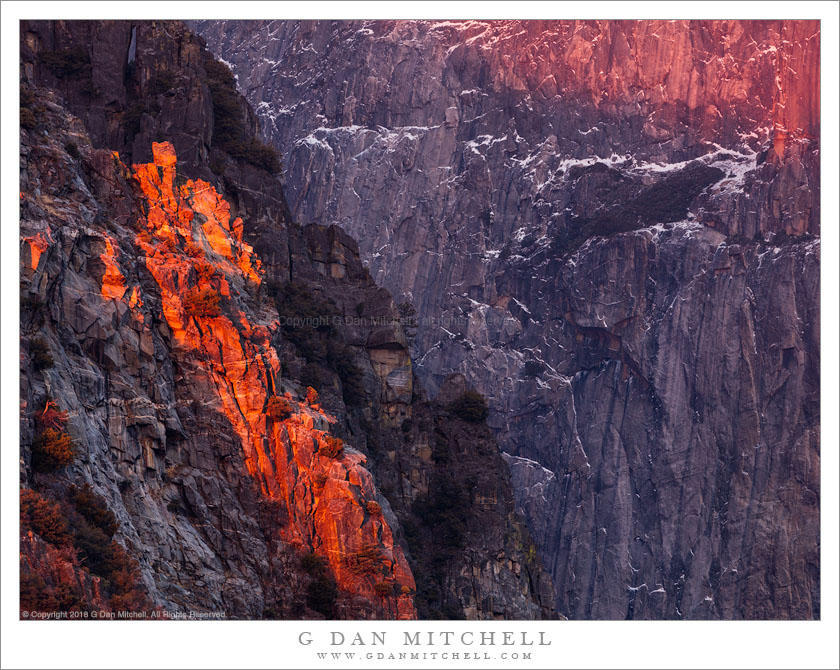
Granite Cliffs, Last Light

Granite Cliffs, Last Light
The line of last sunset light crosses rugged granite cliffs in Yosemite National Park

Granite Cliffs, Last Light. © Copyright 2018 G Dan Mitchell – all rights reserved.

The line of last sunset light crosses rugged granite cliffs in Yosemite National Park

Late last month I had the good fortune to spend a week in Yosemite, thanks to the Yosemite Renaissance artist-in-residence program. Their generosity provided me with a warm place to stay in the park and, most important, with time to chase photographs in the Valley and elsewhere. (With the onset — finally! — of winter weather in the park, it also gave me lots of opportunities to practice my winter driving skills!)

The Valley is, of course, filled with wonderful and well-known icons. Like virtually everyone, I photograph those, too, particularly when special conditions bring the possibility of special and different light and atmosphere to those familiar subjects. However, over time I have become more interested in other little bits of visual interest that don’t necessarily reflect the best-known features. On this evening I was at one of the most famous locations — with the promise of light snow, drifting clouds, and evening light breaking through. I make a habit of scanning the entire 360 panorama around me, even when the most obvious subject is in a 45 degree vector straight in front, and near the very end of the day a beam of sunset light passed across a rocky outcropping to my left, producing intense light on the rocks while the evening’s blue and purple colors began to fill the canyons.


G Dan Mitchell is a California photographer and visual opportunist. His book, “California’s Fall Color: A Photographer’s Guide to Autumn in the Sierra” is available from Heyday Books and Amazon.
Blog | About | Flickr | Twitter | FacebookGoogle+ | LinkedIn | Email


All media © Copyright G Dan Mitchell and others as indicated. Any use requires advance permission from G Dan Mitchell.