
Tag Archives: red

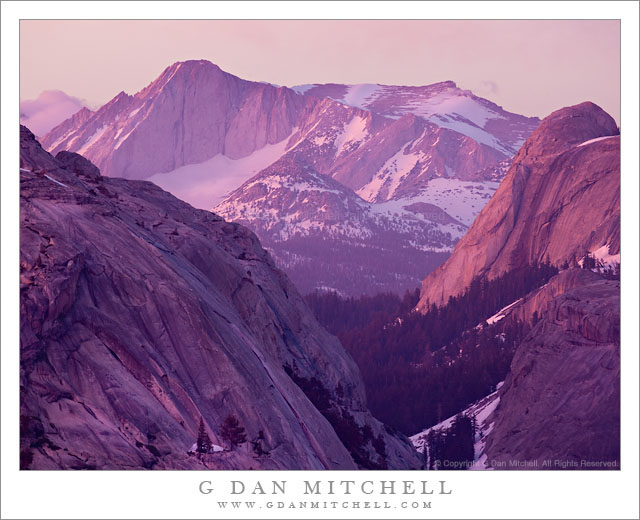
Alpenglow, Mount Conness

Alpenglow, Mount Conness

Alpenglow, Mount Conness. Yosemite National Park, California. June 18, 2011. © Copyright G Dan Mitchell – all rights reserved.

The last evening light illuminates domes near Tenaya Lake and the summit of Mount Conness with briilliantly colorful alpenglow, Yosemite National Park.

The tall peak at upper left is the summit of Mount Conness, one of the highest peaks in Yosemite National Park. The peak is located on the park boundary and the Sierra Nevada crest a bit north of Tioga Pass, and is visible from many places in the Tuolumne/Tioga high country. It is also a popular destination for peak baggers. The left foreground granite dome is the lower face of Polly Dome, which drops to the shoreline of Tenaya Lake. The left slope of Pywiak dome is visible in the shadows at lower right and beyond is the more brightly illuminated Medlicott dome.

I forgive you if you don’t believe the colors that you see in this photograph. I barely believe them myself, and I was (obviously!) there for the show. What happened on this evening was a near perfect example of a light phenomenon that Sierra photographers watch for and are occasionally lucky enough to experience. I have learned to see the signs that indicate that this light is possible, but also to understand that even when the conditions offer this potential that they rarely deliver.

On certain cloudy evenings in the Sierra it appears that there will be no sunset color – everything is hazy and drab and washed out. But if things play out just right, this very set of drab conditions (that induce some photographers to put away their gear too soon!) can produce some of the most striking and intense color possible if a few things fall into place just right. On this evening I had stopped for a moment at Olmsted Point, thinking to photograph ice-covered Tenaya Lake with a long lens and including the mass of Mount Conness in the distance. When I arrived there, things were about as unpromising as they could possibly be. A dull, greenish-blue haze hung in the air, overcast washed out the light, and Conness was obscured by clouds. I had actually put my gear back in the car when I looked back up and noticed that the summit of Conness had briefly poked through the clouds, accentuating its bulk and the sense that it towered over the foreground mountains. The light was still awful (I have the photos to prove it! ;-) but I thought I’d see if I could get something with the peak emerging from its shroud.

But still nothing much happened. I turned the camera to photograph some nearby trees and a blackbird that was looking for snacks. Then I noticed that there was some brighter light to the southwest and I began to consider the possibility that the cloud cover might end a bit to the west – and that is requirement #1 for the light conditions I’m describing. If the cloud deck ends to the west, as the sun reaches the horizon it may briefly break under the clouds and send brilliantly colorful light up into the clouds in the Sierra from below, creating a miles-wide light panel of the most astonishing colors. But still, it was hazy and the peaks were shrouded in clouds. But then I noticed that the clouds around Conness were beginning to drift off to the east and thin a bit. I mentioned (knock on wood!) to one of the other photographers that there was a possibility of “miracle light,” but that I wasn’t making any promises!

Then the thinning clouds began to pick up a slight pink tinge and the left side of Conness began to get some light directly from the west. Then, within a minute or so, the colors went absolutely crazy. People around me were audibly gasping as the color changed. At one point several of us spontaneously looked up to the west when we noticed the light suddenly increase out of the corners of our eyes. At the same time, the clouds almost completely dissipated from the area around the peak and because the whole sky was filled with brilliantly colorful clouds, this light began to suffuse even the depths of the canyon and slopes facing away from the sunset with this amazing light.

Never put your camera away until the last light is gone. :-)

G Dan Mitchell Photography | Flickr | Twitter (follow me) | Facebook (“Like” my page) | LinkedIn | Email
Text, photographs, and other media are © Copyright G Dan Mitchell (or others when indicated) and are not in the public domain and may not be used on websites, blogs, or in other media without advance permission from G Dan Mitchell.
Corner Store With Boarded-Up Windows

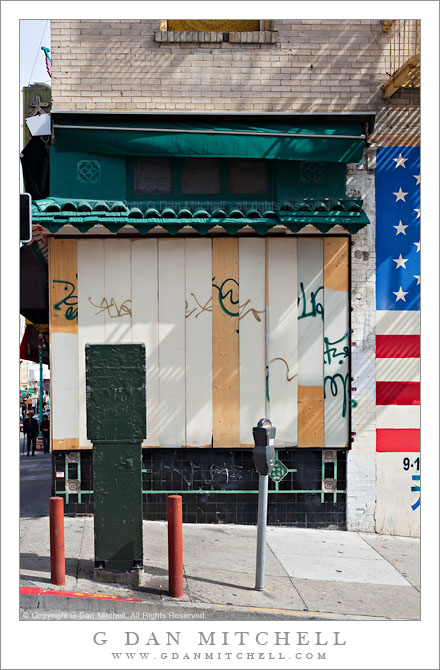
Corner Store With Boarded-Up Windows

Corner Store With Boarded-Up Windows. San Francisco, California. July 12, 2010. © Copyright G Dan Mitchell – all rights reserved.

A corner store with boarded-up windows in the Chinatown district of San Francisco.

There probably isn’t a whole lot to say about the subject of this photograph other than it is a boarded-up corner store in the Chinatown area of San Francisco, photographed in morning light last July. The components of the scene are kind of odd, I think: a bit of a flag, green awnings and painted wall, the slanting sidewalk with some poles and boxes, and the layers of older and newer boards and graffiti over the windows. I also though the light was interesting, partly because it was short period when the San Francisco fog is breaking up and the light is brighter but still soft, and partly because of the diagonal shadows cast across the vertical and horizontal shapes of the wall.

G Dan Mitchell Photography | Flickr | Twitter (follow me) | Facebook (“Like” my page) | LinkedIn | Email
Text, photographs, and other media are © Copyright G Dan Mitchell (or others when indicated) and are not in the public domain and may not be used on websites, blogs, or in other media without advance permission from G Dan Mitchell.
Osgood Place

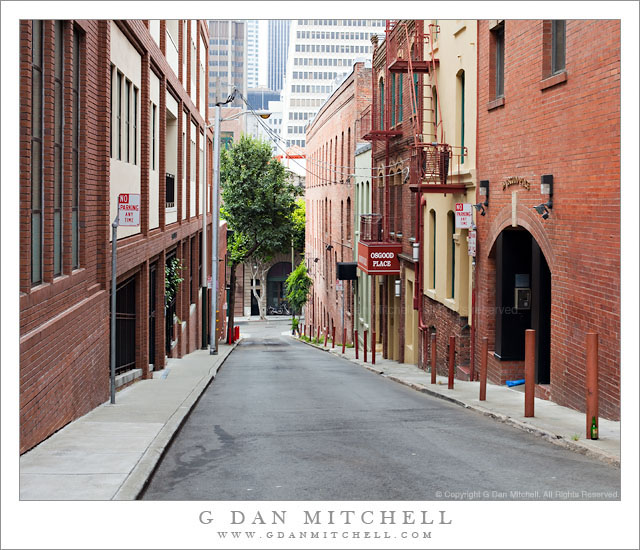
Osgood Place
Osgood Place

Osgood Place. San Francisco, California. July 12, 2010. © Copyright G Dan Mitchell – all rights reserved.

A steep street in downtown San Francisco with a sign for “Osgood Place.”

I came across this photograph from last summer while going over old raw files again this week. To be honest, I barely remember shooting this scene, and the only hints about the precise location are the “Osgood Place” sign (referring to one of the buildings) and the base of the Transamerica Pyramid beyond the end of the street.

When I saw it this week, something caught my attention about it. I like the vantage point that roughly as high as the third story of buildings near the bottom of the street – this does some slightly odd things to perspective lines. I also like the various types of red to brick-red coloration and the row of steel posts along the narrow sidewalk. The subtle green beer bottle against the first post at the right is a touch I like, too. ;-) It is surprising that I managed to take a photograph of this area of San Francisco that includes no people.

(Update: Thanks to some folks who saw this photograph elsewhere, I have learned that the street is also called Osgood Place.)

G Dan Mitchell Photography | Flickr | Twitter (follow me) | Facebook (“Like” my page) | LinkedIn | Email
Text, photographs, and other media are © Copyright G Dan Mitchell (or others when indicated) and are not in the public domain and may not be used on websites, blogs, or in other media without advance permission from G Dan Mitchell.

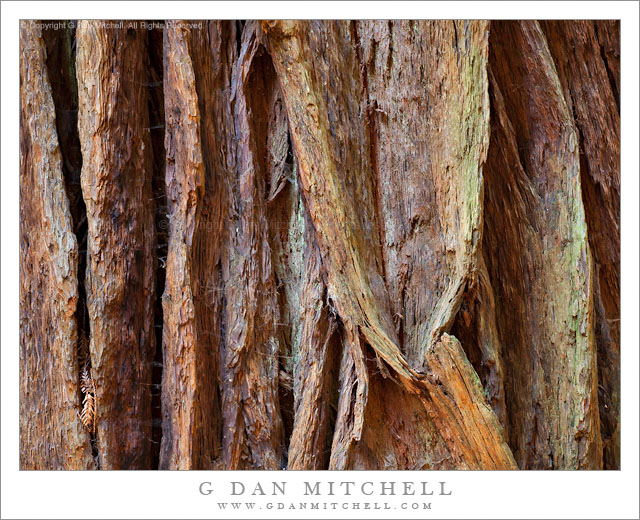
Redwood Trunk, Detail

Redwood Trunk, Detail

Redwood Trunk, Detail. Muir Woods National Monument, California. April 29, 2011. © Copyright G Dan Mitchell – all rights reserved.

Detail view of the convoluted textures of the bark of a coast redwood tree, Muir Woods National Monument.

I’m fascinated by the patterns of tree trunks and bark, and I often try to find ways to make photographs of the thick and rugged bark of coastal redwoods – but not always with a lot of success! The subject is trickier than it seems at first. Even during the daytime these forests can be quite dark – and occasional beams of direct light pose their own problems along the lines of harsh shadows. When shooting close up, relatively small apertures are needed since some amount of DOF is required to get the closest parts of the thick bar, and the deeper parts along the frame edges decently in focus. Low light and small apertures means long exposures, and even a bit of air movement will move leaves, bits of grass, or (in the case of this photo) spider webs. And when a bit of interesting filtered light does make it down through the forest canopy, it is often there and gone within a few seconds. (On this same day I came across a beautiful shadow on the side of one redwood that included the shapes of some nearby alder trees. It was wonderful! It was also gone 10-15 seconds later when I got my camera into position!)

I photographed this bit of bark shape and texture along the main trail at Muir Woods on this late-April morning. As is my usual plan, I had arrived very early – before the park actually opens – and was able to wander around without the typical crowds that appear once the post-breakfast tour buses arrive from nearby San Francisco. In this spot it was quite dark, but there was just a bit of filtered and reflected light to bring out the textures and colors of the redwood bark.

G Dan Mitchell Photography | Flickr | Twitter (follow me) | Facebook (“Like” my page) | LinkedIn | Email
Text, photographs, and other media are © Copyright G Dan Mitchell (or others when indicated) and are not in the public domain and may not be used on websites, blogs, or in other media without advance permission from G Dan Mitchell.