
Tag Archives: two

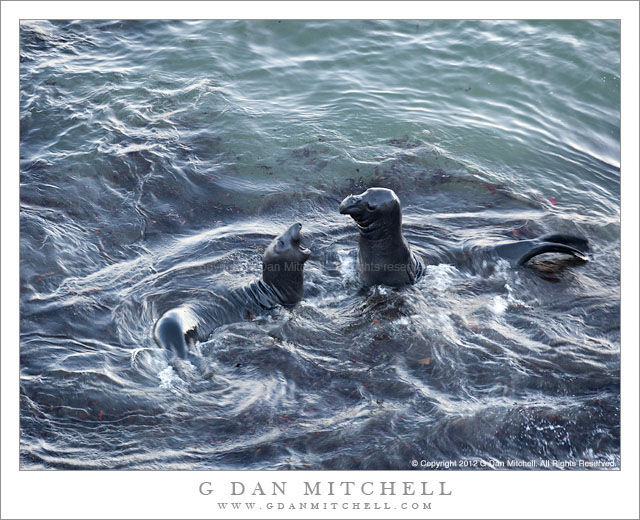
Elephant Seals in Surf

Elephant Seals in Surf - Two elephant seals spar in the surf at Point Reyes National Seashore, California.
Two elephant seals spar in the surf at Point Reyes National Seashore, California.

Elephant Seals in Surf. Point Reyes National Seashore, California. June 24, 2012. © Copyright 2012 G Dan Mitchell – all rights reserved.

Two elephant seals spar in the surf at Point Reyes National Seashore, California.

After over a month of not exposing a single frame, I needed to go out and start shooting again this past week. (June is often a very busy time of year for me, and this June was especially challenging in a number of ways.) So, even though it is finals week at the college and I have a lot of papers to grade and loose ends to tie up, I managed to get away for a half day to photograph at Point Reyes. I went there with few specific ideas about what to shoot, instead just sort of hanging loose, enjoying whatever I could find, and making photographs as I found them. I started by taking an unplanned detour out towards Tomales Point – I was sort of killing time while waiting for the light to do the right stuff, and I thought it would be interesting to head out there and see the tule elk. After that I returned to the main road and headed out toward the Point Reyes lighthouse.

It actually was not my plan to go to the lighthouse, and didn’t even drive the last little bit of roadway to that site. Instead I took the turn towards the start of the Chimney Rock trail, with a general plan of being high up on the bluffs of this southernmost section of the Point when the good light arrived. I pulled in, at a sandwich for dinner, loaded up my camera gear, and headed out along the trail. I had a few things in mind. I know that shooting back along the steep, rocky cliffs of the Point late in the day can be dramatic, and I started by photographing there – fortunately my timing turned out to be almost exactly right, as I caught a last bit of light on the mist and haze along the shoreline before the sun moved too far north to continue to light the area. I then moved on out the end of the trail, where I just sat for a while as I waited for the early evening color to come to the light. I made a few photographs out here, stopped again along the bluffs to photograph along the point (but the best light had passed), made a few photographs back across Drakes Bay, and then started back towards a low point, protected from the wind, from which I thought I might try to photograph the Farallons right at sunset. Once I got there, the light on the islands seemed uninteresting, but I soon realized that the guttural sounds of elephant seals that I had been hearing were coming from the base of the cliff on which I was standing. I moved a bit closer to the edge – but not too close! – and was able to shoot straight down on a group of elephant seals as they alternately lay around on the beach and sparred in the shallow surf just beyond the sand.

G Dan Mitchell is a California photographer whose subjects include the Pacific coast, redwood forests, central California oak/grasslands, the Sierra Nevada, California deserts, urban landscapes, night photography, and more.
Blog | About | Flickr | Twitter | FacebookGoogle+ | 500px.com | LinkedIn | Email

Text, photographs, and other media are © Copyright G Dan Mitchell (or others when indicated) and are not in the public domain and may not be used on websites, blogs, or in other media without advance permission from G Dan Mitchell.
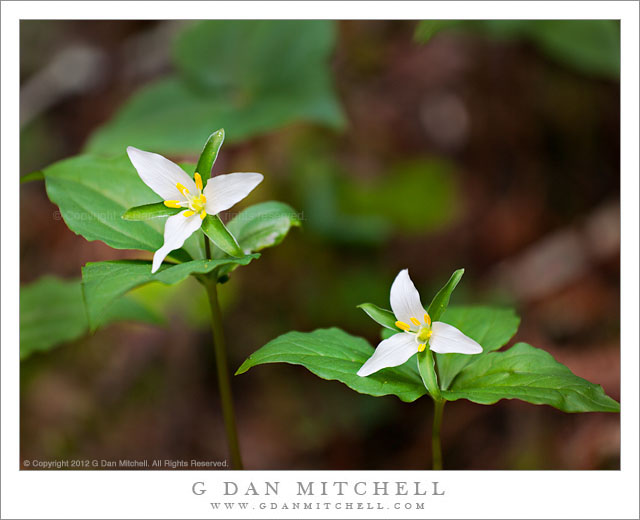
Two Trillium Blossoms

Two Trillium Blossoms - Two trillium blossoms in the redwood forests of the Golden Gate National Recreation Area, California
Two trillium blossoms in the redwood forests of the Golden Gate National Recreation Area, California

Two Trillium Blossoms. Golden Gate National Recreation Area, California. March 10, 2012. © Copyright 2012 G Dan Mitchell – all rights reserved.

Two trillium blossoms in the redwood forests of the Golden Gate National Recreation Area, California.

It is probably obvious by now that I’m a trillium fanatic. Early March is “trillium season” in the redwood forests around the San Francisco Bay Area, so I have been out photographing these flowers during the past couple of weeks. I was originally concerned that this might be a very poor year for them since we are in the midst of a serious drought in California, but some early March rain seems to have provided enough water to get them to sprout. In fact, this past weekend I saw lots of new plants just starting to emerge, so it seems to me that there may be some life left in the this year’s bloom. (And now we are looking hopefully at an upcoming week of much-needed rain.)

I photographed this pair along a trail that traverses a hillside above a valley filled with coast redwoods. I arrived in this spot just as morning light was beginning to filter down through the tall canopy of this forest and, in spots, hit the ground and the new plants. The trick is is to get some of the brighter color of this sunlight but to avoid the direct sun – the latter is far too harsh for photographing these flowers. So I worked in the shaded areas or, at times, in those spots that were right on the sun/shade boundary. I probably most often photograph single flowers, but when I can find a group I like to see how I can make a composition out of them. It is a bit trickier than it might seem, as there are a bunch of elements that must work together. First, the two flowers need to be fairly close together, and they both need to be at roughly the same point in their development – it isn’t so wonderful to get one beautiful flower and one half-dead, dried hulk. Then they must both be illuminated in roughly the same way – it won’t work so well if one is in brighter light than the other. The background is a tricky thing, too. If it is too bright or too busy (or too well focused) it can easily distract from the flowers themselves, so I usually look for something in shadow and without any very bright objects. While I may be able to find a camera position that accomplishes this, sometimes I need to move a small, bright leaf or twig. And once all of this is worked out, the flowers must be roughly in a plane parallel to the camera’s sensor so that both will be in focus – and this must happen while shooting at the large apertures necessary to throw the background out of focus. And last, but not least, exposure can be slightly tricky – it is very easy to over-expose the bright but delicate form of the flower’s petals, and end up losing detail.

G Dan Mitchell is a California photographer whose subjects include the Pacific coast, redwood forests, central California oak/grasslands, the Sierra Nevada, California deserts, urban landscapes, night photography, and more.
Blog | About | Flickr | Twitter | FacebookGoogle+ | 500px.com | LinkedIn | Email

Text, photographs, and other media are © Copyright G Dan Mitchell (or others when indicated) and are not in the public domain and may not be used on websites, blogs, or in other media without advance permission from G Dan Mitchell.
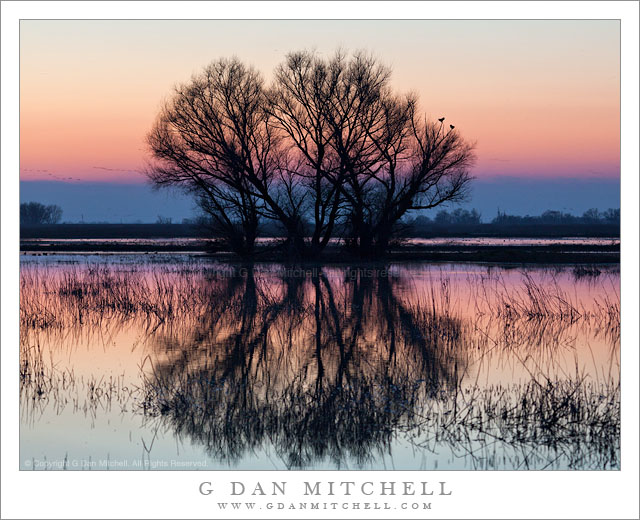
Two Owls, Trees and Ponds, Dusk

Two Owls, Trees and Ponds, Dusk  - Two owls in the branches of a group of trees at dusk, reflected in the waters of a pond at the Merced National Wildlife Refuge
Two owls in the branches of a group of trees at dusk, reflected in the waters of a pond at the Merced National Wildlife Refuge

Two Owls, Trees and Ponds, Dusk. Merced National Wildlife Refuge, California. February 4, 2012. © Copyright 2012 G Dan Mitchell – all rights reserved.

Two owls in the branches of a group of trees at dusk, reflected in the waters of a pond at the Merced National Wildlife Refuge.

I originally posted this in an impromptu manner and out of sequence back on SuperB owl Sunday – but now it comes up “officially” in the queue. At the very end of a winter day that had begun well before dawn back up the Central Valley closer to Sacramento (in the Cosumnes River area, to be precise) we had headed south to Merced National Wildlife Refuge in search of somewhat different subject for the evening. We arrived to find some geese on the pond, but most were a bit too far off for good photography. But while we settled in to wait for whatever else might show up, I turned my attention to the beautiful and wide-open Central Valley landscape.

This little group of trees grows on a small levee between a couple of ponds in this agricultural area. (Over the past few weeks I have come to know this exact spot very well, as I have been back three times now to photograph there, with better and better luck each time.) After the sun set, some of the most beautiful light appeared – the soft and pink/purple/blue atmospheric light of dusk, when there is still some brighter color in the sky. I saw a single bird high in one of the branches of this tree and soon figured out it was an owl. I set up a composition that centered the tree – creating, I hope, a sense of quiet and stillness – and which included a bit of the sky and the beautiful reflection of the tree’s silhouette in the water. As I shot, a second owl showed up for a few seconds and I was able to get a frame with the couple together.

G Dan Mitchell is a California photographer whose subjects include the Pacific coast, redwood forests, central California oak/grasslands, the Sierra Nevada, California deserts, urban landscapes, night photography, and more.
Blog | About | Flickr | Twitter | FacebookGoogle+ | 500px.com | LinkedIn | Email

Text, photographs, and other media are © Copyright G Dan Mitchell (or others when indicated) and are not in the public domain and may not be used on websites, blogs, or in other media without advance permission from G Dan Mitchell.

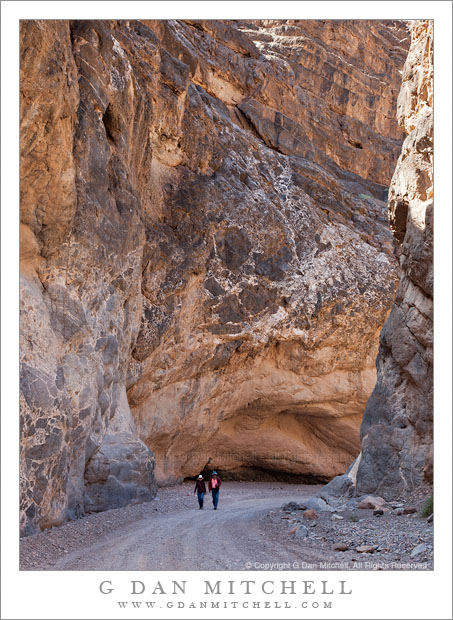
Hikers, Titus Canyon

Hikers, Titus Canyon

Hikers, Titus Canyon. Death Valley, National Park. March 28, 2010. © Copyright 2011 G Dan Mitchell – all rights reserved.

Hikers in Titus Canyon, Death Valley National Park.

There are essentially two ways to get to this portion of Titus Canyon in Death Valley National Park – you can either do a very long drive from near Beatty on gravel roads or you can walk a short distance up from the base of the canyon along the eastern side of Death Valley itself. I’ve done both. The road is quite an experience – in any other park it would probably be regarded as a very special thing, especially the last portion above Death Valley where it twists and turns down a slot canyon that is in places barely wide enough to a vehicle yet so tall that it can be hard to see the tops of the canyon walls. (It is not exactly a bad road, but it isn’t trivial either. There are some very exposed sections where it crosses the mountain ridge and descends past Leadville. Although there are reports of people using lesser vehicles, take seriously the recommendations for reasonably high ground clearance and some from of all-wheel drive.)

However, on this visit I simply parked my car at the base of the canyon, shouldered my camera equipment, and walked up the canyon a ways. There is, of course, much that you probably won’t see if you enter the canyon this way, largely because the road is so long that you won’t likely cover much of it on foot. However, I think that you can more clearly sense the scale of the lower slot canyon when traveling of foot. I included two hikers who happened by to give a sense of that scale to the landscape.

G Dan Mitchell is a California photographer whose subjects include the Pacific coast, redwood forests, central California oak/grasslands, the Sierra Nevada, California deserts, urban landscapes, night photography, and more.
Blog | About | Flickr | Twitter | Facebook | Google+ | 500px.com | LinkedIn | Email

Text, photographs, and other media are © Copyright G Dan Mitchell (or others when indicated) and are not in the public domain and may not be used on websites, blogs, or in other media without advance permission from G Dan Mitchell.