Tag Archives: usa

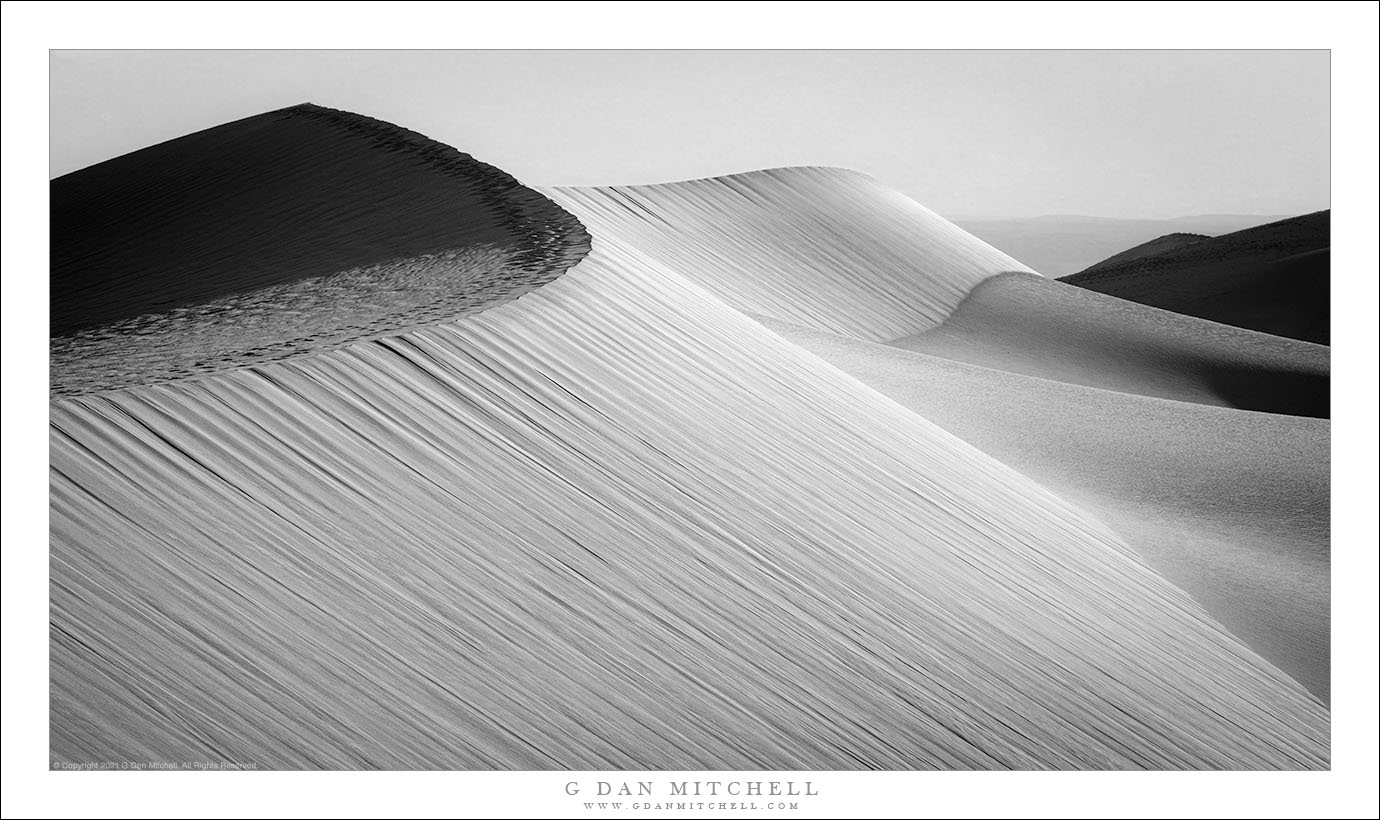
Sea of Dunes

Sea of Dunes
Sand dune forms extend into teh distance, Death Valley National Park.

Sea of Dunes. © Copyright 2021 G Dan Mitchell – all rights reserved.

Sand dune forms extend into the distance, Death Valley National Park.

From just the right vantage points, the terrain of sand dunes can appear to be entirely devoid of living things. (In truth, no landscape is, but the evidence is hard to see here.) And when looking in the ideal directions, the succession of curving shapes can suggest a sort of frozen seascape full of immense waves.

I made this photograph on a spring morning while exploring a favorite area of these dunes, one that isn’t quite as busy with people trying to get to the highest point. This area is mostly a landscape of parallel ridges and valleys that run toward the center of the dunes, so I tend to approach from the edge and work my way toward the center. The main dune in this scene is a remarkable one — it is long and has a face that is marked by an unusual rippled pattern.


G Dan Mitchell is a California photographer and visual opportunist. His book, “California’s Fall Color: A Photographer’s Guide to Autumn in the Sierra” is available from Heyday Books, Amazon, and directly from G Dan Mitchell.

Blog | About | Flickr | FacebookEmail

Links to Articles, Sales and Licensing, my Sierra Nevada Fall Color book, Contact Information.

Scroll down to leave a comment or question.


All media © Copyright G Dan Mitchell and others as indicated. Any use requires advance permission from G Dan Mitchell.

Canyon Wall Detail

Canyon Wall Detail
Detail of a canyon wall with tilted sedimentary rocks and fossils, Death Valley National Park.

Canyon Wall Detail. © Copyright 2021 G Dan Mitchell – all rights reserved.

Detail of a canyon wall with tilted sedimentary rocks and fossils, Death Valley National Park.

These rocks tell a story, a profound one no doubt, but also one that this non-geologist is incapable of fully comprehending. But I do know a few things, and with that bit of knowledge and the time to observe, I can report that there is a lot to think about in places like this and, for that matter, the entirety of Death Valley National Park. A difference between this landscape and most others with which I’m familiar is that here it is almost entirely exposed rather than being hidden underneath forests and snow.

As I understand it, the course of many of the rocks here is sedimentary — they were formed under ancient seas. (Portions of the valley were submerged much more recently, and that shorter tale is visible, too, in places.) Those sediments sometimes captured creatures that became fossilized, as we see in the black spots in the rocks of this photograph. Then various geological forces lifted, tilted, fractured, and contorted these layers over a vast span of time. In many places in the park the strata are inclined upward as they progress to the west. Here one of the inclined rock bands contains colors that are the exception rather than the rule in this national park.


G Dan Mitchell is a California photographer and visual opportunist. His book, “California’s Fall Color: A Photographer’s Guide to Autumn in the Sierra” is available from Heyday Books, Amazon, and directly from G Dan Mitchell.

Blog | About | Flickr | FacebookEmail

Links to Articles, Sales and Licensing, my Sierra Nevada Fall Color book, Contact Information.

Scroll down to leave a comment or question.


All media © Copyright G Dan Mitchell and others as indicated. Any use requires advance permission from G Dan Mitchell.

Stream and Peak

Stream and Peak
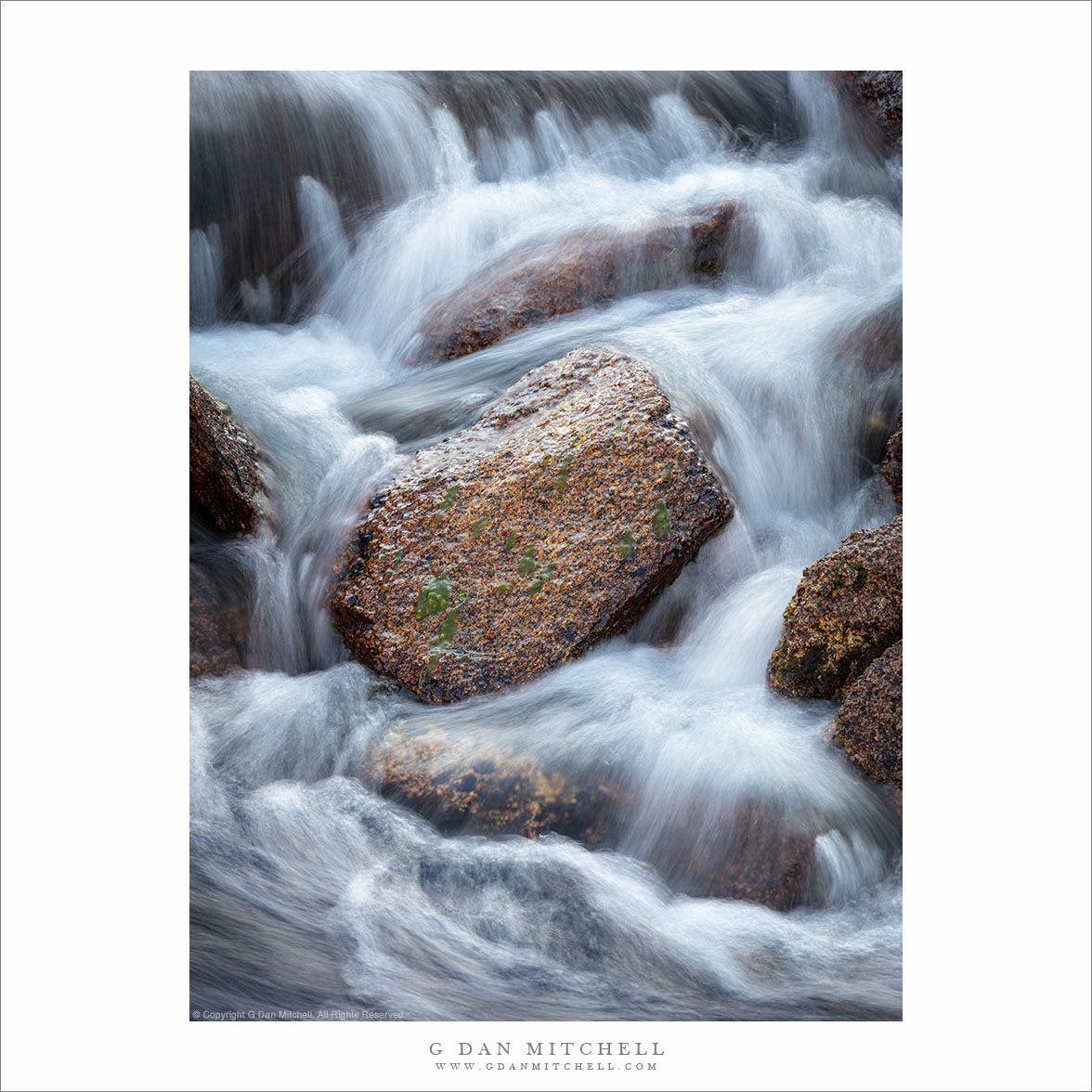
A small subalpine stream descends from higher terrain among the peaks of hte Sierra crest.

Stream and Peak. © Copyright 2021 G Dan Mitchell – all rights reserved.

A small subalpine stream descends from higher terrain among the peaks of hte Sierra crest.

Sometimes I manage to tweak some people a bit by saying, “All photographs lie.” I probably should explain. Too often there is an assumption that photographs are about showing the objective qualities of subjects, and that the best photographs simply convey the reality of these things. I think that is mistaken, and that photographs are literally incapable of being objective analogs of their subjects. Almost everything about a photograph is subjective. How did we choose to frame it? What did we choose to leave out? What time of day did we make it? What lens did we choose? Did we choose color or black and white? If there is a “truth” in a photograph it is the truth about the photographer’s subjective response to the subject. (This is a partial explanation of why two photographers who photograph the same subject usually end up with quite different photographs.)

Beyond that, there are many aspects of a subject that a photograph simply cannot contain. The sound of little mountain streams is central to my experience of places like this, but it is not found in a photograph. A photograph cannot capture the breeze or the slight chill of the shade in high mountains. The knowledge of what lies between this small stream and the lake at the base of those peaks isn’t found here. How I came to find myself at this place is not known to the viewer. Where is this place, and does that even matter?


G Dan Mitchell is a California photographer and visual opportunist. His book, “California’s Fall Color: A Photographer’s Guide to Autumn in the Sierra” is available from Heyday Books, Amazon, and directly from G Dan Mitchell.

Blog | About | Flickr | FacebookEmail

Links to Articles, Sales and Licensing, my Sierra Nevada Fall Color book, Contact Information.

Scroll down to leave a comment or question.


All media © Copyright G Dan Mitchell and others as indicated. Any use requires advance permission from G Dan Mitchell.

Dead Creosote, Dunes

Dead Creosote, Dunes
Morning sun on san dunes and skeletal dead creosote plants, Death Valley.

Dead Creosote, Dunes. © Copyright 2021 G Dan Mitchell – all rights reserved.

Morning sun on san dunes and skeletal dead creosote plants, Death Valley.

We tend to think of the landscape and, in particular, the desert landscape as being relatively static. Landscape photographers often hear comments along the lines of, “You have all the time in the world to make a photograph.” While there is some truth to this notion — yes, that mountain is likely to still be there tomorrow — things are not quite that simple, particularly at the beginning and end of the day. While the physical objects in this photograph stand still, the light most certainly does not!

This photograph was, in a sense, the result of a combination of working slowly and working quickly. Soon after arriving in this area of the dunes I saw this clump of dead creosote bushes. I thought they were interesting, but the lighting at that point wasn’t conducive to how I would photograph them. So I made a mental note about the scene and the spot and went to work on other things. A bit later the light was starting to sweep across the tops of the dunes and I turned my attention back to this subject, hoping that the angles would work out correctly to light the plants while the underlying sand remained in shadow. I waited as the light worked its way down the stems of the plants and then made the photograph during the seconds-long window just before the light struck the sand beneath them.


G Dan Mitchell is a California photographer and visual opportunist. His book, “California’s Fall Color: A Photographer’s Guide to Autumn in the Sierra” is available from Heyday Books, Amazon, and directly from G Dan Mitchell.

Blog | About | Flickr | FacebookEmail

Links to Articles, Sales and Licensing, my Sierra Nevada Fall Color book, Contact Information.

Scroll down to leave a comment or question.


All media © Copyright G Dan Mitchell and others as indicated. Any use requires advance permission from G Dan Mitchell.