Exfoliated and fractured granite ledges form patterns in late afternoon light, Yosemite National Park.
While this particular spot happens to be in the neighborhood of Tenaya Creek, similar features may be found throughout Yosemite and in many other parts of the Sierra. These rocks have probably been eroded in just about every way possible. They have been broken away from the underlying rock via exfoliation. The area was obviously glaciated. No doubt freezing water helped to widen the patterns of cracks and break up the rocks.
I made the photograph in late afternoon light when the sun was just barely above a low ridge beyond the upper edge of the photograph. The zoom was cranked out as wide as it goes in order to capture a good width and density of these wonderfully broken up rocks and the trees and other plants that somehow manage to live on and among them.
That was the question that someone posed today in a photography forum I read:
We will be visiting Yosemite for approximately 7-8 hours one day the 2nd week of October as part of a weeklong trip to Tahoe (we live on the East Coast). I have been to Yosemite before (many years ago), she has not. Although we know it would take much more time to truly experience Yosemite this is the maximum time we can spend so we are looking for the top spots so we can make the most of the short time we have there.
(There was a bit more that I haven’t included here – the poster also would be staying in Mariposa the night before, and needed to drive across Tioga Pass and be in Tahoe that evening… and wanted to do photography along the way!)
Having visited the park for decades, and for an amount of time perhaps totaling well over a year altogether, and still getting to know the place, my first reaction was to ignore the question or respond with a wise-crack one-liner. Frankly, I don’t think it is really possible to do real photography of “the park” during a seven-hour visit. (With careful planning it would be possible to photograph a subject or two perhaps, but that is a different issue.) In any case, I suppressed my instinct to respond along the lines of “are you kidding!?” and instead tried to provide a realistic outline of what this experience might entail. While I’m spoiled, living only hours from the park, I do understand that others may find themselves in the area and not want to miss at least having a brief experience with such a place. And perhaps the way-too-brief visit might be enough to encourage such visitors to find a way to return for a longer visit.
So, with all of that in mind, here is what I wrote, slightly modified for this post:
You are asking quite a lot here… for a seven hour visit that will include at least 3-4 hours of driving… from Mariposa, into and around the Valley, and then up and over Tioga Pass… plus leaving enough time for the remaining hours-long drive to Tahoe.
Too bad, I’m afraid.
To be honest, the odds that you’ll be able to do much beyond “record-my-quick-visit” photography in the park are slender given the amount of time you’ll be there, your tight schedule, and the fact that you’ll be there mostly during the “blah light” time of day. To some extent, I’m inclined to recommend that you not make photography your primary goal – one reason being that trying to “get those photographs” will distract you even more from you brief opportunity to actually see and experience the place a bit. I photograph in the park frequently, so I know where and how to shoot, and I would not try to do real photography under the conditions you describe.
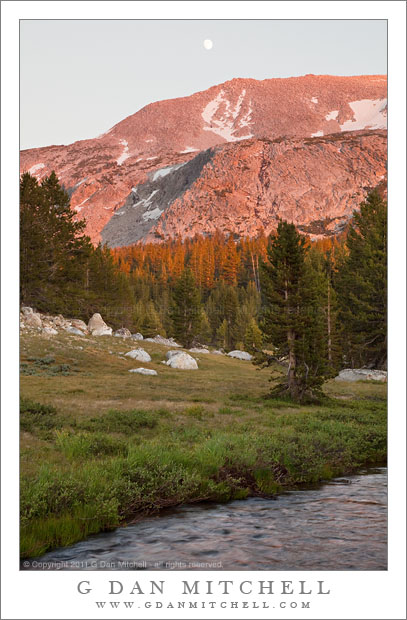
The nearly- full moon rises above the sunset light on Kuna Crest, Yosemite National Park.
Kuna Crest runs up Lyell Canyon between the Lyell and Dana forks of the Tuolumne River with the Sierra crest at one end and Mammoth Peak at the other. (Mammoth Peak is the large peak straight in front of you as you top Tioga Pass entering Yosemite National Park.) This ridge can catch great sunset light during the summer, and as I came down from the pass, heading back toward my camp at Porcupine Flat, and saw the almost full moon appearing over the shoulder of the ridge I decided to quickly stop and make a few exposures as the last light was about to leave the forest and soon after the peaks.
If you have tried photographing a scene that includes the moon in the early evening you know that the exposure is a tricky thing. The moon is lit by daylight, so it isn’t too surprising that the “correct” exposure for the moon is close to a normal daytime exposure. But that is not the right exposure for the rest of the scene, which turns out to be quite a bit darker than daylight at this time of day. In this scene things were even more complicates as the very saturated red colors on the ridge were quite “hot,” while the foreground meadow and forest was in shade and both darker and cooler in color. Basically, the dynamic range between the moon and the foreground was too large for a single exposure… so I made several.
At the time of exposure I thought that I might need as many as three component images in the final photograph – they would be one exposed for the bright ridge and sky, one exposed for the rather dark and shadowed foreground, and possibly a third that correctly exposed the moon. To be on the safe side I bracketed four exposures. When I began to work on the image I figured out that in this case I could construct a final “believable” image from two exposures if I was careful and could make some additional adjustments during post.
This is an example of a shot in which the use of a graduated neutral density filter could have been problematic, but where exposure blending could work very well. (“Exposure blending” is one term for the process of manually combining two component exposures using masked layers in Photoshop. No, it is not the same thing as HDR photography.) One of the things that would have been quite tricking using graduated neutral density filters is that the division between the brighter upper half and the darker lower half is not linear. Instead, the roughly follows the curved boundary between the lower meadow and dark trees and the still sunlit trees and the peak and sky.
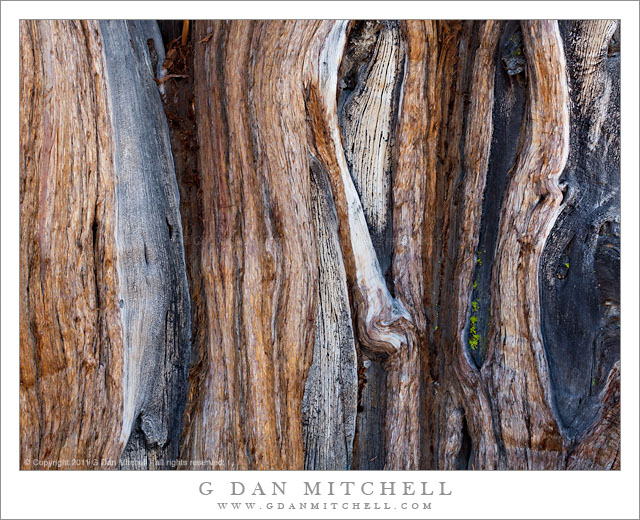
The heavily weathered and contorted trunk of juniper trees near Olmsted Point, Yosemite National Park.
These Sierra juniper trees grow in the most improbable places – on top of granite domes and slabs, with roots somehow finding sustenance in cracks and bits of gravel, and no doubt exposed to the full force of mountain storms. This is actually a group of trees that take advantage of the same crack in the otherwise solid granite, and which have grown together into what almost appears to be one very wide tree at first.
Because of their toughness, the way they grow almost into the rock, and the fact that the trees continue to live even when portions have died, it sometimes seems to me that these trees can have a character that is closer to that of the rock itself than just about any other living thing in the Sierra. The oldest branches and roots grow into the rock and have been shaped so much by their relationship to it that they can almost take on a rock-like character themselves.
These particular specimens happen to be growing part way up a dome-like granite slab above Tioga Pass Road as it passes through Yosemite’s high country. It appears that part of the treed may have been affected by fire, and dead sections have been worn and eroded by the tough sub-alpine environment. The only obvious signs of life in this close up image are the bits of moss or lichen growing in a few cracks in the wood.