
Category Archives: Photographs: Desert

Small Tree and Pink Rock

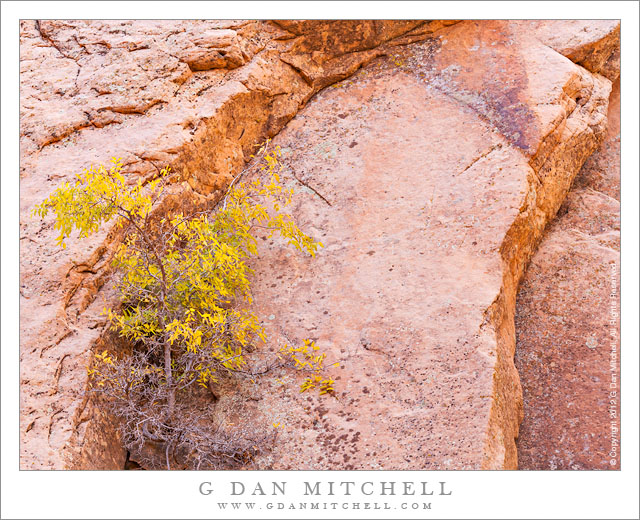
Small Tree and Pink Rock - A small tree with yellow autumn leaves grows from a crack in pink sandstone, Grand Staircase-Escalante National Monument
A small tree with yellow autumn leaves grows from a crack in pink sandstone, Grand Staircase-Escalante National Monument

Small Tree and Pink Rock. Grand Staircase-Escalante National Monument. October 23, 2012. © Copyright 2012 G Dan Mitchell – all rights reserved.

A small tree with yellow autumn leaves grows from a crack in pink sandstone, Grand Staircase-Escalante National Monument

The narrow canyons and slots of South Utah, which I’m just coming to know, are full of surprises at every turn. The “turns” are a literal source of the surprise, since you can’t generally see far up or down the canyons and each turn literally does reveal things that were not visible a moment before. As you progress up (or down) the canyons, the nature of the rock constantly changes as you pass through layers of angled strata of rock – smooth and deep red one moment, pale and broken another, and then light pink or gray. The incline of the canyon changes, as does its width – one moment you are walking on a veritable sidewalk, smooth and wide, and the next you are trying to find your way over rocks and boulders, walking up the middle of a stream, trying to avoid deep and sucking sand, squeezing through a slot, or looking for a higher route around an impassable section. The canyon might be rocky and seemingly devoid of plant life… or you might have to squeeze your way among trees and bushes.

This small canyon presented most of these variables at one point or another. Most of the time we were acutely aware of the stream in the canyon, as our route was in, around, or across the water almost constantly. Here a few small bushes found cracks in the rocky walls with sufficient soil to survive, and the light from far above bounced back and forth between the high canyon walls, picking up the reddish color of the sandstone.

G Dan Mitchell is a California photographer whose subjects include the Pacific coast, redwood forests, central California oak/grasslands, the Sierra Nevada, California deserts, urban landscapes, night photography, and more.
Blog | About | Flickr | Twitter | FacebookGoogle+ | 500px.com | LinkedIn | Email

Text, photographs, and other media are © Copyright G Dan Mitchell (or others when indicated) and are not in the public domain and may not be used on websites, blogs, or in other media without advance permission from G Dan Mitchell.
Three Towers, Morning

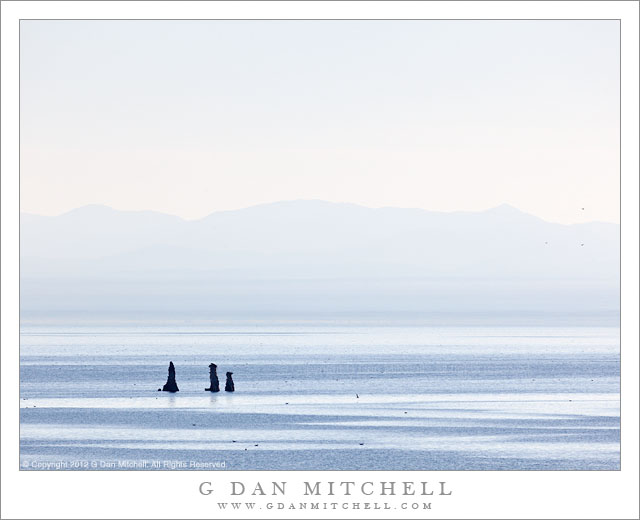
Three Towers, Morning - Three tufa towers in morning light, surrounded by wind-blown patterns on the surface of Mono Lake, California.
Three tufa towers in morning light, surrounded by wind-blown patterns on the surface of Mono Lake, California.

Three Towers, Morning. Mono Lake, California. July 14, 2012. © Copyright 2012 G Dan Mitchell – all rights reserved.

Three tufa towers in morning light, surrounded by wind-blown patterns on the surface of Mono Lake, California.

In mid-July I was in the Tuolumne/Tioga Pass area of the Sierra for a few days of photograph. In the end, I decided to stay over one extra night so that I could drive down to photograph around Mono Lake early in the morning before heading home. I was up before dawn, quickly in my car, and down to the shoreline of Mono Lake before sunrise. My first objective was to try to photograph sand tufa formations – not the more famous tufa towers. I found what I was looking for, and spend the sunrise period photographing them in first light. However, this opportunity quickly ended, so I turned my attention to the lake itself, along with its surroundings of low hills.

While the tufa towers are the iconic visual symbols of Mono Lake, I have some other and perhaps strong associations with the place. Most of them are connected to a time of day, early morning, when I most often visit. They involve near silence, broken only by the sounds of the many gulls and other birds that are found in and around the lake. In my memories, the air is still, and it is warm, the warm of early an early desert morning that holds the smell of sage and dust. And while the moment of sunrise is what I often go there to find, in the end it is the light that comes a bit later that sticks most in my mind. This light is bright – almost too bright to look into if the lake is hazy – and it is blue with distance. This is the light that I saw on this morning, with a bit of very light breeze forming slight patterns on the surface of the lake near three isolated tufa towers.

G Dan Mitchell is a California photographer whose subjects include the Pacific coast, redwood forests, central California oak/grasslands, the Sierra Nevada, California deserts, urban landscapes, night photography, and more.
Blog | About | Flickr | Twitter | FacebookGoogle+ | 500px.com | LinkedIn | Email

Text, photographs, and other media are © Copyright G Dan Mitchell (or others when indicated) and are not in the public domain and may not be used on websites, blogs, or in other media without advance permission from G Dan Mitchell.
Sand Tufa, Mono Lake

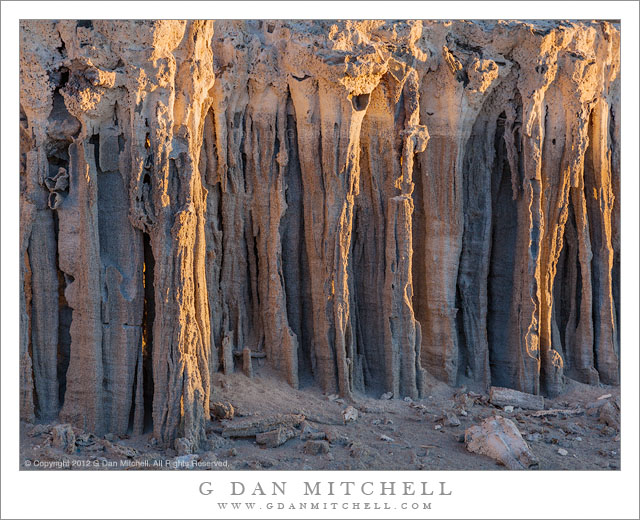
Sand Tufa, Mono Lake - Early morning light on details of sand tufa formations, Mono Lake
Early morning light on details of sand tufa formations.

Sand Tufa. Mono County, California. July 14, 2012. © Copyright 2012 G Dan Mitchell – all rights reserved.

Early morning light on details of sand tufa formations, Mono County.

I have wanted to photograph this subject for some time. The sand tufas are not found in the same location as the better-known “tufa towers” that are so often photographed, and they are smaller and somewhat subtler (if that is the right word) subjects. If you weren’t aware of what you were looking for, it would be very easy to pass right by them and barely notice their presence at all. They also appear to be very fragile, so great care should be taken if you ever happen to come across them. Walk around, not over or through them, and minimize your impact on them to the greatest extent possible. If you come across examples, it is probably best to not blast a lot of specific information to the world. I don’t know all of the details of their formation, but judging by their locations and by the recent history of lower lake levels, I suspect that they may have been underwater before the historically recent extraction of water from the eastern Sierra by Los Angeles.

If you are thinking of looking for an interesting and easy to shoot photographic subject, don’t bother with the sand tufa. You’ll probably have much better luck and more fun shooting the impressive and better known and larger “tower” features at other areas. These small structures do not tower above anything. Some are only inches tall, and the largest are just a few feet tall. Their natural color is a muted and, let’s be honest, boring gray color. Their location does not particularly allow them to be paired with more impressive and distant large-scale landscape features such as the expanse of the lake’s surface or the surrounding mountains and hills, with the possible exception of certain kinds of cloud formations. When I went there I had some pre-conceived ideas about I might photograph them, perhaps including the Sierra’s eastern escarpment in the images, but these ideas did not pan out. However, by shooting in the first few minutes of light and working with a long focal length to crop tightly I found some interesting fluted patterns to work with.

G Dan Mitchell is a California photographer whose subjects include the Pacific coast, redwood forests, central California oak/grasslands, the Sierra Nevada, California deserts, urban landscapes, night photography, and more.
Blog | About | Flickr | Twitter | FacebookGoogle+ | 500px.com | LinkedIn | Email

Text, photographs, and other media are © Copyright G Dan Mitchell (or others when indicated) and are not in the public domain and may not be used on websites, blogs, or in other media without advance permission from G Dan Mitchell.

Green River Canyon, Evening

Green River Canyon, Evening
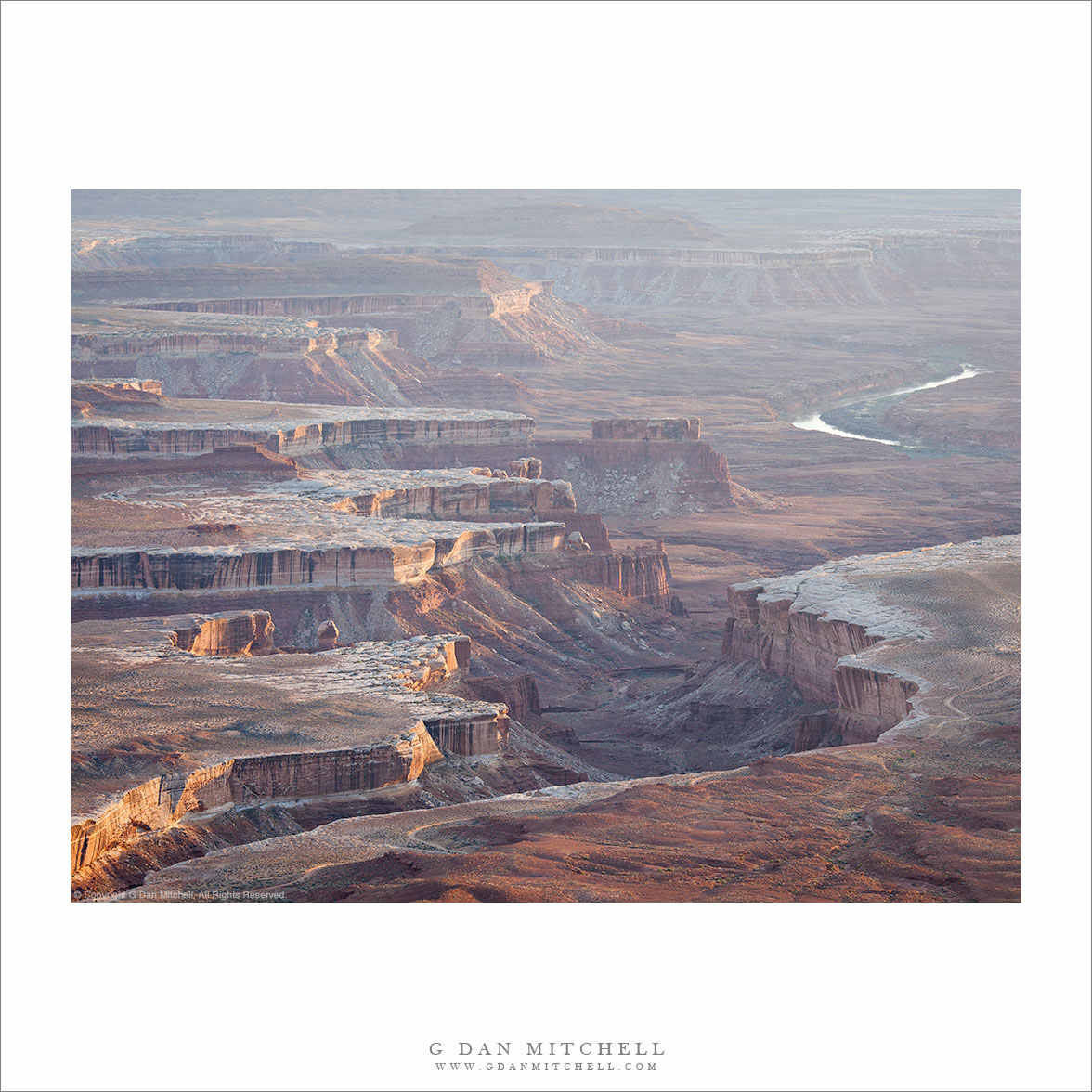
“Green River Canyon, Evening” — Soft evening light on the canyon of the Green River as it winds through the desert terrain of Canyonlands National Park, Utah

I recently returned from a week in Utah which, perhaps surprisingly, was completely new to me as a photographic subject. More about that in a moment, but first a description of the photograph. It was made in Canyonlands National Park in the “Island in the Sky” area, looking west from a high viewpoint above the canyon containing the winding Green River, not far above its confluence with the Colorado River. The “Island” is a high and relatively flat plateau at around 6000+’ of elevation, surrounding on many sides by deep canyons, cliffs, and then several levels of lower plateaus. There are “edges” everywhere, and all of them provide stunning vistas into the vast spaces below and beyond. We ended up at this spot largely due to a photograph I had seen an a park brochure that included a view of receding mesas and canyons in evening light. We scouted it in the middle of the afternoon as we visited several places in this area of the park, and it seemed inevitable that I would end up at sunset. I initially imagined a scene with brighter colors from the sunset and the post-sunset sky, but instead I ended up with something that I think I like even more, namely softer light with haze in the atmosphere and somewhat gentler colors.

As I mentioned above, I have not photographed in Utah before. I had been through the state several times many years ago, but I think we more or less sped through on interstate highways – which don’t tend to follow the most scenic routes – and I had a very limited view of the place. While it is too bad that I waited so long to go there, it gave me the opportunity to have an experience that I don’t have nearly as often in California where I do most of my shooting. Because I live within a short drive of redwood forests, the Pacific coast, and places like Yosemite Valley and the Sierra and visit all of them frequently, I have to admit that I sometimes forget how extraordinary they are. I can drive right past Yosemite’s Tunnel View if the view is just a typical Yosemite Valley view. But on this trip, I more or less intentionally avoided investigating our destinations before we left. Consequently, I had opportunities to be surprised and astonished — like any good tourist! — by things that I was seeing for the first time. For example, I really had no idea what I would see at Arches National Park when we drove into it at just about the “golden hour” – and I was completely stunned by impossible structures and juxtapositions of sandstone columns and arches and towers and cliffs. I just got a quick taste on this trip… but I’ll be back.

G Dan Mitchell is a California photographer and visual opportunist. His book, “California’s Fall Color: A Photographer’s Guide to Autumn in the Sierra” (Heyday Books) is available directly from him. Blog | Bluesky | Mastodon | Substack Notes | Flickr | Email

Join the discussion — you are welcome to leave a comment or question. (Comments are moderated and may not appear immediately.)

This site uses Akismet to reduce spam. Learn how your comment data is processed.

(All media © Copyright G Dan Mitchell and others.)