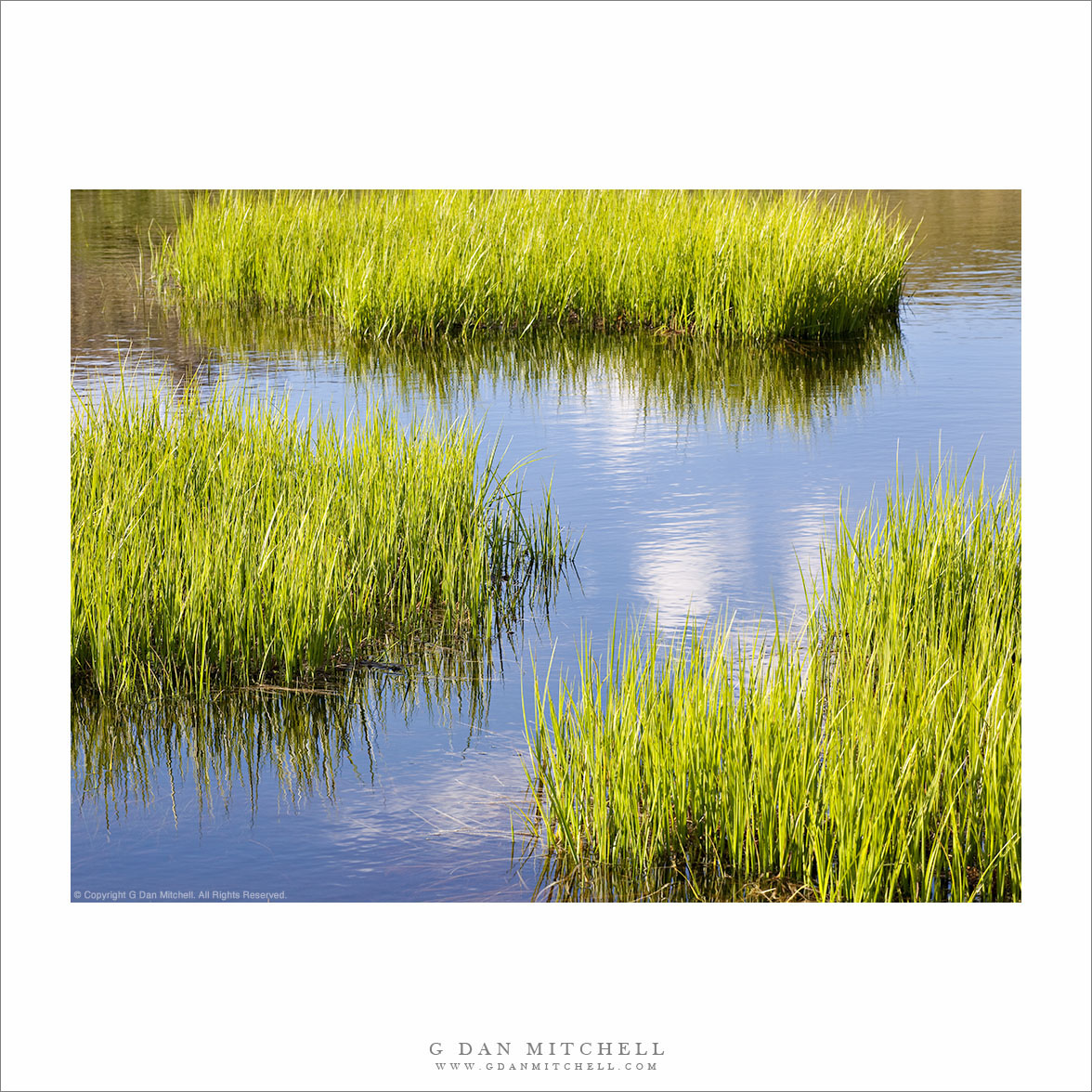
“Shoreline Grasses and Subalpine Pond” — Passing clouds reflected in the surface of a subalpine pond with summer meadow grass, Tioga Pass, Yosemite National Park.
I made this photograph on a special afternoon late last July. Although I had been across Tioga Pass earlier in the season when it was still very snowy, this was my first real visit to the summer high country of the season. It was a beautiful, sunny afternoon with just a few fluffy clouds floating about when I came to the meadows near Tioga Pass. The color of the meadow grasses was at just that perfect point that we think of when we imagine summer subalpine meadows – the intense green just before the wildflowers bloom and the inevitable change toward fall begins. (Yes, after some summers in the high country this cycle becomes clearer and clearer.)
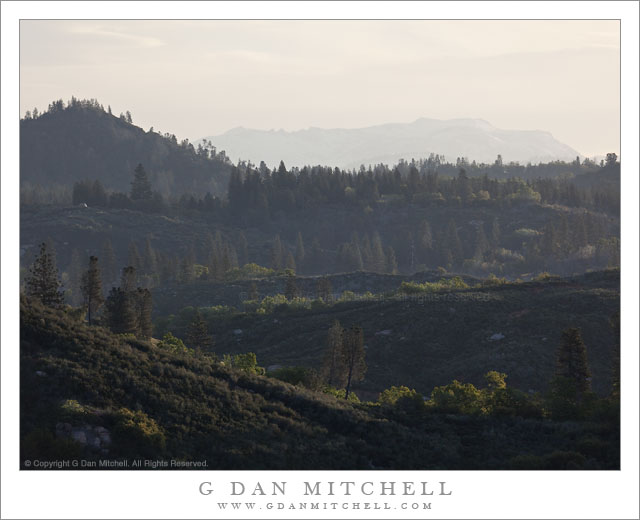
The view toward Yosemite and the High Sierra from the ‘Rim of the World’ overlook above the Tuolumne River canyon along highway 120.
‘Rim of the World’ is the name given to a scenic overlook above the deep valley of the Tuolumne River along route 120, the northern route into Yosemite National Park. It is something of an odd place. It is a fairly pedestrian traffic pullout, though it overlooks the immense and impressively deep canyon of the Tuolumne. But the view is at least partially obstructed by things like power lines. However, it is a view that on clear days can extend great distances to very high Sierra peaks.
I most often simply blow past the spot on my way to or from the park. However, on this morning as I passed I thought the low morning light looked interesting so I found a spot to turn around and drove back. There was a bit of high cloudiness, and the light was coming across the folds of these foreground hills from the right, lighting up various bits of ridge and trees and illuminating the morning haze enough to amplify the effect of distance. If I’m not mistaken, the further ridge with its faintly seen snow fields is in the area of Mount Hoffman.
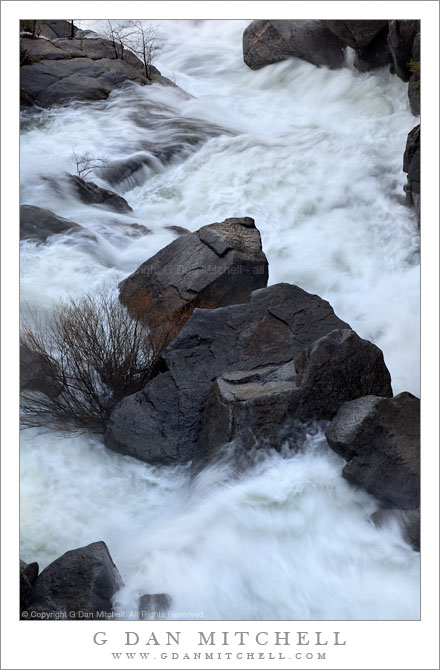
“Boulders and Spring Torrent, Cascade Creek” — Runoff from spring snow melt rushes over boulders of Cascade Creek, Yosemite National Park.
I recently posted the black and white version of this photograph of Cascade Creek in full spring flow.
The color version of this photograph posed a series of post-processing questions and problems that others who have worked with a scene like this one can probably imagine. The creek descends through a narrow, rocky gorge at this point and I photographed it early in the morning before any direct sunlight was able to reach the water. Benefits of shooting at this time included the softer light, which tends to both throw some light into the shadows and to soften the brightest highlights. This also permits a longer exposure which allows the water to blur a bit and express the wild motion of the creek. However, since the primary source of light was the open sky, the camera “sees” a very blue scene. (Our visual system compensates for this, so it doesn’t look as blue as it really is when you are on the scene.)
There are several ways to deal with the color balance issues that this situation creates. You could just “go with the blue,” and I’ve seen photographs done that way. I’ve even seen some in which the photograph amped up the saturation and ended up with something very blue. In general, that’s not my thing! I’m most often looking for something that seems “believable” – it may not be objectively accurate, but I intend it to be “subjectively accurate.” With this in mind, my first instinct was simply to warm the color balance in order to move away from the blue cast and toward a warmer one.
My immediate impression was that this was an improvement, and I worked with this interpretation for several days – but something about it didn’t sit quite right with me. (This is perhaps one reason that I also worked with the black and white rendition in the meantime.) Eventually I did some comparisons between the “warmed up” version and the original… and neither seemed like what I was after. The overly blue original looked garish but the overly warm version seemed artificial. I tried some other approaches and finally discovered that because the blue was so intense that I could simply desaturate it – more than you might think – and keep the “colder” coloration without letting it overwhelm the image.
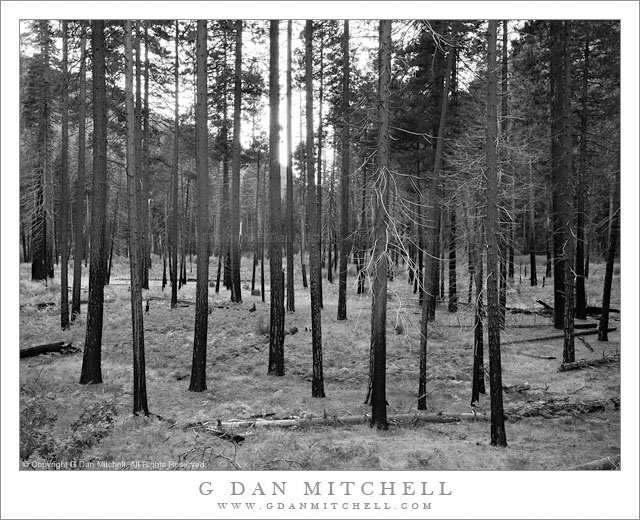
Evening light in a burned section of the forest on the floor of Yosemite Valley.
I’ve been sitting on this photograph for a while, so I figure I’ll post it now. I made it last fall – on Halloween, actually! – during a fall color trip to the Valley. Late on my final evening I finally stopped and walked out across the old terminal moraine that crosses the lower Valley not far upstream from Pohono Bridge. (When you drive into the Valley, the road splits, and before long you’ll see the south end of this feature to your left as you go up a short climb.) I started at the north end and as I walked south looking for a photograph it was a very quite, still, and cold evening.
I finally found a spot where I could go down the lower side of the hill just a bit and find a relatively clear shot through the trees that wasn’t blocked by foliage closer to my position. This area has been burned, and I assume that it is the result of one of the management burns that often occur late in the season. These fires attempt to strengthen the forest by reintroducing the natural process and cycles of fire. The result is interesting charring patterns along the lower portions of the trees, temporary burned undergrowth, and then as the recovery takes place a much more open and airy sort of forest as you see in this photograph.
Photographer and visual opportunist. Daily photos since 2005, plus articles, reviews, news, and ideas.
Manage Consent
To provide the best experiences, we use technologies like cookies to store and/or access device information. Consenting to these technologies will allow us to process data such as browsing behavior or unique IDs on this site. Not consenting or withdrawing consent, may adversely affect certain features and functions.
Functional
Always active
The technical storage or access is strictly necessary for the legitimate purpose of enabling the use of a specific service explicitly requested by the subscriber or user, or for the sole purpose of carrying out the transmission of a communication over an electronic communications network.
Preferences
The technical storage or access is necessary for the legitimate purpose of storing preferences that are not requested by the subscriber or user.
Statistics
The technical storage or access that is used exclusively for statistical purposes.The technical storage or access that is used exclusively for anonymous statistical purposes. Without a subpoena, voluntary compliance on the part of your Internet Service Provider, or additional records from a third party, information stored or retrieved for this purpose alone cannot usually be used to identify you.
Marketing
The technical storage or access is required to create user profiles to send advertising, or to track the user on a website or across several websites for similar marketing purposes.