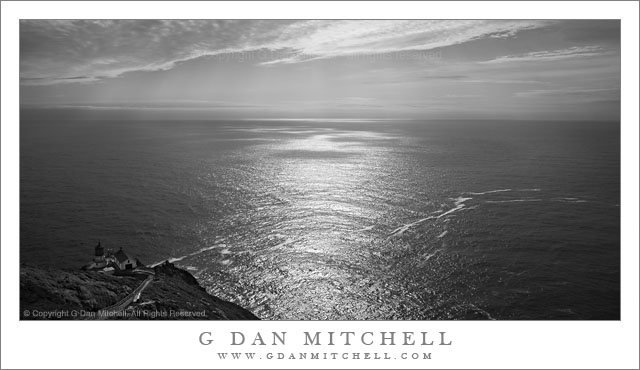
Afternoon light reflects on the surface of the Pacific Ocean beyond the Point Reyes lighthouse.
(Some of the following is repeated from a previous post of the same photograph in a color version.) Although our trip to Point Reyes was not primarily to do photography, somehow I ended up bringing back quite a few photographs! This photograph was made from the iconic overlook at “the point” and right above the long stairway down to the historic lighthouse. On this afternoon high clouds were streaming in from the Pacific and casting a mottled pattern of light and shadows on the surface of the Pacific Ocean.
This spot is often completely socked in by clouds and/or extremely windy and cold. However, this was perhaps the most benign afternoon I’ve experienced there. The temperatures were very comfortable – we were a bit too warm on the walk to the point. The sun was out, and the wind was nearly still at times.
I wasn’t certain when I made the exposure of whether it would end up being a black and white or a color photograph. I’m still not sure! I’m sharing the color version first, but a black and white rendition will follow shortly.
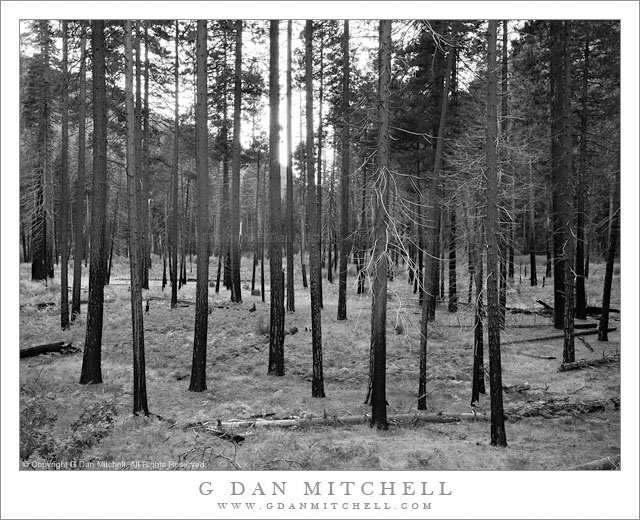
Evening light in a burned section of the forest on the floor of Yosemite Valley.
I’ve been sitting on this photograph for a while, so I figure I’ll post it now. I made it last fall – on Halloween, actually! – during a fall color trip to the Valley. Late on my final evening I finally stopped and walked out across the old terminal moraine that crosses the lower Valley not far upstream from Pohono Bridge. (When you drive into the Valley, the road splits, and before long you’ll see the south end of this feature to your left as you go up a short climb.) I started at the north end and as I walked south looking for a photograph it was a very quite, still, and cold evening.
I finally found a spot where I could go down the lower side of the hill just a bit and find a relatively clear shot through the trees that wasn’t blocked by foliage closer to my position. This area has been burned, and I assume that it is the result of one of the management burns that often occur late in the season. These fires attempt to strengthen the forest by reintroducing the natural process and cycles of fire. The result is interesting charring patterns along the lower portions of the trees, temporary burned undergrowth, and then as the recovery takes place a much more open and airy sort of forest as you see in this photograph.
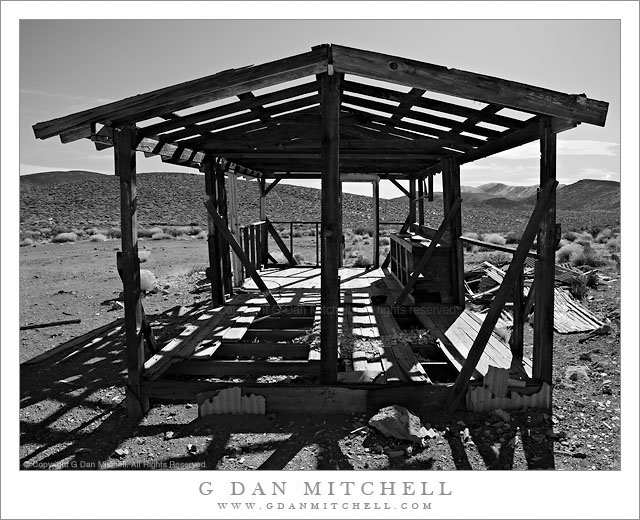
Black and white photograph of the ruins of an abandoned mining cabin high in the Panamint Mountain Range of Death Valley National Park.
There are a number of things that make Death Valley National Park, to the best of my knowledge, rather unique. One is the extensive history of human habitation inside the park boundaries, quite a bit of which is visible – though some takes a bit more effort and attention to spot. The history of mining in the park is well-known, and many of the icons of the park have connections to this history. If you visit Furnace Creek, for example, you cannot miss the displays of old wagons and so forth used to move ore out of the Valley. It doesn’t take a lot of careful study to figure out that many park roads originated in an era of prospecting and mining. There are several well-known examples of structures left over from that era in and around the park, too.
It is largely because of this history that many areas of this national park are (or have been – some are now reverting to wilderness status) accessible by gravel road or four-wheel-drive routes. I would argue that you can’t really get to know this park if you just stick to the paved roads and the points of interest that they access. If you drive any of these other routes and keep your eyes open you will often be surprised by the left overs from relatively recent mining and prospecting, much of which isn’t really written about or described in the usual guides to the park. (And I’m not going to offer specific details about where to find such places here, since I don’t want to be even a little bit responsible for damage to them. If you do visit, treat them with care and respect.)
As I drove along a gravel road in one of the many mountain ranges of the park, returning from a site that is somewhat well-known, I began to notice evidence of fairly recent mining and prospecting. Faint tracks depart from the main “road” and cross valleys and hills, here and there tailing piles and mine entrances are visible, and sometimes you come across old structures such as cabins, storage bunkers, or wooden towers above mine entrances. I spotted the ruins of this old cabin above the road at one point and decided to walk up and investigate.
I’m almost always surprised at how “modern” many of the traces found at these places seem to be. I guess I am expecting something from the 1800s, but quite a few of these places look like they were build and occupied much later than that. I find modern things like linoleum flooring or modern-looking nails or electrical wire in many of them. There obviously isn’t much left of this cabin now, but from the detritus lying around near it and the form and materials found here, it must have been a reasonably comfortable place to live. As I walk around such places I often try to imagine what it must have been like to wake up every morning in this silent desert and head out for another day of physical labor.
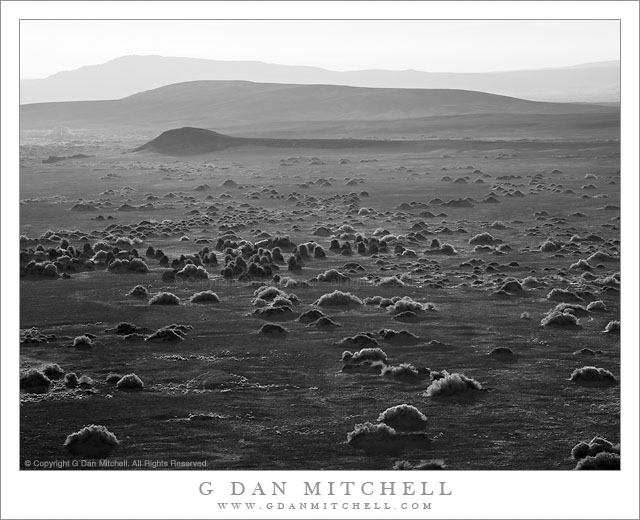
Low angle morning light silhouettes receding hills and plants near Devils Cornfield, Death Valley National Park.
Taking advantage of the low angle light from the sun as it rose above the Funeral Mountains, I shot almost directly into the light with a long lens to photograph these backlit plants (“arrowweed” I believe) growing along the fringes of the Devils Cornfield area not far from Stovepipe Wells. Although the compressed perspective from the relatively long focal length disguises the fact, I was shooting from a hill that gave me some elevation above the flat surface of the Valley here, and provided a bit better view of the tops of the hills receding into the haze.
I made a variation on this photograph at the same time that I posted earlier – it is in color and used an even longer focal length to get a bit more detail of the mesquite tree that is barely visible in the upper right area of this shot. The color image has a much less start appearance than the black and white rendition with its contrast between the light on the tops of the plants and the surrounding dark soil.
Photographer and visual opportunist. Daily photos since 2005, plus articles, reviews, news, and ideas.
Manage Consent
To provide the best experiences, we use technologies like cookies to store and/or access device information. Consenting to these technologies will allow us to process data such as browsing behavior or unique IDs on this site. Not consenting or withdrawing consent, may adversely affect certain features and functions.
Functional
Always active
The technical storage or access is strictly necessary for the legitimate purpose of enabling the use of a specific service explicitly requested by the subscriber or user, or for the sole purpose of carrying out the transmission of a communication over an electronic communications network.
Preferences
The technical storage or access is necessary for the legitimate purpose of storing preferences that are not requested by the subscriber or user.
Statistics
The technical storage or access that is used exclusively for statistical purposes.The technical storage or access that is used exclusively for anonymous statistical purposes. Without a subpoena, voluntary compliance on the part of your Internet Service Provider, or additional records from a third party, information stored or retrieved for this purpose alone cannot usually be used to identify you.
Marketing
The technical storage or access is required to create user profiles to send advertising, or to track the user on a website or across several websites for similar marketing purposes.