Patterns in eroded shoreline sandstone rocks at the Point Lobos State Reserve, California.
The rugged Point Lobos shoreline in places exposes some very interesting rocks, including sections like this one where layers of different colored sand stone are gradually worn away, revealing underlying layers of different colors and textures and sometimes exposing surprising color contrasts. On days when the light is very soft (or very boring!) I may seek out some of these rocks and photograph them since the softer light lets details appear that might easily be washed out in harsher light.
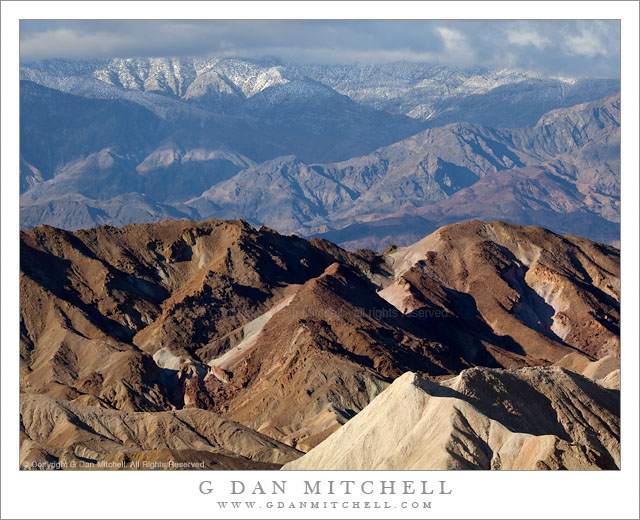
Morning light on fresh snow on the summit of the Panamint Range with Zabriskie Point Badlands in the foreground, Death Valley National Park.
After getting being frustrated by falling snow earlier in the morning when I tried to photograph dawn at Dantes View I headed back down to lower terrain. (Although I was not successful in photographing at Dantes View and, in fact, turned back before the summit in dense clouds and falling snow, it was quite an interesting visit!) I stopped along the way and made some photographs before arriving at Zabriskie Point.
At this point I no longer reflexively photograph at Zabriskie, though I will if something special or unusual is happening with the conditions. Having been frustrated in my original plans, I figured I might as well take a look around since I was there. I left the camera gear in my car and walked up the hill to the famous overlook to see what I could see. The dawn light – if there had even been any on this cloudy morning – was long gone, though a few photographers were still hanging out. As I looked about I noticed two things. First, the clouds were just beginning to thin over the Panamint range. While the summit of Telescope Peak was still socked in – it appeared to be snowing there – light was beginning to break through gaps in the clouds above the east side of the range and interesting shadows were appearing below the snow line. Second, the partially cloudy conditions were softening the light right in the Zabriskie/Gower Gulch area and the light in some of my favorite small gullies to the right of the observation area was looking somewhat interesting. (I have made a project of photographing them with a long lens.)
With no other specific plan, and two potential subjects right here, I followed one of those “laws of photography” that says shoot the thing you see now rather than continuing to wander around hoping that some other miracle crops up. (Sometimes this is great advice. Other times it is dead wrong!) I walked back down the hill to my car, grabbed my gear, and walked back up. I first spent some time photographing the nearby gullies. (I think I have a couple of interesting images of them that will appear here eventually.) But I quickly turned my attention to the interesting weather and light across the Valley, thinking about how I might photograph this wild and rugged scene without making it look like another Zabriskie Point image. I decided to use a relatively long focal length lens – which was already on the camera for shooting the gullies anyway – and try to fill the entire frame with a combination of close and far mountains and snow and clouds in the morning light.
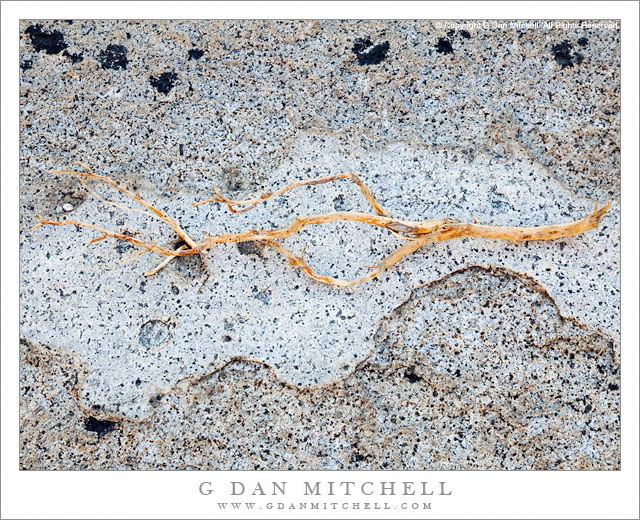
A dead branch lies on glacially-polished granite in the Yosemite National Park back-country.
I made a promise to someone to not say where this photograph was made – I’ll just say it is in Yosemite National Park. But the exact location really doesn’t matter too much, as these large expanses of glaciated granite slab are a common feature throughout the park, and you could find similarly interesting geology in thousands of locations.
I was a little surprised to find this weathered branch in this location, since it was a good distance from any trees and also not near any flowing water. Besides its location, a few other things about it caught my attention. First, its curving shapes lined up in a way tht seems to tie in with the bit of glacially-polished granite that lies beneath it. (And, yes, this is exactly where the branch was when I found it.) In a way, the larger shape of the lighter area of granite winding across the photograph from side to side almost seems like a much thicker echo of the curving shape of the branch. In addition, the warm brown tones of the branch seem to stand out a bit – though perhaps more in a larger print – against the relatively drab color of the rock.
A vertical column of pelicans stacked one above the other along the Pacific Ocean coastline of California.
On a slow night this week – while waiting for a new hard drive to get backed up – I want back through some more raw files from the first half of 2010. Almost invariably, when I go back through older collections of images I find at least a few things that seem interesting to me know even though they didn’t really register at the time I shot them
I have previously shared some other photographs of these magnificent Pacific Coast birds that I made on this mid-May evening along the Pacific Coast Highway north of Santa Cruz, shooting from a bluff locations that I often return to. At this particular spot, when the conditions are just right, birds coming north up the coast and coasting on updrafts along the cliffs often climb toward the top of the bluff and frequently turn inland a bit right here as they come around an outcropping. That is what happened with these pelicans, who were coming almost towards me and were flying below my position on top of the bluff, creating what looks like a vertical stack of birds. How thoughtful of them to line up so that they fit perfectly within a 3:2 ratio portrait orientation frame! :-)
Photographer and visual opportunist. Daily photos since 2005, plus articles, reviews, news, and ideas.
Manage Consent
To provide the best experiences, we use technologies like cookies to store and/or access device information. Consenting to these technologies will allow us to process data such as browsing behavior or unique IDs on this site. Not consenting or withdrawing consent, may adversely affect certain features and functions.
Functional
Always active
The technical storage or access is strictly necessary for the legitimate purpose of enabling the use of a specific service explicitly requested by the subscriber or user, or for the sole purpose of carrying out the transmission of a communication over an electronic communications network.
Preferences
The technical storage or access is necessary for the legitimate purpose of storing preferences that are not requested by the subscriber or user.
Statistics
The technical storage or access that is used exclusively for statistical purposes.The technical storage or access that is used exclusively for anonymous statistical purposes. Without a subpoena, voluntary compliance on the part of your Internet Service Provider, or additional records from a third party, information stored or retrieved for this purpose alone cannot usually be used to identify you.
Marketing
The technical storage or access is required to create user profiles to send advertising, or to track the user on a website or across several websites for similar marketing purposes.